
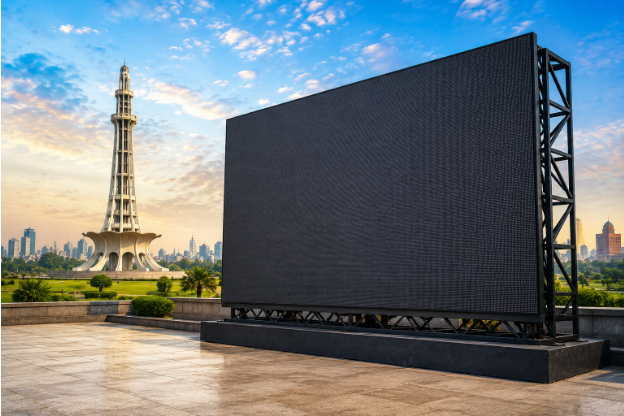

Walk down MM Alam Road in Lahore, through Tariq Road in Karachi, or past the entrance of any major mall in Islamabad, and you’ll notice something: the businesses that catch your eye first are rarely the ones with the biggest signboard. They’re the ones with a screen bright, moving, impossible to scroll past. That is the quiet shift happening across Pakistan’s commercial landscape, and it is being driven almost entirely by SMDLED technology.
But not every business needs the same screen, in the same place, for the same reason. A wedding hall in DHA has different requirements than a motorway billboard outside Multan, and a hospital reception has different needs than a cricket stadium. This guide breaks down the 12 industries in Pakistan seeing the strongest, most measurable results from SMDLED screens, what each one actually uses them for, which screen specifications make sense, what mistakes to avoid, and how to judge whether your own business belongs on this list.
What Are SMD LED Screens, and Why Does Industry Fit Matter?
SMD stands for Surface-Mounted Device, a display technology where individual LED chips are mounted directly onto a printed circuit board rather than housed in the larger, more widely spaced diodes used in older DIP (Dual In-line Package) screens. The practical result is a display with tighter pixel density, smoother color blending, wider viewing angles, and the ability to render sharp video content at close viewing distances, something older LED technology could never do convincingly.
That single technical difference is why SMD screens have replaced static banners, painted signs, and even older LED billboards across Pakistan’s retail streets, motorways, and corporate lobbies. But “SMD screens are good for business” is only half the story. The real question this article answers is which businesses see the fastest, largest, and most defensible return — because a P10 outdoor billboard panel and a P1.8 indoor boardroom screen are built for completely different jobs, and buying the wrong specification for your industry is the single most common (and expensive) mistake we see.
How We Evaluated Which Industries Benefit Most (A Practical Decision Framework)
Rather than guessing, this list is built around five criteria that determine whether SMD screens generate real returns for a specific sector. Any business, even outside these 12 categories, can use this same framework to judge its own fit.
- Foot or vehicle traffic volume: Higher exposure means faster payback on the investment.
- Frequency of message change: Businesses that run seasonal offers, new launches, or rotating content benefit more than those with a single static message.
- Competitive visual pressure: Sectors where competitors are already investing in digital displays face a “keep up or fall behind” dynamic.
- Brand or trust signalling need: Categories like real estate, banking, and healthcare use screen quality as a subtle proxy for credibility.
- Operational or informational use case: Some industries (transportation, government, education) use screens less for advertising and more for real-time information delivery.
The 12 industries below scored highest across these five factors, based on how SMD screens are actually being deployed across Lahore, Karachi, Islamabad, Rawalpindi, and other major Pakistani cities today.
12 Industries That Benefit Most from SMD LED Screens in Pakistan
1. Retail & Shopping Malls
Retail is the most visible SMD success story in Pakistan, and for good reason: a fashion outlet on Lahore’s MM Alam Road or a mobile shop in Karachi’s Saddar market lives or dies on footfall, and footfall responds directly to visual stimulation. An indoor SMD screen showing rotating product shots, flash-sale countdowns, or new-arrival videos consistently outperforms static posters because the human eye is drawn to motion before it registers text.
Storefront-facing outdoor screens (typically P3–P4 pixel pitch for close viewing) let a shop change its promotion daily without reprinting a single banner, while mall-operator video walls at entrances use larger P4–P6 panels to promote multiple tenant brands at once. A common mistake here is buying an outdoor-rated screen for a shaded storefront that never gets direct sunlight — a wasted brightness premium that could have gone toward a bigger panel instead.
Pro tip: Retailers who update their screen content at least twice a week see meaningfully better recall than those who leave the same loop running for months.
2. Real Estate & Property Developers
Pakistan’s real estate sector, from DHA and Bahria Town phases to smaller housing societies in Lahore, Islamabad, and Multan, depends on trust signalling as much as on the property itself. A buyer deciding between two competing societies often forms a first impression from the sales office alone, and a large-format indoor video wall running 3D walkthroughs, floor plans, and payment-plan details projects a level of credibility a printed brochure simply cannot.
Outdoor project-site SMD screens (P6–P10 depending on road distance) work alongside these indoor displays to advertise plot availability and booking deadlines to passing traffic. Developers frequently under-invest here by treating the screen as a one-time launch tool rather than an ongoing sales asset that should be refreshed with every new block, phase, or payment plan.
Pro tip: Pair the indoor sales-office screen with a content calendar tied to your project’s actual sales milestones. The screen should always reflect what’s available today, not what launched a year ago.
3. Hospitality — Restaurants, Hotels & Banquet Halls
Few sectors are as visually driven as hospitality. A restaurant that displays its signature dishes in vibrant motion on an outdoor SMD screen creates an appetite trigger that a laminated menu board cannot replicate — and in a market as food-conscious as Pakistan, that difference shows up directly in walk-in traffic. Hotels use lobby and conference-room screens for wayfinding, event schedules, and brand storytelling, while banquet and wedding halls — a genuinely large commercial category in Pakistani cities — use both outdoor screens to advertise availability and indoor screens as a premium in-venue feature that justifies higher booking rates.
A frequent oversight in this sector is ignoring audio-visual synchronisation for banquet hall screens used during events; a screen that only shows static branding during a live function undersells the investment.
Pro tip: For wedding halls, a mixed content strategy, venue promotion during off-hours, live event visuals during functions — gets far more value from the same screen.
4. Automotive Showrooms & Dealerships
Car dealerships across Pakistan have adopted indoor SMD video walls specifically because the showroom experience is part of the sale. A vehicle displayed alongside a large-format screen running its performance specs, available colour options, and financing details in motion creates an international-standard showroom feel that directly influences how customers perceive the vehicle’s quality — even before they’ve sat inside it.
Fine pixel pitch (P1.8–P2.5) indoor panels are standard here because viewing distances are short and image clarity matters more than raw brightness. Outdoor forecourt screens, by contrast, need higher brightness to compete with direct sunlight on the sales lot.
Pro tip: Sync showroom screen content with your sales team’s current promotions (financing rates, trade-in offers) rather than running only manufacturer brand videos. This turns the screen into an active sales tool, not just ambience.
5. Banking & Financial Services
Banks and financial institutions in Pakistan use SMD and digital signage screens for two distinct purposes: branch-level customer communication (queue information, product promotions for loans, credit cards, and savings schemes) and brand-building at flagship locations. As branchless banking and digital wallets like Raast reshape how Pakistanis interact with financial services, physical branches increasingly rely on visual technology to justify their continued relevance and to communicate new digital products to less tech-familiar customers.
Indoor screens in banking halls typically run smaller, fine-pitch panels focused on clarity for financial disclosures and rate information, which carries a regulatory-adjacent responsibility — content must be accurate, current, and easy to read at a glance.
Pro tip: Financial institutions should treat screen content governance (who approves and updates rate information) as seriously as they treat printed material, since outdated promotional content on a screen is just as much a compliance risk as an outdated brochure.
6. Telecom & Internet Service Providers
Pakistan’s telecom operators and internet service providers use SMD screens at franchise/retail outlets and public locations to communicate constantly-changing information: data package pricing, network coverage announcements, device launches, and promotional bundles. Because telecom pricing and packages change more frequently than almost any other retail category, the ability to update content in seconds — rather than reprinting signage — delivers an outsized return relative to almost any other sector on this list.
Telecom franchise outlets typically pair a customer-facing indoor screen with an outdoor storefront panel, using the same content management system to push updates to both simultaneously.
Pro tip: Centralising content across multiple franchise locations through a single CMS dashboard (rather than letting each outlet manage its own screen) keeps pricing consistent and avoids the reputational risk of one branch displaying an outdated offer.
7. Healthcare & Hospitals
Hospitals and private clinics across Pakistan are quietly becoming one of the fastest-growing SMD adopters, using screens for wayfinding, token/queue displays, health awareness campaigns, and service promotion (diagnostic packages, specialist availability). In a sector where patients are often anxious and unfamiliar with a facility’s layout, clear digital signage genuinely improves the patient experience — this is an operational benefit, not just a marketing one.
Reception-area and corridor screens typically use mid-range indoor pixel pitches (P2–P3) for a balance of clarity and cost, while larger hospital groups use lobby video walls to reinforce brand trust to visiting families.
Pro tip: Keep health-related screen content calm and informational rather than promotional-heavy — hospitals are one sector where restrained, trustworthy messaging outperforms aggressive advertising tone.
8. Education — Schools, Colleges & Universities
Educational institutions use SMD screens at campus entrances, in lobbies, and inside auditoriums for admissions campaigns, event promotion, achievement announcements, and lecture-hall presentations. A prospective student’s first impression of a university often forms in the reception lobby, and a well-produced video wall showing campus life, faculty achievements, and program highlights does more persuasive work in thirty seconds than a stack of printed prospectuses.
Beyond marketing, classrooms and auditoriums increasingly use interactive touch-enabled SMD panels for teaching, a genuinely different use case from advertising, and one that is growing quickly across private schools and universities in Lahore, Karachi, and Islamabad.
Pro tip: Separate your admissions-marketing content strategy from your internal-communication content (timetables, notices) — mixing the two on one screen dilutes both purposes.
9. Corporate Offices & Conference Rooms
Corporate head offices use SMD video walls in reception areas as a brand-credibility statement for visiting clients and partners, while conference rooms use smaller, fine-pitch indoor panels (P1.2–P1.8) for presentations, video calls, and data visualisation. This is a distinct category from retail or hospitality because the objective is rarely direct advertising — it is about projecting operational sophistication to clients, investors, and new hires.
A common mistake corporate buyers make is over-specifying brightness for a boardroom screen that will only ever be viewed from six feet away in a controlled-lighting room; that budget is better spent on higher resolution and colour accuracy instead.
Pro tip: For hybrid meeting rooms, prioritise refresh rate and colour calibration over raw size — video call clarity depends more on these two factors than on screen dimensions.
10. Government & Public Sector
Government departments, development authorities, and public-sector organisations across Pakistan use SMD screens for public service announcements, civic awareness campaigns, traffic and safety information, and emergency communication. These installations, often at toll plazas, public offices, and city intersections, serve a genuinely different purpose from commercial advertising: informational reach for the public good, frequently funded through public-private partnerships with local display suppliers.
Outdoor public-sector screens must be built to a higher durability standard than typical retail displays, since they operate unattended in open public spaces for years at a time.
Pro tip: Public-sector installations should specify vandal-resistant, higher-IP-rated enclosures from the outset; retrofitting protection later is far more expensive than specifying it correctly during procurement.
11. Event Management, Entertainment & Sports Venues
Concerts, corporate launches, cricket and hockey venues, and large-scale public events across Pakistan rely on SMD screens for live visuals, sponsor branding, replays, and crowd engagement. Because audiences at these events typically view screens from a greater distance than in retail or corporate settings, event and stadium screens use coarser pixel pitches (P6–P10) that remain crisp at range while keeping costs manageable for temporary or semi-permanent installations.
Event organisers increasingly rent rather than buy SMD screens for one-off functions, making rental-ready, quick-assembly panel systems a distinct sub-category worth asking your supplier about directly.
Pro tip: For touring or rental use, ask specifically about panel weight, quick-lock rigging, and turnaround time between events. These logistics matter as much as picture quality for this sector.
12. Transportation Hubs & Public Infrastructure
Airports, bus terminals, metro/BRT stations, and motorway service areas represent one of the most overlooked but fastest-growing SMD use cases in Pakistan. These installations combine advertising revenue (screens sold to brands as high-footfall media space) with a genuine operational function — flight and departure information, route maps, delay notices, and safety announcements — making them a hybrid category unlike anything else on this list.
Because transportation displays often run 24/7 in environments with constant foot traffic and variable lighting, reliability and automatic brightness adjustment matter more here than almost anywhere else; downtime on an informational display has a direct, visible impact on public experience.
Pro tip: For any transportation or infrastructure screen, insist on a service-level agreement with guaranteed response time for repairs — an advertising screen going dark is a lost sale, but an informational screen going dark is a passenger-experience failure.
Industry-to-Screen Comparison Table
| Industry | Recommended Screen Type | Typical Pixel Pitch | Indoor/Outdoor | Primary Business Goal |
| Retail & Shopping Malls | Storefront panel / mall video wall | P3–P6 | Both | Footfall & promotion |
| Real Estate | Sales-office video wall / project-site billboard | P2.5 (indoor), P6–P10 (outdoor) | Both | Trust & lead generation |
| Hospitality | Menu display / lobby & banquet screen | P3–P5 | Both | Footfall & premium positioning |
| Automotive | Showroom video wall | P1.8–P2.5 | Indoor | Product presentation |
| Banking & Finance | Branch information screen | P2–P3 | Indoor | Customer communication |
| Telecom & ISPs | Franchise indoor + outdoor pair | P3–P4 | Both | Rapid pricing updates |
| Healthcare | Wayfinding & lobby screen | P2–P3 | Indoor | Patient experience |
| Education | Campus entrance / auditorium panel | P2.5–P4 | Both | Admissions & communication |
| Corporate Offices | Reception wall / boardroom panel | P1.2–P1.8 | Indoor | Brand credibility |
| Government & Public Sector | Vandal-resistant public display | P4–P8 | Outdoor | Public information |
| Events & Entertainment | Rental-ready stage/stadium panel | P6–P10 | Both | Engagement & sponsorship |
| Transportation Hubs | 24/7 information display | P3–P6 | Both | Operational information + ad revenue |
How to Choose the Right SMD LED Screen for Your Industry (Checklist)
- ☐ Have I identified whether the screen is primarily indoor, outdoor, or both?
- ☐ Have I measured the typical viewing distance to determine the right pixel pitch?
- ☐ Does the location get direct sunlight, requiring higher brightness (nits)?
- ☐ Have I planned for load-shedding or power fluctuation protection?
- ☐ Do I have a content management plan (who updates it, and how often)?
- ☐ Have I budgeted for installation, not just the panel cost?
- ☐ Does my supplier offer warranty and maintenance support in my city?
- ☐ Have I compared my industry’s benchmark pixel pitch against my quote?
Common Mistakes Pakistani Businesses Make with SMD Screens
- Buying based on price alone: The cheapest panel per square foot is often the most expensive over five years due to poor pixel failure rates and weak after-sales support.
- Ignoring viewing distance: Installing a coarse outdoor pixel pitch in a close-viewing indoor space (or vice versa) wastes budget in one direction and image quality in the other.
- No content strategy: A screen left running the same loop for months delivers a fraction of the value of one refreshed regularly.
- Underestimating power protection: Skipping voltage stabilisation or backup planning in areas with frequent load-shedding shortens hardware lifespan significantly.
- Skipping a maintenance contract: Treating an SMD screen as a “set and forget” purchase rather than an asset that needs periodic servicing.
Myths vs. Facts About SMD LED Screens
| Myth | Fact |
| “SMD screens are only for large corporations with big budgets.” | Modular SMD panels scale down to small storefront and reception sizes, making them accessible to small and medium businesses. |
| “Outdoor SMD screens can’t survive Pakistan’s summer heat or monsoon rain.” | Properly IP65-rated outdoor panels with active cooling are engineered specifically for high-heat, dusty, and monsoon conditions. |
| “SMD and LED screens are completely different technologies.” | SMD is a specific mounting technique within the broader LED display category — every SMD screen is an LED screen, but not every LED screen uses SMD mounting. |
| “Once installed, an SMD screen requires no further attention.” | Like any electronic hardware, SMD screens benefit from periodic cleaning, calibration checks, and firmware updates to maintain performance. |
| “A bigger screen always performs better.” | The right pixel pitch and placement for the actual viewing distance matters more than raw screen size. |
Maintenance & Longevity Tips for Pakistan’s Climate and Power Conditions
Pakistan’s operating environment is genuinely demanding on electronic display hardware: summer temperatures exceeding 45°C in cities like Multan and Sargodha, dust exposure across Sindh and Punjab, monsoon humidity, and frequent voltage fluctuation or load-shedding in many areas. A screen specified for a milder climate will underperform and fail sooner here. A few practical, often-overlooked maintenance habits extend an SMD screen’s working life considerably.
- Schedule quarterly physical inspections of cabinet seals, cooling fans, and cable connections rather than waiting for a visible fault.
- Install voltage stabilisation or surge protection as standard, not as an optional extra, in any area with irregular power supply.
- Keep firmware and content management software updated — many performance issues attributed to “hardware problems” are actually outdated control software.
- Clean outdoor panels seasonally, particularly after dust storms, since accumulated grime measurably reduces brightness output over time.
- Sign an Annual Maintenance Contract (AMC) with your supplier rather than relying on reactive, pay-per-visit repairs — this is consistently the cheaper option over a screen’s lifespan.
Future Trends — Where SMD LED Technology in Pakistan Is Heading
A few directions are becoming visible as adoption matures across Pakistan’s major cities and gradually extends to smaller ones like Faisalabad, Multan, Sialkot, and Peshawar.
- Expansion beyond the “big four” cities: As commercial competition intensifies in Tier-2 cities, SMD adoption is following retail and real estate growth into these markets.
- Interactive and touch-enabled displays: Kiosks, digital menu boards, and touch tables are moving from novelty to standard equipment in retail, hospitality, and education.
- Smart-city integration: Government and transportation displays are increasingly expected to carry live data — traffic, weather, and public safety information — rather than static announcements.
- Finer indoor pixel pitches becoming affordable: As manufacturing scales up, sub-P1.5 indoor panels are becoming accessible to a wider range of corporate and retail buyers, not just flagship installations.
- Rental and flexible-installation models growing: The events and hospitality sectors are driving demand for modular, quick-assembly panels that can move between venues.
Why Businesses Across Pakistan Choose SMDLED.PK
Whichever of these 12 industries your business falls into, the specification details matter more than the marketing pitch — pixel pitch, brightness, IP rating, and after-sales support determine whether a screen is still performing well in year four or already causing headaches. SMDLED.PK supplies and installs indoor and outdoor SMD screens, LED video walls, digital billboards, advertising kiosks, digital menu boards, and LED tickers for businesses across Lahore, Karachi, Rawalpindi, and Islamabad, working with Leyard-grade panels and handling installation and maintenance directly rather than leaving clients to coordinate multiple vendors.
If you’ve identified your industry above and want a recommendation matched to your specific space, foot traffic, and budget, the SMDLED.PK team offers a free consultation to walk through pixel pitch, placement, and realistic ROI expectations before you commit to a purchase.
Conclusion
SMD LED screens have moved well beyond “advertising billboard” status in Pakistan — they are now embedded in how retail stores sell, how real estate developers build trust, how hospitals guide patients, and how transportation hubs keep the public informed. The businesses getting the most value from this technology are not necessarily the biggest brands; they are the ones that matched the right screen specification to their actual industry use case, budgeted for maintenance from day one, and committed to keeping their content genuinely current. Use the framework and checklist in this guide to judge where your own business fits — and if you’re ready to move from research to a real quote, that’s exactly where a conversation with a specialised local supplier like SMDLED.PK should begin.
Frequently Asked Questions
Which industries in Pakistan benefit most from SMD LED screens?
Retail, real estate, hospitality, automotive, banking, telecom, healthcare, education, corporate offices, government, events/entertainment, and transportation hubs see the strongest returns, based on foot traffic, message-change frequency, and brand-trust needs.
What pixel pitch is best for outdoor advertising in Pakistan?
Most outdoor advertising in Pakistan uses P4 to P10, depending on viewing distance — closer storefronts suit finer pitches like P3–P4, while highway billboards and stadium screens use P8–P10.
How long do SMD LED screens last in Pakistan’s climate?
A properly IP65-rated outdoor SMD screen, maintained with regular inspections and voltage protection, typically lasts 5 to 10 years, even in high-heat and dusty conditions.
Do SMD screens work during load-shedding?
The screen itself will power down without electricity, but protection circuitry safeguards the hardware from damage during voltage fluctuations; businesses in high-outage areas often add UPS or generator backup to keep screens running.
Is an SMD screen a good investment for a small business?
Yes — modular panel sizing means small businesses can install a compact indoor or storefront screen at a fraction of the cost of a large video wall, while still gaining the content-flexibility benefit over printed signage.
What is the difference between SMD and regular LED screens?
SMD is a mounting method within the LED display category, where diodes are mounted directly on the circuit board for higher pixel density and better color blending than older DIP-style LED screens.
Can SMD screens be rented for events?
Yes — many suppliers, including SMDLED.PK, offer modular, rental-ready panels suited for weddings, concerts, and corporate events that need temporary installation.


