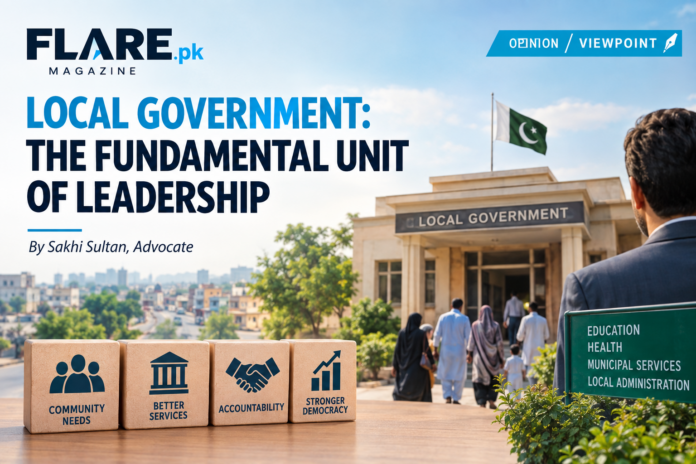

By Sakhi Sultan, Advocate: Local government is widely regarded as an important foundation of democratic governance, bringing public administration and decision-making closer to citizens. Across different democratic systems, local councils and mayors exercise powers defined by their respective laws, including responsibilities related to local legislation, budgets, municipal services and administration.
Pakistan also needs a strong, effective and representative system of local government. Local government elections should be held regularly, fairly and transparently in accordance with the Constitution and applicable law. Elected local institutions should be provided meaningful political, administrative and financial authority so that they can effectively address community needs and improve public service delivery.
There is also a need to review the relationship between provincial administrations and elected local governments to ensure that local institutions can perform their constitutional role effectively. Greater coordination and accountability in areas such as education, health, municipal services and local administration could help strengthen governance at the grassroots level.
The author proposes that the mayor should serve as the principal elected head of the local institution, subject to democratic accountability within the relevant local government framework. He also argues for reviewing the role and structure of district administration, including the office of the Deputy Commissioner, as part of a broader discussion on administrative devolution.
Public access should remain a central principle of local governance. Local government institutions should be designed to respond efficiently to citizens and address their day-to-day needs. Stronger institutions at the local level can also provide citizens with greater opportunities to engage with public administration and hold elected representatives accountable.
Article 140A of the Constitution provides for the establishment of local government systems by the provinces and the devolution of political, administrative and financial responsibility and authority to elected representatives. The broader policy question is how this constitutional principle can be translated into stronger, sustainable and effective local institutions.
Any debate on administrative restructuring, including proposals for the creation of new provinces, should likewise be guided by constitutional requirements, public interest and the objective of improving governance and public service delivery.
A meaningful local government system can provide a direct institutional link between citizens and elected leadership. Strengthening that link requires not only regular elections but also clearly defined responsibilities, adequate resources, institutional accountability and effective coordination among different levels of government.
The future of governance in Pakistan therefore depends, in part, on how effectively constitutional principles of devolution are implemented at the grassroots level. A strong and representative local government system can help ensure that public administration remains responsive to the people it is intended to serve.
Editor’s Note: This is a contributed opinion article. The views expressed are those of the author and do not necessarily represent the editorial position of FLARE Magazine.