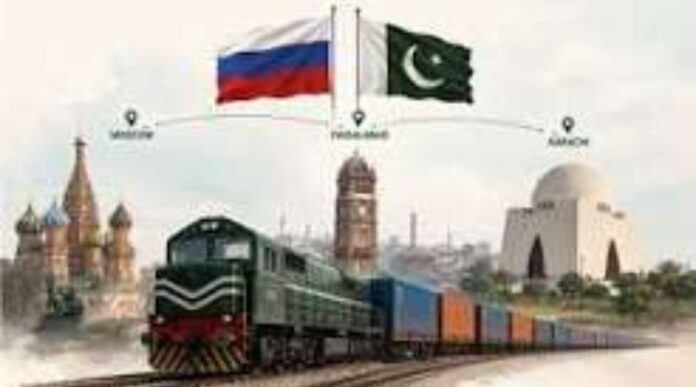

Pakistan is taking another important step to improve its railway network and increase trade with Russia and Central Asian countries. Pakistan Railways has signed a Freight Forwarding Contract with Russian Railways Logistics, commonly known as RZD Logistics, to expand cooperation in international goods transportation and logistics services.
The agreement is expected to help Pakistan build stronger railway links with Russia and Central Asia. It also aims to provide businesses with another option for moving goods across the region.
Under the new agreement, Pakistan Railways and RZD Logistics have agreed to work on the launch of a Pakistan-Russia Pilot Container Freight Train. The proposed service will connect Pakistan with Russia and Central Asian countries and is expected to support regional trade.
However, the pilot train could not start as planned because of the regional conflict. Both sides are still working together and have said they want to launch the service when the situation allows.
Pakistan Looks to Expand Railway Trade
Pakistan has been trying to increase the role of railways in international trade. For many years, the country has mainly depended on roads and sea routes to move goods to foreign markets. A direct and organised freight rail service could give exporters and importers another useful option.
The planned Pakistan-Russia freight train is important because it can connect Pakistan with several markets beyond its traditional trading partners. The route is expected to support links with countries in Central Asia as well as Russia.
The government believes stronger railway connections can help improve regional trade and make transportation more efficient. The latest agreement with RZD Logistics is part of these wider efforts.
Pakistan Railways and Russia have already been discussing closer cooperation in the railway sector. In June 2026, Pakistan and Russia reaffirmed their commitment to increasing cooperation and exploring opportunities for investment and joint work in railways.
Pilot Container Train Is the Main Focus
The main part of the latest agreement is the proposed pilot container freight train.
A pilot service is usually used to test how a new route works before it becomes a regular service. In this case, Pakistan and Russia want to test a freight connection that can later become an important trade route.
The train will carry goods in containers, making it easier to load and move different types of products. Container-based transportation can also allow goods to move between trains, trucks and other transport systems without unloading the products from their containers.
This is especially useful for international trade because cargo often has to cross several countries before reaching its final destination.
The proposed service is expected to improve connections between Pakistan, Russia and Central Asian states. It could also give Pakistani businesses better access to markets that are currently more difficult to reach.
Regional Conflict Delays the Service
Although the project has moved forward, the pilot train has not started yet.
According to the government, the service could not begin on its planned schedule because of the regional conflict. Pakistan Railways and RZD Logistics, however, have not abandoned the project.
Both sides are continuing discussions and coordination so that the train can be launched when regional conditions become suitable.
This delay shows one of the major challenges involved in international railway projects. Such services depend not only on railway tracks and trains but also on political conditions, border arrangements, customs procedures and security along the route.
Once these issues become manageable, the two sides can move ahead with the pilot service.
Earlier Plan Included a Route Through Iran and Central Asia
The idea of a Pakistan-Russia freight train is not new. Pakistan and Russia have been working on the project for some time.
Earlier plans called for a railway route connecting Karachi with Moscow through Iran, Turkmenistan and Kazakhstan. The proposed corridor would cover more than 7,000 kilometres.
In 2025, Pakistan and Russia were working toward launching the first pilot freight train. The first shipment was planned to carry 16 containers of rice from Pakistan. The proposed journey from Karachi to Moscow was expected to take around 20 to 25 days.
The earlier plan showed how the railway could become an important route for Pakistani exports. Products such as rice and other agricultural goods could be transported toward Russia and Central Asian markets.
The new agreement suggests that both sides remain interested in developing this wider railway connection.
Why Russia Is Important for Pakistan
Russia is a major country with a large market and strong industrial base. Better transport links between Pakistan and Russia could create new opportunities for businesses in both countries.
Pakistan has a strong agricultural and textile sector. Its exporters are already looking for new markets where they can sell products such as rice, cotton, textiles, food items and other goods.
A railway route to Russia could make it easier for Pakistani companies to reach customers in Russia and Central Asia.
At the same time, Pakistan can potentially receive products from Russia through improved freight links. Earlier plans for the service included the possibility of Russia sending products such as industrial goods, steel, oil and natural gas to Pakistan.
This means the railway connection could support trade in both directions rather than only helping Pakistani exporters.
Central Asia Could Become a Bigger Market
Central Asian countries are also an important part of Pakistan’s railway plans.
Countries such as Kazakhstan, Turkmenistan and Uzbekistan have large markets and natural resources. However, Pakistan does not currently have easy and direct land connections with many of these markets.
Better railway links could help change this situation.
Pakistan has already been working on other regional railway projects aimed at connecting the country with Central Asia. In May 2026, Railways Minister Muhammad Hanif Abbasi said Pakistan was working on major projects to improve rail links with Central Asian countries.
The government has also discussed a proposed corridor connecting Chaman with Kandahar, Herat and Turkmenistan. Such projects could eventually create stronger links between Pakistan and Central Asian markets.
The Russia freight train project can therefore be seen as part of a much larger plan to make Pakistan a regional trade and transport hub.
Railways Could Reduce Transport Costs
One of the biggest advantages of freight trains is the ability to move large amounts of goods over long distances.
Road transport can become expensive when goods have to travel through several countries. Sea transport can also take a long time, especially when cargo has to pass through busy ports and shipping routes.
Railways can provide another option.
Earlier estimates for the Pakistan-Russia route suggested that goods could reach Moscow in around 20 to 25 days, compared with about 35 to 45 days by sea. The earlier estimate placed the cost at around $5,600 per container.
Actual delivery time and cost can change depending on the route, border procedures, security conditions, fuel prices and other factors. Still, a reliable rail service could offer businesses more choices when deciding how to transport their goods.
Better Opportunities for Pakistani Exporters
Pakistani exporters could be among the biggest beneficiaries if the freight train becomes a regular service.
The country’s agricultural sector produces large quantities of rice, wheat, fruits and other food products. Pakistan’s textile industry is also one of the country’s biggest export sectors.
If transport links improve, exporters may be able to reach new customers in Russia and Central Asia more easily.
A faster and more reliable freight route can also help businesses plan their shipments. When companies know how long their goods will take to arrive, they can manage orders and production more effectively.
The railway service could also help small and medium-sized businesses that may not have many options for international transportation.
Pakistan Railways Wants More International Freight Business
The agreement is also important for Pakistan Railways itself.
The railway department needs to increase its income and improve its financial position. Expanding freight services can provide a major opportunity because freight operations can generate revenue while also supporting trade.
Pakistan Railways has been working on several projects to improve freight operations and infrastructure.
In February 2026, the Railways Minister said freight trains operating between Karachi and Rohri had increased from eight to ten daily. He also discussed major infrastructure projects aimed at improving the railway system.
International freight services could add another source of business for the department.
If the Pakistan-Russia service becomes successful, it could encourage Pakistan Railways to develop more international freight routes.
Multimodal Transport Will Play an Important Role
The new agreement is not limited to railway transportation alone. It also covers multimodal logistics.
Multimodal transport means using more than one type of transportation to move goods from one location to another. For example, cargo could travel by ship to a port, then move by train and later by truck to reach its final destination.
This system can make international trade more flexible.
For Pakistan, this could be especially important because the country has ports, roads and railways that can work together.
The proposed freight train could therefore become part of a wider transport network rather than operating as a simple train route between two points.
Exchange of Railway Knowledge and Skills
The agreement also provides an opportunity for Pakistan and Russia to exchange technical knowledge.
Russian Railways has experience in handling large-scale freight operations. Pakistan Railways can potentially learn from this experience in areas such as freight management, logistics, railway operations and international cargo services.
The government has said the cooperation will allow both sides to exchange technical expertise and best practices.
Such cooperation could help Pakistan improve the quality of its freight operations over time.
Better systems for handling containers, tracking cargo and managing railway schedules could make Pakistan’s freight services more reliable.
Stronger Regional Connectivity
The project is about more than one train.
Pakistan’s location gives it the potential to connect South Asia with Central Asia and other regional markets. The country has access to the Arabian Sea through its ports and can potentially provide routes toward landlocked Central Asian countries.
Improving these connections could increase Pakistan’s importance as a regional transport route.
The revival and development of international freight corridors has already become an important part of Pakistan’s railway plans. Pakistan has also been working with Iran and Türkiye on regional railway cooperation, including efforts to revive the Islamabad-Tehran-Istanbul freight corridor.
The Pakistan-Russia project can support the same wider goal.
Challenges Still Need to Be Addressed
Despite the potential benefits, the project faces several challenges.
The first major issue is regional security. The pilot train has already been delayed because of regional conflict. International freight routes need stable conditions to operate regularly.
Border procedures are another important issue. Goods travelling through several countries have to pass customs checks at different points. Delays at borders can increase delivery time and costs.
Railway infrastructure is also important. Tracks, locomotives, wagons, terminals and cargo handling facilities all need to be ready for international freight operations.
Pakistan will also need strong coordination with transit countries along the route.
If these challenges are handled properly, the service has a better chance of becoming a reliable trade route.
What the Agreement Means for Pakistan
The latest agreement with RZD Logistics is a positive development for Pakistan’s railway and trade sectors.
The pilot train has not started yet, but the agreement confirms that both sides remain interested in the project. Once conditions allow, the service could provide Pakistan with another route to Russia and Central Asia.
For Pakistani businesses, this could mean access to new markets and more choices for moving goods.
For Pakistan Railways, it could mean higher freight activity, more international experience and better opportunities to earn revenue.
For the wider economy, improved regional connectivity could support exports, imports and investment.
A Step Toward a Bigger Trade Network
Pakistan’s railway system has traditionally played a major role in domestic passenger and freight movement. Now, the government is trying to give it a bigger role in international trade.
The proposed Pakistan-Russia pilot container train fits into this plan.
The project could eventually connect Pakistani ports and markets with Russia and Central Asia through a wider network of railways and other transport services.
However, its success will depend on several factors, including regional peace, reliable railway infrastructure, efficient border procedures and strong demand from businesses.
For now, Pakistan Railways and RZD Logistics are continuing their coordination to launch the pilot train when conditions permit.
If the service starts successfully and proves commercially useful, it could become the beginning of a much larger railway trade network.
Pakistan has already shown interest in improving connections with Central Asia, Iran, Türkiye and Russia. The latest freight agreement adds another important piece to that plan.
With better railway links, Pakistan could make it easier for local exporters to reach new markets while also creating new opportunities for imports, investment and regional trade.
The project is therefore not simply about launching a freight train. It is part of Pakistan’s wider effort to turn its railway system into a stronger tool for trade and regional connectivity.
Read Also: check