
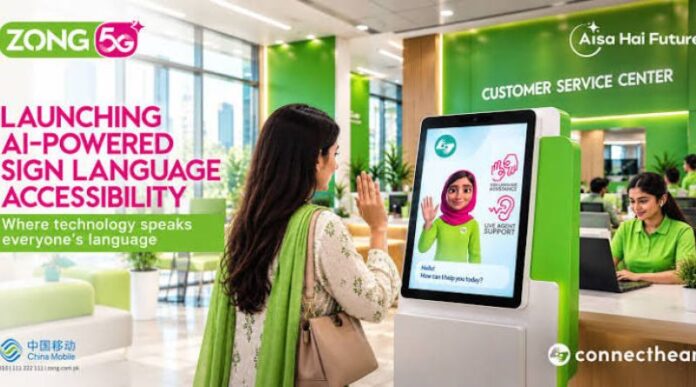

Zong has joined hands with Pakistani accessibility technology company ConnectHear to make customer service more accessible for Deaf and hard-of-hearing people. The two companies have introduced an AI-powered sign language service at Zong Customer Service Centers, giving customers the option to communicate through Pakistan Sign Language (PSL).
The new initiative was launched on September 23, 2026, on the International Day of Sign Languages. It is being introduced as Pakistan’s first AI-powered sign language customer experience in the telecom sector.
The service is powered by ConnectHear’s SILA, a conversational sign language AI agent designed to help Deaf customers communicate more independently. The technology allows customers to use sign language when dealing with customer service instead of depending on family members or finding an interpreter.
For a country where digital services are becoming an important part of everyday life, the move could help remove a communication barrier faced by many people with hearing disabilities.
Zong Moves Beyond Traditional Connectivity
Zong is widely known as a telecom company that provides mobile connectivity, data and digital services. However, the company has increasingly been focusing on artificial intelligence, digital platforms and technology-based solutions.
The new partnership with ConnectHear is part of this wider direction.
According to the announcement, Zong wants technology to do more than simply connect people to mobile networks. The company says digital tools should also make services easier to access for people with different needs.
The introduction of sign language support is therefore aimed at making customer service more inclusive.
For many customers, visiting a telecom service center is a simple process. They can explain their problem, ask questions, submit documents and receive help from staff. However, the same process can become difficult for a Deaf person who communicates mainly through sign language.
In many situations, such customers may need another person to communicate on their behalf. This can affect privacy and independence.
Zong and ConnectHear are now trying to reduce that problem through technology.
How the New AI System Works
The service uses ConnectHear’s SILA technology to support communication in Pakistan Sign Language.
The system is designed to understand sign language and help customers communicate during their interaction with customer service. When a customer needs additional support, professionally trained human interpreters can also be involved.
This combination of AI and human support is important because not every customer interaction is the same.
Simple questions and common service requests can potentially be handled through the technology, while more complicated situations may still require human judgment and assistance.
According to the companies, SILA provides real-time sign language communication and is designed specifically around Pakistan Sign Language.
The technology is described as a patent-pending conversational sign language AI agent.
This means the system is not simply showing pre-recorded sign language videos. Instead, it is designed to support an interactive conversation between the customer and the service system.
Customer Service Can Become More Independent
One of the biggest goals of the project is to give Deaf customers more independence.
Normally, a person visiting a customer service center may need to explain an issue related to a SIM, mobile account, package, billing or another service. For someone who communicates through sign language, explaining these issues can be difficult if the staff member does not understand PSL.
A family member or interpreter may then be needed.
This can create extra delays and may also make the customer uncomfortable when discussing private account information.
With AI-powered sign language support available at the service center, customers can have a more direct way to communicate.
The goal is not only to make communication possible but also to make the customer experience more comfortable and respectful.
ConnectHear has previously worked on technology aimed at making sign language interpretation more easily available. Its customer application provides access to professionally trained virtual interpreters and supports real-time interpretation.
The new Zong partnership takes this idea directly into telecom customer service centers.
Initial Rollout in Major Cities
The new service is being introduced at Zong Customer Service Centers in Islamabad, Lahore and Karachi.
These cities are among Pakistan’s major business and technology centers, making them suitable locations for the first phase of the project.
The initial rollout will allow Zong and ConnectHear to gain experience with the technology in real customer service environments.
The companies can also learn from customer feedback and identify areas where the system can be improved.
Zong has a network of customer service centers across different parts of Pakistan, where customers can visit for support and service-related issues.
The current launch is described as the first stage of a wider accessibility plan. Zong says it plans to gradually expand sign language accessibility across its digital ecosystem.
Why Pakistan Sign Language Matters
Sign language is not simply a collection of hand movements. Like spoken languages, sign languages have their own structure and ways of expressing ideas.
This is why technology developed specifically for Pakistan Sign Language can be important.
A system built around another country’s sign language may not properly understand the signs, expressions or communication style used by Pakistani users.
ConnectHear’s work focuses on sign language accessibility in Pakistan. The company’s technology and services are aimed at helping Deaf and hard-of-hearing people communicate more easily in different situations.
The use of PSL in a major telecom company’s customer service environment could therefore help show how local technology can address local accessibility problems.
AI Can Help Remove Communication Barriers
Artificial intelligence is being used in many areas, including customer service, education, healthcare and business.
Most AI services, however, are designed around spoken or written communication.
The Zong and ConnectHear project looks at another important use of AI: helping people communicate through sign language.
For a Deaf customer, the problem may not be the lack of a mobile service. The real problem can be the communication barrier when trying to access that service.
AI can potentially help reduce that barrier by providing a communication bridge.
This is especially useful in situations where a professional interpreter may not be available immediately.
The government has also been exploring the use of AI and sign language technology for greater accessibility. In 2025, the Ministry of Information Technology and Telecommunications and other government stakeholders discussed AI-powered sign language solutions and potential applications for public services and media.
This shows that sign language technology is becoming part of a wider discussion about digital inclusion in Pakistan.
Human Support Still Has an Important Role
Although AI is at the center of the new service, human interpreters have not been removed from the process.
Zong and ConnectHear say professionally trained human interpreters can provide additional support when a situation requires more context or human judgment.
This is an important part of the system because technology may not always understand every situation perfectly.
Customer service problems can sometimes involve unusual requests, complicated account matters or sensitive discussions. In such cases, human assistance can make the process easier.
The combination of AI and human support gives the system more flexibility.
AI can help with regular communication, while trained interpreters can step in when additional assistance is needed.
A Step Toward a More Inclusive Digital Pakistan
Zong says the partnership is part of its broader goal of supporting an inclusive and digitally connected Pakistan.
The company has already been investing in AI and other digital technologies. Earlier in 2026, Zong also highlighted its work in artificial intelligence and digital transformation through its participation in Indus AI Week.
The latest initiative connects those technology efforts with a social need.
Instead of using AI only for business efficiency, the technology is being applied to make services easier to access for a group that can face communication difficulties.
This approach can become important as more Pakistani companies move their services online and introduce technology-based customer support.
Digital inclusion is not only about having internet access. It also means making sure that people with different abilities can actually use digital services.
Launch Ceremony Held in Islamabad
The launch ceremony took place at Zong’s Islamabad Customer Service Center.
Representatives from Zong, ConnectHear and government and industry organizations attended the event. Participants included officials from the Ministry of Information Technology and Telecommunications, Pakistan Telecommunication Authority and GSMA.
Zong’s Head of Strategy and company spokesperson Nabila Yazdani said the company’s idea of a truly digital Pakistan includes making sure technology allows everyone to participate.
She described the partnership with ConnectHear as a step toward making accessibility a part of the customer experience rather than treating it as something separate.
ConnectHear Co-founder and CEO Azima Dhanjee also highlighted the importance of allowing Deaf customers to communicate independently.
She said the technology is intended to reduce the need for Deaf customers to depend on another person when communicating at service locations.
The Bigger Picture for Telecom Services
Telecom companies are no longer limited to providing calls and mobile internet.
Today, telecom operators are also becoming digital service providers. They are using AI, cloud services, apps, digital payments and other technologies to change the way customers interact with their services.
Accessibility can become an important part of this change.
If digital services are designed with accessibility from the beginning, more people can use them without needing special arrangements.
For Zong, the ConnectHear partnership could therefore be more than a single customer service project. It could become part of a wider approach to designing services for different groups of customers.
What Comes Next?
The current launch is only the first phase of Zong’s accessibility roadmap.
The company says it plans to gradually increase sign language accessibility across its digital ecosystem. This could eventually mean that customers have more ways to access telecom services without visiting a physical location or depending on another person.
The exact future services and locations will depend on how the project develops.
However, the direction is clear: AI and sign language technology are being brought closer to everyday customer services in Pakistan.
The partnership also highlights the growing role of Pakistani technology companies in solving local problems.
ConnectHear has already worked on several accessibility-focused projects, while Zong has been expanding its use of AI and digital technology. Their partnership brings these two areas together.
Final Thoughts
Zong’s partnership with ConnectHear introduces a new way for Deaf and hard-of-hearing customers to interact with telecom services.
Through ConnectHear’s SILA technology, customers at selected Zong service centers in Islamabad, Lahore and Karachi can use Pakistan Sign Language to communicate more directly. Human interpreters remain available when additional support is required.
The project is important because accessibility is not only about providing a service. It is also about making sure people can use that service with dignity and as much independence as possible.
As Pakistan continues to adopt AI, projects like this show that artificial intelligence can be used for more than business and entertainment. It can also help address real communication problems.
Zong’s latest initiative may be an early step toward a wider digital environment where accessibility is built into customer services from the start. With plans to expand the technology across its digital ecosystem, the partnership between Zong and ConnectHear could open the door to more inclusive telecom experiences in Pakistan.
Read Also: check


