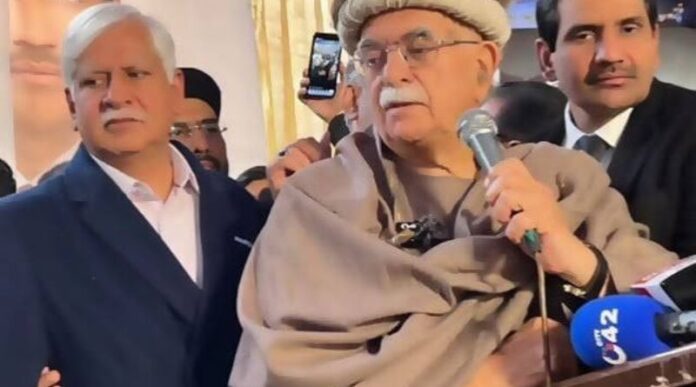

Pashtunkhwa Milli Awami Party (PkMAP) Chairman Mahmood Khan Achakzai has refused to hold talks at the Prime Minister’s House or the office of the National Assembly speaker, saying that any serious political dialogue should take place at a neutral and suitable location.
The development comes at a time when political tensions remain high and efforts are being made to bring different political groups to the table. Achakzai’s position has added another challenge to the process, as he has made it clear that the venue of negotiations is also important for his participation.
According to people familiar with the matter, attempts were made to arrange a meeting between Achakzai and government representatives. However, the PkMAP leader did not agree to visit either the Prime Minister’s House or the speaker’s office for the proposed discussions.
Achakzai Wants a Neutral Place for Talks
Achakzai has reportedly taken the position that political negotiations should not be held at a location linked directly to one side of the dispute. He believes that a neutral venue would provide a better environment for meaningful discussions.
For Achakzai, the issue is not simply about sitting across the table from government representatives. The location of the meeting, according to his stance, should reflect the seriousness of the dialogue and provide equal respect to all participants.
The PkMAP chairman has remained active in political discussions involving opposition parties and other political groups. His latest decision shows that he wants the process to be handled in a way that does not create the impression that one side has an advantage over another.
Political talks often require both sides to show flexibility. However, the choice of venue can become important when relations between political groups are already tense. In this case, Achakzai has apparently decided that he will not compromise on where the meeting should take place.
Government Efforts to Start Political Dialogue
The government has been trying to engage political opponents in discussions on a number of issues. These efforts are aimed at reducing political tension and finding areas where different sides can work together.
Pakistan’s political environment has remained divided for some time. Differences between the government and opposition groups have affected parliamentary politics, public debate and the overall political atmosphere.
In such a situation, dialogue is often seen as one possible way to reduce tensions. However, talks can only move forward when the parties involved agree on basic matters such as who will participate, what issues will be discussed and where the meetings will take place.
Achakzai’s refusal to visit the Prime Minister’s House or the National Assembly speaker’s office means that these discussions may require additional arrangements.
The government may now have to consider another venue if it wants Achakzai to participate directly in the process.
Why the Venue Matters
At first glance, the location of a political meeting may appear to be a minor issue. However, in Pakistan’s political environment, the venue can carry political meaning.
A meeting at the Prime Minister’s House could be viewed as a government-hosted event. Similarly, a meeting at the National Assembly speaker’s office could be seen as taking place under the parliamentary leadership.
For opposition politicians, a neutral location can help create the impression that all participants are being treated equally.
Achakzai’s decision appears to be based on this concern. Rather than accepting an invitation to either government-linked location, he has asked for talks to take place somewhere that is acceptable to all sides.
Such an approach is not unusual in political negotiations. When trust between political groups is limited, even small details can become important.
The choice of venue can also affect how the talks are presented to the public. Political leaders often want to avoid creating an impression that they have accepted a subordinate position in negotiations.
Political Background
Mahmood Khan Achakzai is a senior politician and chairman of the Pashtunkhwa Milli Awami Party. He has been involved in Pakistani politics for decades and has frequently raised issues related to democracy, parliamentary institutions, provincial rights and political representation.
His party has maintained a distinct political position and has often worked with other opposition groups on issues of common concern.
Achakzai has also participated in broader opposition efforts in the past. His political statements have regularly focused on the need for democratic institutions to play their proper role and for political disputes to be settled through constitutional and parliamentary means.
Because of his long political experience and position within opposition politics, his participation in dialogue can carry significance.
His refusal to meet at the Prime Minister’s House or speaker’s office therefore becomes more than a simple scheduling matter. It reflects his approach toward political negotiations and the conditions he considers necessary before entering formal talks.
Dialogue Remains Important
Despite disagreements over the venue, the possibility of dialogue remains important for Pakistan’s political system.
Political disagreements are common in democratic countries. Governments and opposition parties often have different views about economic policy, governance, elections, legislation and other national issues.
The key question is how those disagreements are managed.
When political groups communicate directly, there is a greater chance of finding common ground. On the other hand, when communication breaks down, disagreements can become more difficult to resolve.
For this reason, political talks are often considered an important part of democratic politics. They allow different parties to present their concerns and explore possible solutions without relying only on public statements or political campaigns.
However, successful dialogue requires trust, patience and willingness from all sides.
Achakzai’s Position Could Affect the Process
Achakzai’s refusal to attend meetings at the proposed locations could slow down efforts to begin direct discussions with him.
The government and other political actors may now need to decide whether to change the venue or continue trying to convince him to attend one of the locations already proposed.
The situation also shows how difficult it can be to bring different political groups together when there is already a high level of mistrust.
A political dialogue does not begin only when leaders sit together. Preparations, invitations, venue selection and agreement on the agenda can all become part of the process.
If the parties cannot agree on these basic issues, formal negotiations may take longer to begin.
Opposition Parties and the Need for Coordination
Opposition politics in Pakistan includes several parties with different political backgrounds and priorities. While they may agree on certain issues, they do not always have the same approach to negotiations with the government.
This can make coordination difficult.
Achakzai’s latest position is an example of how individual political parties and leaders may have their own conditions for participating in talks.
For broader negotiations to succeed, opposition groups may need to agree among themselves on their objectives and approach. Similarly, the government may need to understand the concerns of each political group instead of treating all opposition parties in exactly the same way.
A flexible approach from both sides could help create space for further discussion.
Neutral Venue Could Be the Next Option
With Achakzai unwilling to visit the Prime Minister’s House or the speaker’s office, a neutral venue could provide a possible way forward.
Such a location could be selected through mutual agreement between the participants. It could allow all sides to enter the meeting without the political symbolism attached to a government office.
A neutral venue could also make it easier for other political leaders to join future discussions.
However, changing the location alone would not guarantee that talks would succeed. The participants would still need to agree on the purpose of the meeting, the issues to be discussed and the expected outcome.
Political dialogue can only produce results when participants are prepared to listen to one another and consider practical solutions.
Wider Political Impact
The latest development comes as Pakistan continues to face several political and economic challenges. Political stability is important for government decision-making, investment, economic planning and the functioning of state institutions.
Continued political disagreement can make it harder to build agreement on major national issues.
At the same time, political leaders have different responsibilities toward their supporters and voters. They are expected to defend their positions while also finding ways to work with others when national issues require cooperation.
Achakzai’s stance highlights this balance. He is keeping his political position clear while leaving the door open to discussions under conditions he considers acceptable.
Whether the government is willing to accommodate his demand for a neutral venue could determine whether direct talks move forward.
What Happens Next?
The next step will likely depend on how the government and other political leaders respond to Achakzai’s position.
If another venue is offered and accepted, discussions could still take place. If no agreement is reached on the location, the proposed meeting may be delayed.
The issue may also lead to further communication between political representatives before a formal meeting is arranged.
For now, Achakzai has made his position clear: he does not want to hold the proposed talks at the Prime Minister’s House or the National Assembly speaker’s office.
The development shows that political negotiations involve more than simply bringing leaders into the same room. The participants must also agree on the conditions under which those talks will take place.
Conclusion
Mahmood Khan Achakzai’s refusal to hold talks at the Prime Minister’s House or the National Assembly speaker’s office has added another issue to ongoing efforts for political dialogue.
The PkMAP chairman wants negotiations to be held at a neutral location, reflecting his view that all sides should enter the process on equal terms.
While the disagreement over the venue may appear small, it reflects the wider lack of trust among political groups. Reaching an agreement on the location could therefore become an important first step toward broader discussions.
The government now faces the task of deciding whether it can offer an alternative venue that satisfies Achakzai and other participants. If the sides are able to overcome this initial issue, they could move toward discussions on the larger political matters that remain unresolved.
For Pakistan’s political system, continued dialogue can provide a way for disagreements to be discussed through political channels. Whether the current efforts succeed will depend on the willingness of all sides to communicate, show flexibility and agree on a process that they can accept.
Read Also: check