
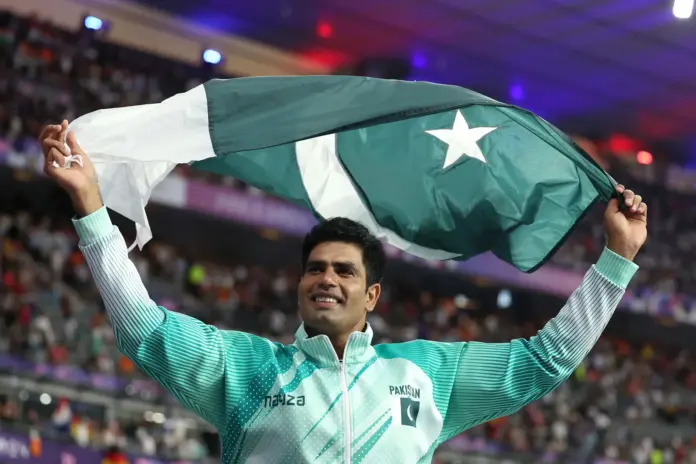

Quick Facts. Full name: Arshad Nadeem. Born: 2 January 1997, Mian Channu, Punjab, Pakistan. Age: 29. Profession: javelin thrower. Employer: WAPDA. Height: 1.92 m. Coaches: Salman Iqbal Butt and Terseus Liebenberg. Biggest achievement: Olympic gold at Paris 2024 with 92.97 m, an Olympic and Asian record. Other major medals: World Championships silver (2023), Commonwealth Games gold (2022), Asian Championships gold (2025). National honours: Pride of Performance (2022) and Hilal-e-Imtiaz (2024). Status: alive and still competing.
A note on spelling. This article uses Arshad Nadeem, Mian Channu, Khanewal, Punjab, WAPDA, Salman Iqbal Butt, Rasheed Ahmad Saqi, Terseus Liebenberg and Neeraj Chopra throughout. Some official lists write his name as “Nadeem Arshad”. Where a detail comes from only one report or still needs checking, the article says so.
Arshad Nadeem Biography: From Mian Channu to Olympic Gold
On the night of 8 August 2024, a 27-year-old man walked onto the runway at the Stade de France in Paris and threw a javelin 92.97 metres. That is almost the length of a football pitch. No one had ever thrown a javelin that far at an Olympic Games. Back in Pakistan, a country that had not won an Olympic gold medal since 1984, millions of people were watching.
If you are asking who is Arshad Nadeem, that one throw is the short answer. He is the first Pakistani to win an individual Olympic gold medal. This Arshad Nadeem biography tells the longer answer: where he comes from, what held him back, how he won, what people have said for and against, and what has happened to him since.
Who Is Arshad Nadeem? Early Life in Mian Channu
Arshad Nadeem was born on 2 January 1997 in Mian Channu, a town in the Khanewal district of Punjab, Pakistan. Khanewal is farming country in the middle of the province, far from the big cities of Lahore and Karachi. He is the third of eight children, so the family home was a crowded and busy one.
His father, Muhammad Ashraf, is reported to have worked as a mason, which means he laid bricks and did hard physical work on building sites. In a 2022 interview with the Indian Express, he said he did not want his son to end up in the same trade. Other outlets describe him as a construction worker. The exact details of the family’s finances are not fully documented, so this article does not go beyond what has been reported.
At school, Arshad tried almost everything on offer: cricket, badminton, football and athletics. Cricket was his real love. He played in district-level tape-ball tournaments. Tape-ball is a street version of cricket in which a tennis ball is wrapped in tape so that it moves fast and swings, and it is how many Pakistani players first learn the game. At that stage, he wanted to be a cricketer, not a javelin thrower.
His path changed in about Grade 7. At a school athletics meet, a local coach named Rasheed Ahmad Saqi noticed him. Saqi had a record of finding and training young sportspeople in the area. He began coaching Arshad soon afterwards. Arshad tried shot put and discus first. Then he won javelin gold at the Punjab Youth Festival in two successive years, and again at an inter-board meet, which is a competition between school education boards.
Those wins brought him to the attention of bigger teams. The Pakistan Army, the Pakistan Air Force and WAPDA all offered him a place. WAPDA is the Water and Power Development Authority, the state body that runs the country’s dams and power stations. Like many Pakistani athletes, he joined a government department team. In Pakistan, these teams give athletes a salary and a place to train, and Arshad ended up competing for WAPDA.
His father also played a part. He urged his son to take up the javelin seriously, and Arshad began competing in it in 2015. Looking back, Arshad has called taking up the javelin the best thing that happened to him, according to a reference profile of his career.
In 2016, a scholarship from World Athletics, the sport’s global governing body, allowed him to train at a high-performance centre in Mauritius. That year he won bronze at the South Asian Games in Guwahati, India, with a throw of 78.33 metres, and bronze again at the Asian Junior Championships in Ho Chi Minh City.
His long-time coach, Salman Iqbal Butt, is a former national-level discus thrower. Over the years, Butt has stayed beside Arshad through injuries, poor form and big wins. He once described Arshad as quiet and focused, a person who does not let setbacks linger. Arshad himself says he is an introvert.
The Early Climb: Small Medals, Rising Distances
A javelin thrower’s career is measured in metres, so it helps to see how his numbers grew.
In May 2017, he took bronze at the Islamic Solidarity Games in Baku with 76.33 metres. In April 2018, at the Commonwealth Games on Australia’s Gold Coast, he threw 80.45 metres in the qualifying round and finished eighth in the final. Soon afterwards, he developed a back injury.
In August 2018, he won bronze at the Asian Games in Jakarta with 80.75 metres. According to reference listings, that was Pakistan’s first athletics medal at the Asian Games in 24 years.
In 2019, he was the only Pakistani athlete at the World Championships in Doha. He threw a national record of 81.52 metres but did not reach the final. A few weeks later, he threw 83.65 metres at the National Games in Peshawar for WAPDA. In December 2019, he won the South Asian Games in Kathmandu with 86.29 metres, a Games record. That result also booked his place at the Tokyo Olympics.
In April 2021, he won at the Imam Reza Cup in Mashhad, Iran, with another national record of 86.38 metres.
The Struggle: No Ground, Old Equipment and Constant Injuries
By 2021, Arshad had earned a direct place at the Tokyo Olympics through his results. He was the first Pakistani track and field athlete to do this under the modern entry rules, which means he qualified on merit and not through a special invitation.
His preparation was not easy. In August 2021, his father told Geo News that Arshad did not have a proper ground to train on. Reports at the time said he practised in the courtyard of his home and on nearby streets, and that he had received little financial help from the government after qualifying. These are claims made by his family and reported by the media, and officials have not been quoted in the sources checked here.
In Tokyo, he reached the final and finished fifth with 84.62 metres. It was close to a medal, but not close enough. According to reference listings, he was only the third Pakistani to compete in an Olympic athletics final, after javelin thrower Muhammad Nawaz in 1956 and hammer thrower Muhammad Iqbal in 1956 and 1960.
In 2022, the Athletics Federation of Pakistan (AFP) arranged for him to train in South Africa under coach Terseus Liebenberg. At the World Championships in Eugene, USA, in July 2022, he became the first Pakistani to reach the final of any event at that competition. He finished fifth with 86.16 metres.
Injuries kept returning. He played through pain in his elbow and knee. In December 2022, he flew to the UK for treatment at a hospital in Cambridge, arranged by the AFP. Then, in May 2023, he hurt his knee again at the National Games, which forced him out of the Asian Championships. The AFP president, Akram Sahi, blamed WAPDA for pushing him to compete in that event. WAPDA’s response was not found in the reports checked, so that side of the story still needs verification.
Equipment was another worry. An Indian outlet, The Bridge, reported before Paris that he had turned to crowd-funding to buy a new javelin, despite his Commonwealth gold and world silver. That claim comes from a single source and needs a second one before it is treated as settled.
Throughout these years, Arshad spoke openly about how athletes outside cricket are often ignored by sports officials in Pakistan. That is the background to everything that happened next: he was a world-class athlete working with limited help.
The Breakthrough: 90 Metres, a World Silver, then Paris
The first big change came on 7 August 2022 at the Commonwealth Games in Birmingham, England. The Commonwealth Games bring together athletes from Britain and its former territories, including Pakistan, India and Sri Lanka. Arshad threw 90.18 metres on his fifth attempt, even though he was carrying an injury. He became the first South Asian ever to pass 90 metres, a mark that top javelin throwers treat as an elite line.
He beat the reigning world champion, Anderson Peters of Grenada, who threw 88.64 metres. It was Pakistan’s first athletics gold at the Commonwealth Games since 1962. Five days later, he won gold at the Islamic Solidarity Games in Konya, Turkey, with 88.55 metres, a Games record.
In August 2023, at the World Championships in Budapest, Hungary, he won silver with 87.82 metres. It was the first medal Pakistan had ever won at that event. Then his knee kept him out of competition until July 2024, when he came back at the Paris Diamond League and finished fourth with 84.21 metres. He was the first Pakistani athlete to compete in the Diamond League, which is a series of top-level one-day meets. Few observers saw him as the favourite for Olympic gold at that point. Reports described him as an underdog.
On 8 August 2024, he walked out for the Olympic final in Paris. On his second attempt, he threw 92.97 metres. The old Olympic record was 90.57 metres, set by Norway’s Andreas Thorkildsen at the 2008 Beijing Games. Arshad had beaten it by more than two metres. His throw was also the longest by any man in the world that year.
India’s Neeraj Chopra, the defending champion, won silver with 89.45 metres. Peters took bronze with 88.54 metres. The result was a double first for Pakistan. It was the country’s first individual Olympic gold, and its first Olympic medal of any kind since 1992. Pakistan’s three earlier golds had all come from the national hockey team, in 1960, 1968 and 1984.
After the final, Arshad said he was happy to see Chopra win silver, according to The Bridge. Chopra and Arshad are close rivals, and every contest between them is watched in both countries. Reports said the athletes’ mothers also spoke kindly of each other’s sons. The two men and their families have spoken warmly of each other, according to Arab News.
Homecoming: Rewards, a Buffalo and National Honours
Arshad returned to Pakistan to a hero’s welcome. A parade was held in Lahore on 11 August 2024. Punjab’s Chief Minister, Maryam Nawaz, travelled to Mian Channu to meet him and his family and to present him with a cash prize and a car.
Money followed from many directions. Prime Minister Shehbaz Sharif announced Rs150 million from the federal government, according to Aaj News. The Punjab government gave a cheque reported at Rs100 million. Some outlets reported this amount as 10 million rupees, so the figure is disputed and should be treated as approximate. The Sindh government announced Rs50 million, and the Khyber Pakhtunkhwa Chief Minister gave Rs5 million from his own funds. NPR reported a further $50,000 prize from World Athletics.
His father-in-law, Muhammad Nawaz, gave him a buffalo. In Punjab villages, a buffalo is a prized and valuable gift, since it gives milk and can be sold for cash. Arshad laughed about it in an ARY News interview, saying he might have hoped for land instead. The story spread around the world and became one of the most shared parts of his victory.
The state also honoured him with the Hilal-e-Imtiaz, one of Pakistan’s highest civilian awards, in August 2024. He had already received the Pride of Performance, another national award for excellence, in 2022. A postage stamp with his image was issued for Independence Day 2024. Islamabad’s capital authority also decided to name a service road in sector F-10 after him. Whether the renaming has been completed needs checking.
Praise, Criticism and Hard Questions: Two Sides of the Story
The story of Arshad Nadeem is not only a story of success. Some parts of it divide opinion, and this section sets out both sides.
The money question. Supporters say the rewards honoured a historic win and gave an athlete from a modest background financial security. Critics, and Arshad himself in earlier interviews, said support came late. They ask why so much help arrived only after a gold medal when he had trained in a courtyard just three years earlier, and what that means for athletes in less visible sports. Both points can be true at once.
The injury dispute. After his knee injury in 2023, the AFP president blamed WAPDA for pushing him to play at the National Games. WAPDA is the department he works for and represents. Its answer has not been found in the sources reviewed.
The form dip. Since Paris, results have been uneven. In July 2025, he had surgery in the UK for partial muscle damage in his right calf. In September 2025, he finished 10th at the World Championships in Tokyo with 82.75 metres, even though he was described as fully fit. Later in 2025, he won the Islamic Solidarity Games in Riyadh with 83.05 metres.
The year 2026 has been harder. He was ninth at the Luzern meet in Switzerland in July with 78.47 metres. At the Commonwealth Games in Glasgow, he qualified seventh with 78.63 metres but finished ninth in the final with 77.41 metres, so he could not defend his title. In Budapest in September, he was fifth at the World Athletics Ultimate Championship. On 28 September, at the Asian Games in Nagoya, Japan, he finished fourth with 80.29 metres, missing the podium in rainy conditions. He opened with 76.69 metres, threw 80.29 on his third attempt, and fouled his last three throws.
The Express Tribune called Nagoya another disappointing outing. His camp sees a rebuilding year. Coach Salman Iqbal Butt said Arshad skipped the Lausanne Diamond League to train in South Africa, and that he was prioritising practice over competition, as reported by Olympics.com. The full reasons for the dip have not been confirmed.
The field has changed as well. Sri Lanka’s Rumesh Pathirage, 23, won gold in Nagoya with 88.55 metres. His personal best of 92.62 metres is only 35 centimetres short of Arshad’s Olympic record. Chopra missed the Asian Games with an ankle ligament injury, so the two did not meet.
The India-Pakistan frame. Many fans see every Arshad and Chopra contest as a national rivalry. The athletes themselves have mostly avoided that framing, and they have spoken respectfully of one another.
Life Away from the Runway
Arshad is married, with a daughter and a son, according to a reference profile; this needs verification from a recent source. He describes himself as an introvert and is known as a devout Muslim. He rarely speaks at length in public.
He now works with several brands. He has served as a brand ambassador for Haier, FFC and PTCL, and he is a sponsored athlete of Toyota Pakistan. He carried Pakistan’s flag at the opening of the National Games in Karachi in December 2025 and, according to reports, at the opening of the 2026 Commonwealth Games. In December 2025, he won the javelin gold at those National Games with 81.81 metres.
Arshad Nadeem Legacy: What He Changed for Pakistan Sport
The gold medal ended a 32-year wait for any Pakistani Olympic medal. It was also the country’s first Olympic gold of any kind since the 1984 hockey team.
His career has opened a path for others. At the 2025 Islamic Solidarity Games in Riyadh, his compatriot Muhammad Yasir took silver behind him, giving Pakistan a one-two finish in the javelin. Whether the Olympic win has increased javelin participation across the country needs verification.
International recognition followed too. Asian Athletics named him Best Asian Athlete in May 2025. In December 2025, he received the Global Breakthrough Athlete Award in Dubai. In June 2025, he reached a career-high world ranking of fourth. A book about his Olympic journey, Khawab Se Haqeeqat Tak (From Dream to Reality), was launched in Lahore in August 2026, on the second anniversary of the Paris final.
He is 29 and still competing. The 2028 Los Angeles Olympics would find him at 31. His career is not finished, and its next chapter is not yet written.
Closing
Whatever his next throw measures, the number from Paris is fixed: 92.97 metres, thrown by a boy from Mian Channu who once wanted to be a cricketer.
Arshad Nadeem FAQ: Age, Family, Net Worth and More
How old is Arshad Nadeem? Arshad Nadeem was born on 2 January 1997, so he is 29 years old as of October 2026. He was 27 when he won Olympic gold in Paris.
Who is Arshad Nadeem’s family? He is the third of eight children and is married, with a daughter and a son, according to a reference profile (needs verification from a recent source). His father is Muhammad Ashraf. His father-in-law gave him the famous buffalo after the Olympics.
What is Arshad Nadeem’s net worth? No reliable public figure exists, so any exact number you see online should be treated with caution. We know he received large government rewards after Paris, including a reported Rs150 million from the federal government. He also earns from brand deals and his WAPDA job, but those amounts are not public.
Is Arshad Nadeem dead or alive? He is alive. There is no credible report of his death. He competed at the Asian Games in Nagoya on 28 September 2026 and finished fourth.
What are Arshad Nadeem’s biggest achievements? He won Olympic gold in Paris in 2024 with 92.97 metres, an Olympic and Asian record. He also won World Championships silver in 2023, Commonwealth Games gold in 2022 and Asian Championships gold in 2025. He was the first South Asian to throw the javelin beyond 90 metres.


