
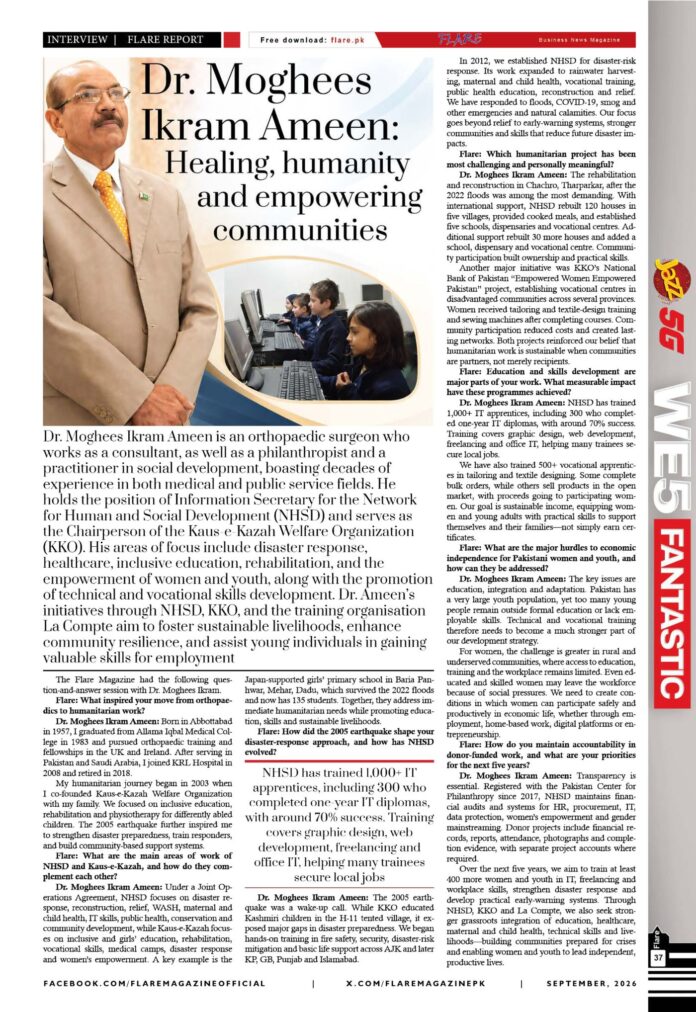

Dr. Moghees Ikram Ameen
Information Secretary, NHSD
Chairperson, KKO
Dr. Moghees Ikram Ameen is an orthopaedic surgeon who works as a consultant, as well as a philanthropist and a practitioner in social development, boasting decades of experience in both medical and public service fields. He holds the position of Information Secretary for the Network for Human and Social Development (NHSD) and serves as the Chairperson of the Kaus-e-Kazah Welfare Organization (KKO). His areas of focus include disaster response, healthcare, inclusive education, rehabilitation, and the empowerment of women and youth, along with the promotion of technical and vocational skills development. Dr. Ameen’s initiatives through NHSD, KKO, and the training organisation La Compte aim to foster sustainable livelihoods, enhance community resilience, and assist young individuals in gaining valuable skills for employment.
The Flare Magazine had the following question-and-answer session with Dr. Moghees Ikram.
Flare: What inspired your move from orthopaedics to humanitarian work?
Dr. Moghees Ikram Ameen: Born in Abbottabad in 1957, I graduated from Allama Iqbal Medical College in 1983 and pursued orthopaedic training and fellowships in the UK and Ireland. After serving in Pakistan and Saudi Arabia, I joined KRL Hospital in 2008 and retired in 2018.
My humanitarian journey began in 2003 when I co-founded Kaus-e-Kazah Welfare Organization with my family. We focused on inclusive education, rehabilitation and physiotherapy for differently abled children. The 2005 earthquake further inspired me to strengthen disaster preparedness, train responders, and build community-based support systems.
Flare: What are the main areas of work of NHSD and Kaus-e-Kazah, and how do they complement each other?
Dr. Moghees Ikram Ameen: Under a Joint Operations Agreement, NHSD focuses on disaster response, reconstruction, relief, WASH, maternal and child health, IT skills, public health, conservation and community development, while Kaus-e-Kazah focuses on inclusive and girls’ education, rehabilitation, vocational skills, medical camps, disaster response and women’s empowerment. A key example is the Japan-supported girls’ primary school in Baria Panhwar, Mehar, Dadu, which survived the 2022 floods and now has 135 students. Together, they address immediate humanitarian needs while promoting education, skills and sustainable livelihoods.
Flare: How did the 2005 earthquake shape your disaster-response approach, and how has NHSD evolved?
Dr. Moghees Ikram Ameen: The 2005 earthquake was a wake-up call. While KKO educated Kashmiri children in the H-11 tented village, it exposed major gaps in disaster preparedness. We began hands-on training in fire safety, security, disaster-risk mitigation and basic life support across AJK and later KP, GB, Punjab and Islamabad.
In 2012, we established NHSD for disaster-risk response. Its work expanded to rainwater harvesting, maternal and child health, vocational training, public health education, reconstruction and relief. We have responded to floods, COVID-19, smog and other emergencies and natural calamities. Our focus goes beyond relief to early-warning systems, stronger communities and skills that reduce future disaster impacts.
“NHSD has trained 1,000+ IT apprentices, including 300 who completed one-year IT diplomas, with around 70% success. Training covers graphic design, web development, freelancing and office IT, helping many trainees secure local jobs”
Flare: Which humanitarian project has been most challenging and personally meaningful?
Dr. Moghees Ikram Ameen: The rehabilitation and reconstruction in Chachro, Tharparkar, after the 2022 floods was among the most demanding. With international support, NHSD rebuilt 120 houses in five villages, provided cooked meals, and established five schools, dispensaries and vocational centres. Additional support rebuilt 30 more houses and added a school, dispensary and vocational centre. Community participation built ownership and practical skills.
Another major initiative was KKO’s National Bank of Pakistan “Empowered Women Empowered Pakistan” project, establishing vocational centres in disadvantaged communities across several provinces. Women received tailoring and textile-design training and sewing machines after completing courses. Community participation reduced costs and created lasting networks. Both projects reinforced our belief that humanitarian work is sustainable when communities are partners, not merely recipients.
Flare: Education and skills development are major parts of your work. What measurable impact have these programmes achieved?
Dr. Moghees Ikram Ameen: NHSD has trained 1,000+ IT apprentices, including 300 who completed one-year IT diplomas, with around 70% success. Training covers graphic design, web development, freelancing and office IT, helping many trainees secure local jobs.
We have also trained 500+ vocational apprentices in tailoring and textile designing. Some complete bulk orders, while others sell products in the open market, with proceeds going to participating women. Our goal is sustainable income, equipping women and young adults with practical skills to support themselves and their families—not simply earn certificates.
Flare: What are the major hurdles to economic independence for Pakistani women and youth, and how can they be addressed?
Dr. Moghees Ikram Ameen: The key issues are education, integration and adaptation. Pakistan has a very large youth population, yet too many young people remain outside formal education or lack employable skills. Technical and vocational training therefore needs to become a much stronger part of our development strategy.
For women, the challenge is greater in rural and underserved communities, where access to education, training and the workplace remains limited. Even educated and skilled women may leave the workforce because of social pressures. We need to create conditions in which women can participate safely and productively in economic life, whether through employment, home-based work, digital platforms or entrepreneurship.
Flare: How do you maintain accountability in donor-funded work, and what are your priorities for the next five years?
Dr. Moghees Ikram Ameen: Transparency is essential. Registered with the Pakistan Center for Philanthropy since 2017, NHSD maintains financial audits and systems for HR, procurement, IT, data protection, women’s empowerment and gender mainstreaming. Donor projects include financial records, reports, attendance, photographs and completion evidence, with separate project accounts where required.
Over the next five years, we aim to train at least 400 more women and youth in IT, freelancing and workplace skills, strengthen disaster response and develop practical early-warning systems. Through NHSD, KKO and La Compte, we also seek stronger grassroots integration of education, healthcare, maternal and child health, technical skills and livelihoods—building communities prepared for crises and enabling women and youth to lead independent, productive lives.


