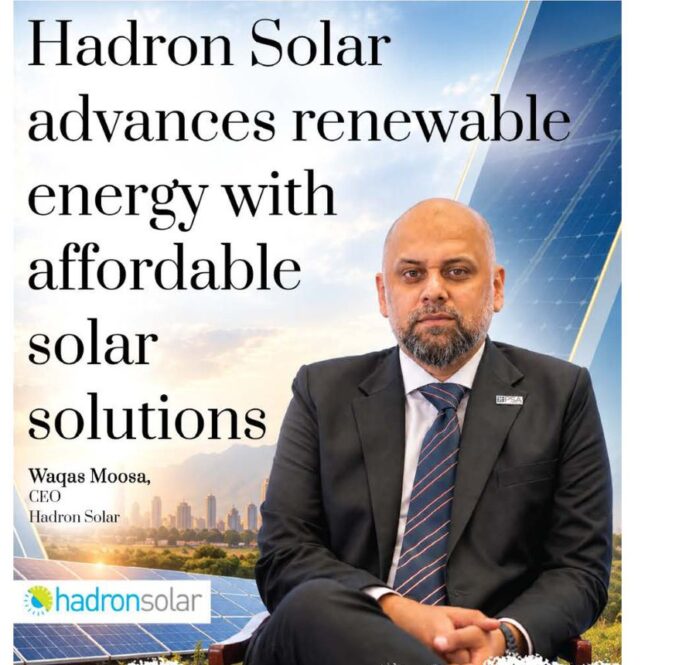

Flare team conducted an interview with Waqas Moosa, the CEO of Hadron Solar and Chairman of the Pakistan Solar Association, who stated that he possesses more than 20 years of experience in business within Pakistan and the GCC, specializing in renewable energy, business expansion, and market development. In 2014, I co-founded Hadron Solar with the aim of offering solar solutions to the developing solar market in Pakistan.
Flare: Please introduce yourself and describe how your career path led to founding Hadron Solar and becoming the leader of the Pakistan Solar Association.
Waqas Moosa: I have over 20 years of business experience across Pakistan and the GCC, with expertise in renewable energy, business growth and market development. I co-founded Hadron Solar in 2014 to provide solar solutions to Pakistan’s emerging solar market.
Since then, Hadron Solar has deployed over 650 net-metering licenses and installed more than 20 MW of solar capacity. My hands-on experience has provided deep insight into the sector’s evolving regulatory and consumer landscape, which I have applied to research and policy dialogue with the LUMS Energy Institute and GIZ on distributed solar and net metering.
As the sector matured, I became involved in industry advocacy and policy reform, addressing net billing, import duties and local manufacturing. This led to my appointment as Chairman of the Pakistan Solar Association (PSA) in 2024, representing over 300 member organizations.
Since then, I have led the association with a focus on a just transition toward a truly distributed power generation landscape.
Flare: Pakistan has experienced exceptionally rapid growth in solar adoption. What factors have driven this transformation, and how do you assess the sector’s current size and future potential?
Waqas Moosa: The biggest drivers have been the rising cost of electricity, load-shedding and reliability concerns, combined with the dramatic reduction in the cost of solar technology.
Consumers have essentially decided that they want to generate their own electricity. The scale is now enormous and current estimates put deployed solar capacity at tens of gigawatts, much of it behind the meter and therefore not captured in official statistics.
The future potential is therefore not just about installing more panels. It is about moving towards distributed generation, storage and smarter integration with the grid.
Flare: Hadron Solar serves residential, commercial, and agricultural customers. Which segment has the most growth potential, and how does your company differ from other solar providers in Pakistan?
Waqas Moosa: At Hadron Solar, our priority is customer ROI. We treat solar installations as investments, using skilled technicians and specialists to customize and design systems with real-time monitoring for maximum lifetime efficiency.
Forecasting growth by segment is difficult due to a turbulent policy landscape and different demand drivers. Residential users seek relief from load-shedding and lower bills; agriculture is driven largely by high diesel costs; while commercial demand has been strongly affected by the shift from net-metering to net-billing.
The reversal of net-metering has also accelerated interest in batteries and BESS as costs become more affordable. Rather than one segment dominating, opportunities will shift with economic conditions.
The broader trend is clear: Pakistan is moving toward distributed generation, with solar-plus-storage becoming increasingly important.
Flare: How does Hadron Solar ensure project quality and safety, and how is PSA improving industry standards?
Waqas Moosa: Hadron Solar prioritizes quality installation by skilled technicians and real-time monitoring to ensure optimal returns and consistent payback. This proactive approach to installation and maintenance minimizes system failures throughout its operational life.
The Pakistan Solar Association helps raise industry standards through vocational training partnerships with TEVTA and the Hunar Foundation, and by co-founding the CLIP training institute with Renewables First and New Energy Nexus.
These efforts build customer confidence while ensuring safety, quality and technical standards are maintained alongside rapid deployment.
Flare: What policies, financing and incentives are needed to develop solar-plus-storage in Pakistan?
Waqas Moosa: The “Battery Emergency” is already here. Following the rapid growth of solar, Pakistan urgently needs a clear regulatory framework and policy roadmap to support battery adoption and plan for the influx, rather than relying on ad-hoc policies.
Continued investment in imported-fuel infrastructure will perpetuate dependency. Instead, Pakistan should promote renewable energy financing and community solar projects, including subsidized solar kits, as piloted in Sindh.
Such initiatives can promote energy freedom and economic empowerment, shifting Pakistan from energy dependence toward energy sovereignty.
Flare: Which solar products can Pakistan manufacture locally, and what government support is needed?
Waqas Moosa: We should move towards local manufacturing where Pakistan can realistically become competitive. This could include mounting structures, cables, electrical equipment and other balance-of-system components.
We need technology transfer, investment, skills development, quality standards and a stable policy environment. The objective should be a competitive industry that can eventually serve both domestic demand and export markets.
Flare: What financing options or business models can make solar energy more accessible?
Waqas Moosa: The key opportunity is to reduce large upfront costs through leasing, instalments, solar-as-a-service and structured financing.
The SBP Financing Scheme for Renewable Energy offers concessional financing for solar and storage. For agriculture, diesel-savings-based financing can improve access, while longer-tenor financing can make solar more affordable for households and SMEs.
Flare: Could you highlight some of Hadron Solar’s most significant projects?
Waqas Moosa: One of Hadron Solar’s most significant projects was a Power Purchase Agreement project that we developed for a mall in Faisalabad almost eight years ago.
It was among the first commercial PPAs in Pakistan and served as an important model and test case that was subsequently adopted by multiple other companies. We have also been deeply involved in the early development of net metering in Pakistan.
Flare: As Chairman of PSA and CEO of Hadron Solar, what are your priorities for both organizations?
Waqas Moosa: The goal that both the Pakistan Solar Association and Hadron Solar are ultimately working towards is a Pakistan where every rooftop is covered with solar panels — where the default energy source for residential, industrial or commercial use is the sun.
A future like this necessitates solar being accessible across the country, allowing for the aforementioned “truly distributed” generation.
In many ways, our priority now is to sustain the leadership position that Pakistan has established in solar deployment and take the next step by becoming a leader in battery energy storage as well.
Source/Publication: Flare Magazine, September 2026