
On the afternoon of 22 March 2026, a young visitor at Keenjhar Lake slipped into deep water. An SIEHS-1122 boat crew, already on a safety patrol, pulled him aboard. He was struggling to breathe. Oxygen support began on the water, while a land ambulance waited at the shore to take over. The rescue did not end when the boat docked. Care simply changed hands.
It was a rescue, certainly. But it was also an illustration of something less visible: an effective emergency service is not defined only by the vehicle that arrives first. It is defined by the people, decisions and systems that connect every step that follows.
For most of us, emergency healthcare is an ambulance cutting through traffic. Across Sindh, however, the challenge begins much earlier. Where is the patient? How serious is the emergency? Which team can reach them? What care can begin while help is still on the way?
These are the questions Sindh Integrated Emergency & Health Services (SIEHS) has been built to answer at scale.
Since 2021, SIEHS has run the 1122 emergency ambulance service under the Health Department, Government of Sindh, building on the legacy of the Aman emergency ambulance service. It is a Section 42 not-for-profit backed by the provincial government. Five years on, its network covers all 30 districts of Sindh, with more than 500 emergency response vehicles and over 27,000 calls managed on an average day, according to figures reported through September 2026. Its core services are free of charge.
The numbers describe reach. The deeper story is the institutional discipline required to make that reach meaningful.
The system behind the siren
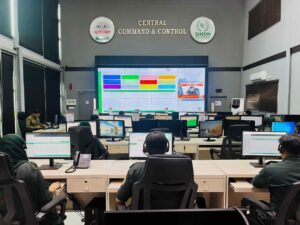
Before an ambulance moves, an emergency begins as a conversation. SIEHS call-takers use the Medical Priority Dispatch System (MPDS) to ask structured questions, assess urgency and identify potentially life-threatening situations first.
This is a specialised skill: hearing panic without adopting it, asking the next right question and making decisions under pressure. In January 2023, the SIEHS centre in Karachi was accredited as a Center of Excellence under MPDS by the International Academies of Emergency Dispatch, only the 315th centre worldwide to earn that status. The recognition reflects something the public rarely sees: the protocols, training and quality assurance behind each critical call.
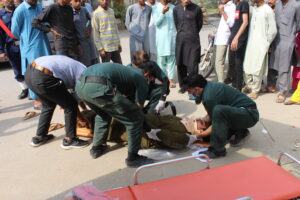
On the road, the response continues through trained emergency medical technicians and purpose-equipped vehicles. According to SIEHS, each ambulance in its certified fleet carries 29 essential medical tools, including a ventilator, cardiac monitor, defibrillator and oxygen. This is why SIEHS calls its ambulances an ICU on Wheels. The principle is straightforward: treatment should not have to wait for the hospital gate.
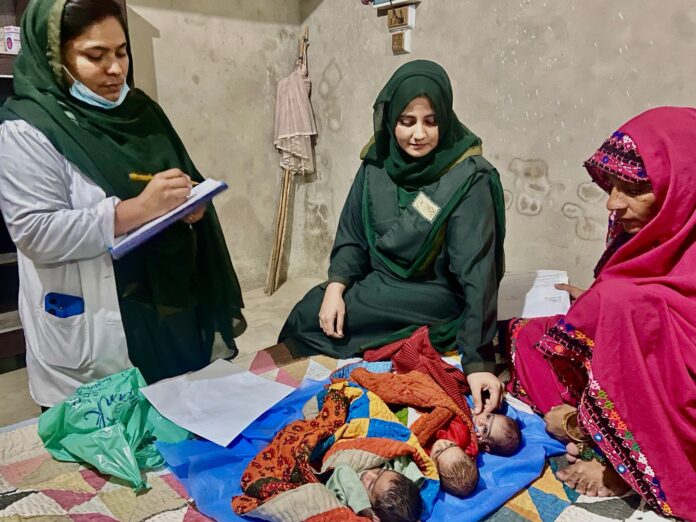
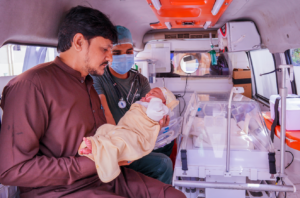
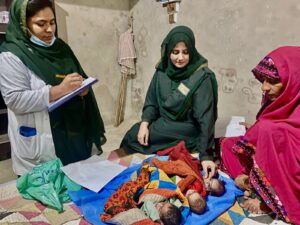
The ventilator matters most when a patient cannot breathe adequately on their own. Over five years, SIEHS ambulances have provided ventilator support in 2,821 cases. For the smallest patients, 25 incubator-equipped ambulances keep premature and low-birth-weight babies warm and oxygenated during transfer, and have handled more than 5,000 neonatal emergencies.
The range of emergencies is considerable. Between August 2021 and September 2026, SIEHS responded to more than 135,600 road traffic accident cases and assisted with over 1,100 births inside its ambulances. These situations demand very different skills, but both underline why the journey to hospital is itself part of healthcare.
One province, many kinds of distance
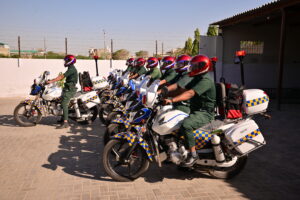
Geography poses its own test. An ambulance is indispensable on a highway but may struggle in a congested neighbourhood, so a dedicated SIEHS bike ambulance unit reaches patients in narrow inner-city lanes. The boat ambulance at Keenjhar Lake extends the same logic to the water: if the terrain changes, the response model has to change with it.
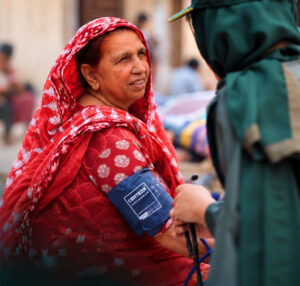
Yet distance is not always measured in kilometres. Sometimes it is the cost of a consultation, the absence of a nearby clinician or the hesitation to speak about a mental health concern. Tele-Tabeeb 1123, another round-the-clock SIEHS lifeline, connects callers across Pakistan to free medical advice and mental health support by telephone. It offers professional guidance without requiring a journey, an appointment or an internet connection.
One service takes emergency care towards the patient. The other brings clinical guidance within reach of someone who may not need an ambulance at all. Together, they suggest a more useful definition of healthcare access: not simply how many facilities exist, but how readily a person can reach competent help.
The business of being ready
For any large public service, growth is easiest to see in vehicles purchased and facilities opened. Those investments matter. But an ambulance is only ready when its equipment works, medicines are stocked, the crew is trained, dispatch is dependable, and the receiving hospital is prepared for a safe handover. The quality of the whole system depends on the links that are easiest to overlook.
Workforce capability is therefore infrastructure in its own right. The Research, Development and Education function at SIEHS has delivered more than 410 training sessions and trained over 10,000 emergency responders, based on its September 2026 figures. The work is less visible than a fleet inauguration, but it is what allows a protocol to be followed consistently in very different places and circumstances.
The institution is also testing how digital tools can support that discipline. In a review published in the International Journal of Advances in Medicine in October 2026, SIEHS researchers documented four AI-enabled tools at the organisation: triage support for Tele-Tabeeb, AI-based candidate matching in recruitment, a facial-recognition and geolocation app for field monitoring, and AI-assisted monitoring of training sessions. As the authors note, sustainable adoption depends less on novelty than on data protection, attention to algorithmic bias and workforce consent.
The challenge ahead is the one faced by every service operating at provincial scale: sustaining quality as expectations and demand grow. That requires investment in maintenance, people, clinical governance, hospital coordination and public trust, long after the excitement of a launch has passed. It is also where public, philanthropic and corporate support can make the most lasting difference.
In a moment of crisis, families do not ask how many departments contributed to the response. They remember whether someone answered, whether trained help came and whether they were treated with dignity.
Five years on, the SIEHS story is not simply one of ambulances added or districts covered. It is the gradual construction of a public health institution designed to reach people where emergencies happen: on roads, in homes, across remote communities, on the water and, sometimes, through a telephone line.
Hospitals will always be essential. But the first minutes of care often happen long before a patient sees one. Building a system worthy of those minutes may be among the most important health investments a province can make.
Sindh Integrated Emergency & Health Services (SIEHS) is a Section 42 not-for-profit backed by the Government of Sindh. For a medical emergency anywhere in Sindh, call 1122. For free medical advice and mental health support anywhere in Pakistan, call Tele-Tabeeb 1123. SIEHS accepts Zakat, Sadaqah and general donations at siehs.org/donation.