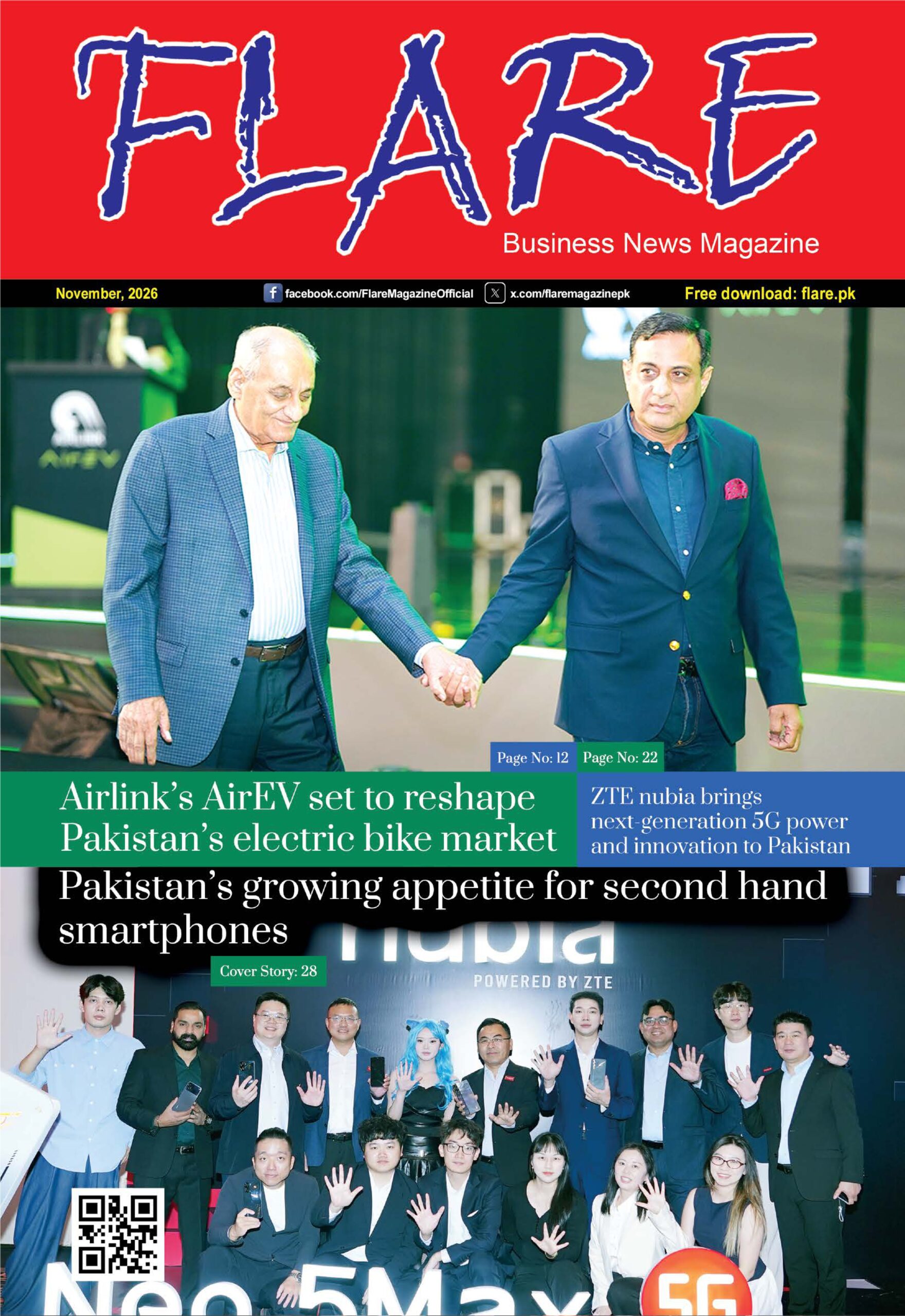

The Flare panel interviews Muhammad Zeeshan Mianoor, CEO of Inovi Telecom, who discusses his entrepreneurial journey linked to his family’s history in Pakistan’s mobile phone business. Their involvement helped him learn about a rapidly evolving sector. He intended to build on this foundation to establish a company that would enhance the industry’s business side and contribute to Pakistan’s technological growth. This vision led to the creation of Inovi Telecom in 2016.
Flare: How did your entrepreneurial journey lead you to Inovi Telecom, and what are major achievements of the company?
Muhammad Zeeshan Mianoor: My entrepreneurial journey is rooted in my family’s long-standing association with Pakistan’s mobile phone industry. My family’s involvement in the industry provided an early foundation and exposure to a sector that was rapidly transforming the way people communicated and accessed technology. However, I wanted to build on this foundation and create an enterprise that could contribute not only to the commercial side of the industry but also to Pakistan’s technological and industrial development. This vision led me to the establishment of Inovi Telecom in 2016. The objective was to build a business that could bring internationally recognised technology brands closer to Pakistani consumers while developing local capabilities in distribution, manufacturing and after-sales support.
Our approach has been to build a business around quality, reliability and long-term partnerships. We recognised the potential of Pakistan’s mobile phone market, particularly the opportunity to strengthen local manufacturing and reduce dependence on imported finished devices.
One of our significant milestones has been establishing partnerships with international brands, including Infinix and itel, and developing our presence in Pakistan’s mobile phone manufacturing and distribution ecosystem.
We believe that local manufacturing is not simply about assembling devices; it is about developing technical expertise, creating employment, strengthening industrial infrastructure and positioning Pakistan as a competitive participant in the global electronics industry.
Our long-term vision is to see Inovi grow into a recognised Pakistani technology enterprise with an increasingly significant role in regional and international markets.
Flare: What is the scale of Inovi Telecom’s operations, and how does it contribute to employment and local manufacturing?
Muhammad Zeeshan Mianoor: Inovi Telecom has developed a substantial operational presence within Pakistan’s mobile manufacturing and telecommunications sector, with operations spanning manufacturing, corporate management, sales, distribution and related business functions.
Our operations support a diverse workforce across factory and corporate functions, creating employment opportunities in production, technical operations, quality control, administration, marketing, sales and supply-chain management.
Beyond direct employment, our business contributes to a wider network of economic activity involving distributors, logistics providers, suppliers and other industry partners.
We believe local mobile manufacturing plays an important role in strengthening Pakistan’s industrial capabilities. It provides opportunities to develop technical expertise, build specialised skills and create a more experienced workforce within the electronics industry.
As we continue to expand our operations, our focus remains on strengthening local capabilities, creating employment opportunities and contributing to the development of a sustainable mobile manufacturing ecosystem in Pakistan.
Flare: What challenges face Pakistan’s mobile manufacturing industry, and how are consumer preferences shifting between feature phones and smartphones?
Muhammad Zeeshan Mianoor: Pakistan’s mobile manufacturing sector has made considerable progress, but it continues to operate in an environment influenced by economic uncertainty, inflation, taxation, currency fluctuations and changing consumer purchasing power.
One of the biggest challenges is the affordability of smartphones. Although consumers increasingly recognise the importance of smartphones for communication, education, digital payments, entertainment and business, purchasing power remains a significant constraint. We are also witnessing a market in which consumers are holding on to their existing devices for longer periods rather than upgrading frequently.
Feature phones continue to serve an important market, particularly among price-sensitive consumers, rural communities and users who prioritise basic communication and battery life. Smartphones, meanwhile, are becoming increasingly important as internet access and digital services expand. Pakistan’s manufacturing figures demonstrate this transition. During January–October 2025, approximately 25.11 million mobile phones were locally manufactured or assembled. Of these, 13.2 million were smartphones, while approximately 11.9 million were feature phones. This illustrates that both segments continue to have considerable market relevance.
Our view is that the industry must focus on producing devices that offer better specifications, durability and user experience at accessible price points.
Flare: How have Inovi Telecom’s partnerships with Infinix and itel supported technology transfer and local manufacturing?
Muhammad Zeeshan Mianoor: Our relationships with international technology brands are an important part of Inovi Telecom’s business strategy.
Infinix and itel are among the key brands associated with our operations in Pakistan. These relationships allow us to participate in a broader technology ecosystem that encompasses product manufacturing, distribution, market development and consumer access.
Working with established international brands also provides exposure to global product standards, manufacturing processes, quality-control requirements and evolving consumer technologies.
We see technology transfer as a gradual process. It involves developing local technical capabilities, improving manufacturing practices, training personnel and strengthening the domestic industrial ecosystem.
Our ambition is to progressively increase local value addition wherever technically and commercially viable. This includes exploring opportunities in packaging, accessories, plastic components, assembly processes and other manufacturing-related activities. The ultimate objective is to move beyond basic assembly towards a more developed manufacturing ecosystem in Pakistan.
Flare: What are the main barriers to local production of mobile components, and what government support is needed to strengthen the supply chain?
Muhammad Zeeshan Mianoor: The localisation of critical mobile phone components is one of the most important challenges facing Pakistan’s electronics manufacturing industry.
Components such as displays, batteries, semiconductors and printed circuit boards require substantial capital investment, specialised machinery, technical expertise, quality-control infrastructure and economies of scale. Pakistan currently faces limitations in many of these areas. The absence of a sufficiently developed component supplier ecosystem means that manufacturers continue to depend heavily on imported components.
Establishing local component manufacturing facilities also requires consistent demand, reliable energy infrastructure, access to financing and predictable industrial policies.
We believe the government can play a transformative role through:
- Long-term and predictable tax and tariff policies for electronics manufacturing.
- Incentives for foreign companies establishing component manufacturing facilities in Pakistan.
- Joint ventures between international technology companies and Pakistani manufacturers.
- Reduced duties on machinery, specialised equipment and raw materials used in local production.
- Investment in technical education, engineering and research and development.
- Establishment of internationally accredited testing and certification laboratories.
- Special incentives for manufacturers that achieve measurable localisation and export targets.
Pakistan should aim to attract component manufacturers rather than concentrate exclusively on the final assembly of mobile phones. The government’s policy direction towards localisation and export-oriented manufacturing is encouraging. However, implementation, consistency and industry consultation will determine its success.
Flare: How do taxes, exchange rates and import costs affect smartphone prices, and how can locally assembled devices become more affordable?
Muhammad Zeeshan Mianoor: The pricing of locally manufactured smartphones is closely linked to the cost of imported components, exchange-rate movements, taxation, freight charges and manufacturing overheads.
Although devices are assembled locally, a substantial proportion of their critical components are sourced internationally. Consequently, any depreciation in the Pakistani rupee increases the local cost of procurement. Taxation also has a direct impact on the final retail price. Changes in sales tax and other applicable duties can significantly affect consumer affordability, particularly in the entry-level and mid-range smartphone categories.
We have seen how taxation can influence market demand. Following the introduction of an 18% sales tax measure in the 2025–26 budget, the industry experienced considerable pressure on sales and production. The impact of higher prices and declining consumer demand has also been highlighted by industry representatives.
To improve affordability, we believe Pakistan needs:
- A predictable and competitive taxation framework.
- Rationalisation of duties on imported manufacturing inputs.
- Incentives for greater domestic component production.
- Greater access to affordable financing for manufacturers.
- Policies that encourage economies of scale.
- Support for technology partnerships and local research and development.
Our objective should be to ensure that consumers benefit from local manufacturing through competitive pricing, better quality and improved access to technology.
Flare: How is Inovi Telecom preparing for 5G adoption, and what is the future of affordable 5G smartphones in Pakistan?
Muhammad Zeeshan Mianoor: The global telecommunications industry is moving towards faster, more reliable and increasingly connected digital ecosystems. The adoption of 5G technology will eventually create new opportunities for smartphone manufacturers and consumers in Pakistan.
We believe that preparation for 5G should begin well before widespread commercial adoption. This means developing relationships with technology partners, understanding evolving device specifications, preparing manufacturing capabilities and ensuring that our product portfolio remains aligned with international technological developments.
“For Pakistan, affordability will be a decisive factor in the adoption of 5G smartphones. Initially, 5G devices are likely to remain concentrated in the mid-range and premium segments.”
However, as component costs decline and production volumes increase, more affordable devices should become accessible.
The expansion of 5G will also depend on spectrum availability, telecommunications infrastructure, network investment and a supportive regulatory environment. Our approach is to remain aligned with these developments and position Inovi to participate in the next phase of mobile technology adoption.
Flare: What are Inovi Telecom’s export and expansion plans through 2030, and what reforms could boost Pakistan’s global competitiveness?
Muhammad Zeeshan Mianoor: Our long-term vision is to position Inovi Telecom as a significant participant in Pakistan’s evolving electronics manufacturing and export industry. We believe Pakistan has considerable potential to develop into a regional manufacturing base, supported by its workforce, strategic geographical position, established mobile phone market and growing industrial capabilities. Our ambitions through 2030 centre on three broad areas:
Manufacturing expansion: Strengthening existing production capabilities, improving operational efficiency and progressively increasing local value addition.
International partnerships: Developing relationships with global technology brands and exploring opportunities for joint ventures, technology transfer and manufacturing partnerships.
Export development: Exploring opportunities to manufacture and assemble devices for international markets, particularly regional and emerging markets where competitively priced mobile technology has considerable potential.
However, international competitiveness requires more than production capacity. It requires consistent product quality, internationally recognised certifications, reliable supply chains, competitive energy costs and a predictable regulatory environment.
We believe the government should prioritize export incentives, simplified customs procedures, competitive industrial financing, stable taxation and support for international quality certifications.
Our ultimate ambition is to contribute towards building a Made in Pakistan technology and manufacturing identity that can compete beyond domestic borders.
Flare: What is Inovi Telecom’s CSR strategy, and what initiatives is it undertaking in education, healthcare, digital literacy and environmental sustainability?
Muhammad Zeeshan Mianoor: We believe that the responsibility of a manufacturing company extends beyond its commercial performance. Businesses have an important role to play in supporting the communities in which they operate and contributing towards broader national development.
For Inovi Telecom, this responsibility is closely connected to the potential of technology to improve people’s lives.
We believe there are several areas where the technology and manufacturing sector can make a meaningful contribution:
Education and skills development: Supporting technical education, vocational training and opportunities for young people to develop skills relevant to Pakistan’s growing technology and manufacturing industries.
Digital literacy: Promoting greater access to digital technology and encouraging the responsible use of smartphones and digital platforms, particularly among underserved communities.
Healthcare and community welfare: Supporting initiatives that improve access to healthcare and contribute towards the welfare of communities surrounding our operations.
Environmental sustainability: Encouraging responsible manufacturing practices, energy efficiency, waste management and awareness regarding electronic waste and recycling.
We recognise that meaningful CSR is not measured merely by financial contributions but by the sustainability and measurable impact of initiatives. Our objective is to develop a structured CSR approach with clearly defined priorities, measurable outcomes and long-term community engagement.
Source: Flare Magazine, November 2026