
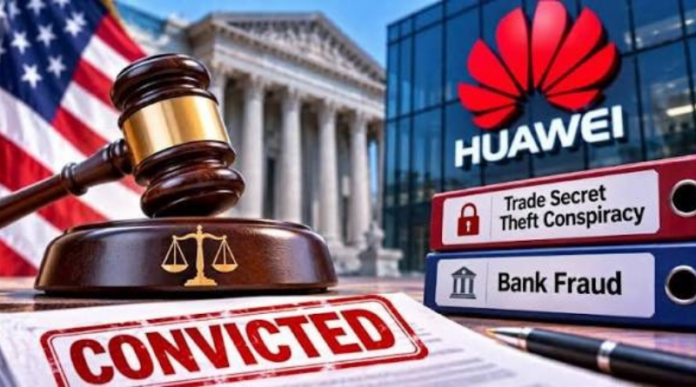

A major legal development in the United States has brought Huawei back into the spotlight after a US jury found the Chinese technology company guilty of conspiracy involving bank fraud and the theft of trade secrets. The decision is another important chapter in the long-running legal and political tensions between the United States and China.
The case highlights serious concerns about business practices, international banking rules, technology competition, and the protection of private company information. It could also create further challenges for Huawei as the company continues to expand its smartphone, telecom equipment, artificial intelligence, and other technology businesses.
The verdict is particularly important because Huawei has already faced several restrictions in the US market. The company has spent years trying to maintain its global position despite export controls, trade restrictions, and security-related concerns raised by American authorities.
What Happened in the Huawei Criminal Case?
The verdict was delivered on November 24, 2026, by a federal jury in Brooklyn, New York. The jury found Huawei guilty on 10 of the 12 criminal counts it faced in the case.
The charges covered several serious issues, including:
Bank fraud and conspiracy to commit bank fraud.
Wire fraud and conspiracy to commit wire fraud.
Conspiracy to steal trade secrets.
Violations of US economic sanctions.
Conspiracy to defraud the United States.
Money laundering conspiracy.
The case also involved three Huawei subsidiaries: Huawei Device Co. Ltd., Futurewei Technologies Inc., and Huawei Device USA Inc.
However, the jury did not find Huawei guilty of every accusation. It acquitted the company of racketeering conspiracy and conspiracy to obstruct justice. This distinction is important because prosecutors had attempted to show that Huawei operated as part of a wider criminal enterprise.
The trial lasted approximately 12 weeks and included testimony from more than 60 witnesses presented by prosecutors and 15 witnesses called by the defence.
Why Did the United States Charge Huawei?
The investigation into Huawei began several years ago. US authorities accused the company of hiding important information about its business activities in Iran and obtaining access to international banking services through misleading statements.
American investigators claimed that Huawei used a company called Skycom to conduct business in Iran. According to prosecutors, Huawei had a much closer relationship with Skycom than it publicly admitted.
The US government also alleged that Huawei continued certain business activities in Iran despite international restrictions.
The main concern was that banks could have faced serious legal problems if they continued providing financial services to a company involved in activities that violated US sanctions.
Prosecutors argued that Huawei gave banks incorrect information about its Iranian operations to maintain access to financial services.
The case also included allegations that Huawei misled US officials and other organisations about its business relationships.
According to the US Department of Justice, the company used these activities to obtain billions of dollars in credit and loans and maintain access to US-dollar financial services.
These allegations became an important part of the criminal case that eventually reached the federal court in Brooklyn.
United States Department of Justice+1
Bank Fraud Allegations Against Huawei
Bank fraud was one of the most important parts of the case.
International technology companies often depend on major banks to manage payments, loans, international transfers, and other financial activities. Companies operating in different countries must also follow international financial regulations.
US prosecutors argued that Huawei provided misleading information to financial institutions about its operations in Iran.
The allegations involved major international banks, including HSBC, Standard Chartered, and BNP Paribas.
According to the prosecution, Huawei misrepresented the relationship between the company and Skycom. It also allegedly made false statements about the nature of its Iranian business and its compliance with international sanctions.
Prosecutors said these statements helped Huawei maintain access to banking services and international financial transactions.
The defence presented a different position. Huawei’s lawyers argued that banks were aware of the company’s activities and continued working with it because they wanted its business.
However, the jury ultimately found Huawei guilty of bank fraud-related offences.
The result is significant because international companies must provide accurate information to banks, particularly when their business operations involve countries facing economic restrictions.
Huawei Accused of Stealing Trade Secrets
Another major part of the trial involved allegations of stealing confidential technology and trade secrets from American companies.
Trade secrets are valuable business information that companies protect to maintain their competitive position. They can include software source code, engineering designs, manufacturing methods, testing equipment, and technical documents.
US prosecutors argued that Huawei obtained confidential technology from several American companies without proper permission.
The government presented examples involving Cisco, T-Mobile, CNEX, and Quintel.
These allegations were not limited to one incident. Prosecutors described several disputes and activities that allegedly took place over more than two decades.
The jury found Huawei guilty of conspiracy to steal trade secrets.
Cisco Router Source Code Allegations
One of the examples presented during the trial involved Cisco Systems.
Cisco develops networking equipment and software used by businesses, internet service providers, and telecommunications companies.
Prosecutors alleged that Huawei copied confidential source code connected to Cisco routers.
Source code is an important part of software development because it contains the instructions that allow a computer programme or networking device to work.
According to the prosecution, Huawei engineers copied parts of Cisco’s code and used them in their own technology.
Prosecutors also presented evidence that Huawei employees referred to Cisco’s name backwards as “ocsic” in internal notes connected to the copied code.
The allegation was important because networking software requires years of research and development. Unauthorised access to another company’s source code can create major financial and competitive advantages.
T-Mobile Testing Robot Case
Another important example involved T-Mobile and a testing robot known as Tappy.
T-Mobile used the robot to test the responsiveness of smartphone touchscreens.
The robot helped engineers understand how smartphone screens responded to different types of touches and movements.
According to the US government, Huawei wanted access to Tappy so that it could develop a similar testing system.
Prosecutors said Huawei signed a non-disclosure agreement with T-Mobile to access the technology but later used information obtained from the arrangement for its own purposes.
The government presented evidence that Huawei employees photographed the robot and shared technical information with colleagues in China.
Prosecutors also alleged that an employee removed a component from the robot and carried it out of the controlled laboratory area.
This incident became one of the most discussed examples during the trial because it involved physical equipment as well as confidential technical information.
CNEX Technology Allegations
The case also involved CNEX, an American semiconductor technology company.
Prosecutors alleged that Huawei wanted access to CNEX’s confidential hardware and technical information.
According to the government, Huawei hired a university researcher to arrange cooperation with CNEX after the company refused to work directly with Huawei.
The prosecution claimed that confidential information was shared through this arrangement.
This included access to proprietary hardware developed by CNEX.
The case highlighted how technology companies must protect their research and development work when dealing with business partners, universities, and outside researchers.
Quintel Antenna Technology Case
Quintel, an American antenna manufacturer, was another company mentioned during the trial.
Prosecutors alleged that Huawei obtained confidential antenna technology from Quintel under a non-disclosure agreement.
They further claimed that Huawei later submitted a patent application involving technology based on Quintel’s confidential ideas.
According to the prosecution, a confidential presentation provided by Quintel was also attached to the patent application.
These examples helped prosecutors build their argument that Huawei had repeatedly obtained technology and confidential information from other companies without proper authorisation.
Huawei Was Acquitted of Racketeering Conspiracy
Although the jury found Huawei guilty on 10 counts, it also rejected two important charges.
One of them was racketeering conspiracy.
Racketeering charges are often used in cases involving organised criminal activity. Prosecutors wanted to establish that Huawei operated as a wider criminal enterprise involved in repeated illegal activities.
However, the jury did not agree with this charge.
Huawei was also acquitted of conspiracy to obstruct justice.
These acquittals were welcomed by Huawei’s legal team.
The company’s lawyer, Brian Heberlig, described the outcome as a major rejection of the government’s wider claims about Huawei’s corporate culture.
The defence argued that prosecutors had combined separate incidents involving individual employees and different business disputes to create a broader criminal narrative.
Huawei’s lawyers also said that some of the trade-secret disputes had already been resolved through civil proceedings.
The acquittals do not cancel the 10 guilty verdicts, but they are an important part of the overall result.
Huawei Plans to Appeal the Verdict
Huawei has rejected the allegations and expressed disappointment with the jury’s decision.
The company said that the charges on which it was convicted lacked legal and factual merit.
Huawei also indicated that it would take further legal action to protect its rights and interests.
Its legal team argued that the government relied on incidents that had been addressed through earlier business disputes.
The company believes its success comes from investment, research, innovation, and hard work rather than the activities described by prosecutors.
Huawei’s lawyer also indicated that the company expected to appeal the convictions.
An appeal could give the company another opportunity to challenge the legal findings. However, the jury’s decision remains in place unless it is changed through the legal process.
The next major development will be the sentencing process, where the court will decide the financial penalties and other consequences.
Huawei Could Face Billions of Dollars in Penalties
The financial impact of the verdict could be significant.
According to US authorities, Huawei and its subsidiaries face possible criminal fines, forfeiture, and restitution.
The final amount has not yet been determined.
US District Judge Ann M. Donnelly is scheduled to sentence the defendants on September 14, 2027.
The potential financial penalties could affect Huawei’s business operations, although the exact impact will depend on the court’s final decision.
For a company with operations across international markets, a major financial penalty could create additional pressure.
However, Huawei has a large global business and multiple sources of revenue. Its activities include telecommunications equipment, smartphones, cloud services, digital infrastructure, and semiconductor development.
This means the verdict does not automatically suggest that Huawei will stop operating or selling products in international markets.
What Does the Verdict Mean for Huawei’s Global Business?
Huawei is one of the world’s largest telecommunications equipment manufacturers. The company has built a strong position in mobile networks, smartphones, enterprise technology, and digital infrastructure.
However, its relationship with the United States has been difficult for several years.
In 2019, the US government placed Huawei on its Entity List, restricting its access to certain American technology and products.
These restrictions created challenges for Huawei’s smartphone business, particularly its access to Google services and some advanced semiconductor technologies.
Despite these problems, Huawei continued investing in its own technology.
The company expanded its smartphone operations, developed its HarmonyOS ecosystem, and increased its focus on domestic chip development.
It has also become an important company in China’s efforts to build alternatives to foreign artificial intelligence chips.
The latest guilty verdict could create further pressure on its international business relationships.
Some governments and businesses may review their dealings with Huawei because of the legal findings.
However, the actual effect will depend on how different countries and international companies respond.
Could the Verdict Affect Huawei Smartphones?
For ordinary smartphone buyers, the most important question is whether this decision will affect Huawei devices.
At present, the verdict does not automatically mean that Huawei smartphones will stop working or that existing devices will lose their features.
The company can continue developing and selling products according to the rules of the markets where it operates.
However, the legal outcome could influence the company’s future international partnerships and business plans.
Huawei already faces restrictions in accessing some American technologies. Further legal pressure could make certain international business arrangements more complicated.
For consumers in Pakistan, there is no reason to assume that Huawei phones will immediately disappear from the local market because of this verdict.
Availability, software support, warranty services, and future product launches will depend on Huawei’s business decisions and applicable local regulations.
Pakistani buyers should continue checking official product announcements and local availability rather than assuming that the US court decision directly affects local smartphone sales.
China Reacts to the US Court Decision
The verdict has also created another diplomatic issue between Washington and Beijing.
China has repeatedly criticised American restrictions against its technology companies.
Following the Huawei decision, China’s Foreign Ministry said that Beijing firmly opposed what it described as US efforts to suppress and contain Chinese companies.
Chinese officials also said that the government supports Chinese businesses in protecting their legitimate rights and interests.
The disagreement reflects the wider technology competition between the two countries.
The United States has raised concerns about national security, international sanctions, and the protection of sensitive technology.
China, on the other hand, has argued that American restrictions are unfair and harm Chinese businesses.
The Huawei case has therefore become more than a legal dispute between a company and the US government. It also reflects the growing competition between the world’s two major technology economies
What Happens Next?
The next stage will focus on sentencing and the possibility of an appeal.
Huawei and its subsidiaries will have to deal with the consequences of the 10 guilty verdicts unless the results are changed through further legal proceedings.
The sentencing hearing is scheduled for September 14, 2027.
The court will consider the relevant legal factors before deciding the financial penalties and other consequences.
At the same time, Huawei is expected to continue defending itself through the legal system.
The company will also need to maintain its global business while dealing with the possible financial and reputational impact of the verdict.
Technology companies around the world will be watching the case because it highlights the importance of following banking regulations, international sanctions, and intellectual property laws.
Conclusion
The US jury’s decision to find Huawei guilty on 10 criminal counts is a major development in the company’s long-running legal battle with American authorities.
The verdict includes bank fraud, wire fraud, sanctions violations, money laundering conspiracy, and conspiracy to steal trade secrets.
However, Huawei was acquitted of racketeering conspiracy and conspiracy to obstruct justice, giving the defence important grounds to highlight the parts of the case it successfully challenged.
Huawei plans to appeal the convictions, while the company and its subsidiaries are scheduled to face sentencing in September 2027.
The long-term impact remains uncertain, but the decision could affect Huawei’s finances, international reputation, and future business relationships.
For now, Huawei continues to operate in global technology markets, and the next important development will be the court’s final sentencing decision.
Frequently Asked Questions (FAQs)
1. Why did a US jury find Huawei guilty?
The jury found Huawei guilty of 10 criminal counts involving bank fraud, wire fraud, sanctions violations, money laundering conspiracy, and conspiracy to steal trade secrets.
2. When was Huawei found guilty in the United States?
The verdict was delivered on November 24, 2026, in a federal court in Brooklyn, New York.
3. How many charges did Huawei face?
Huawei faced 12 criminal counts. The jury found the company guilty on 10 counts and acquitted it on two.
4. Did Huawei steal technology from American companies?
US prosecutors presented evidence involving Cisco, T-Mobile, CNEX, and Quintel. The jury found Huawei guilty of conspiracy to steal trade secrets.
5. What was the Huawei bank fraud case about?
Prosecutors accused Huawei of misleading international banks about its business activities in Iran and its relationship with a company called Skycom.
6. Will Huawei appeal the US jury verdict?
Yes. Huawei’s lawyer said that the company expected to appeal the convictions.
7. How much money could Huawei pay in penalties?
Huawei could face significant financial penalties, potentially reaching billions of dollars. However, the final amount has not been announced.
8. When will Huawei receive its sentence?
Huawei and the relevant subsidiaries are scheduled to be sentenced on September 14, 2027.
9. Will this decision affect Huawei smartphones in Pakistan?
The verdict does not automatically stop Huawei smartphone sales in Pakistan. Local availability and services will depend on the company’s business operations and local regulations.
10. Was Huawei found guilty of racketeering conspiracy?
No. The jury acquitted Huawei of racketeering conspiracy and conspiracy to obstruct justice, although it convicted the company on 10 other counts.