
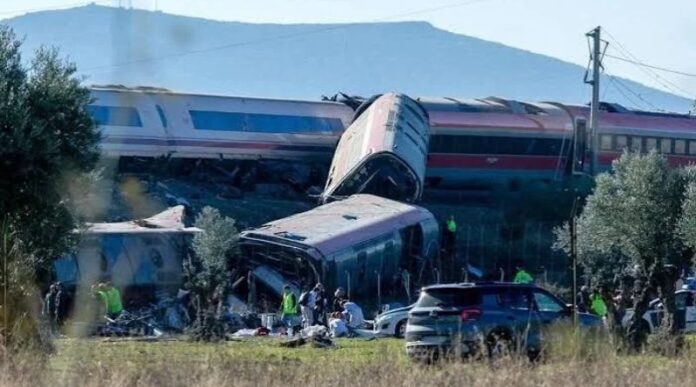

A deadly collision between two high-speed trains in Spain has claimed at least 64 lives, according to local authorities. The tragic accident took place on Wednesday, October 28, 2026, in the central region of Castilla-La Mancha, leaving dozens of people injured and causing major damage to the country’s railway network.
Emergency workers rushed to the crash site to rescue passengers trapped inside damaged carriages and provide medical assistance to survivors. Officials have warned that the death toll could rise further as rescue teams continue their work and search through the wreckage.
The accident involved two high-speed trains operated by Spain’s state-owned railway company Renfe and private railway operator Iryo. Initial reports indicated that the Renfe train struck the rear of an Iryo train that had stopped on the tracks. The impact caused several carriages to derail, with some falling down a railway embankment.
The disaster has shocked Spain and raised fresh concerns about railway safety. It is also the second major deadly train accident to hit the country in 2026.
Death Toll Reaches 64 After Deadly Train Crash
Authorities in Castilla-La Mancha confirmed that the number of people killed had reached 64. Regional officials said the situation remained serious, with rescue workers still dealing with the results of the powerful collision.
Emiliano García-Page, the president of Castilla-La Mancha, described the incident as a terrible tragedy. He warned that the final death toll might increase as emergency teams continued to examine the damaged trains and search areas where passengers had been trapped.
More than 80 people were reported injured in the accident, although figures varied between early reports. Many injured passengers required medical treatment, and some were reported to be in critical condition.
The scale of the damage made rescue work difficult. Several train carriages were badly damaged, while twisted metal and scattered debris covered parts of the accident site. Emergency workers had to reach passengers in the most heavily damaged sections before they could fully assess the situation.
Officials said their immediate priority was to save lives, treat the injured and recover people who remained trapped inside the trains.
Two High-Speed Trains Involved in the Collision
The accident happened on a railway line serving routes between Madrid and southern Spain. Both trains were travelling in the direction of Seville when the collision occurred.
One train belonged to Renfe, Spain’s state-owned railway operator, while the other was operated by Iryo, a private company that runs high-speed passenger services.
According to initial information, the Iryo train had stopped on the track before the Renfe train struck it from behind. The impact was powerful enough to derail carriages and throw parts of the trains off the railway line.
The Iryo train was carrying 147 passengers and five staff members, including the driver, according to information released by the company. The Renfe train was carrying hundreds of passengers, with regional officials reporting that around 397 passengers were on board.
These figures show how many people may have been affected by the disaster. However, the exact circumstances of the collision and the movements of both trains remained under investigation.
The accident occurred near Urda in Toledo province, in an area between local towns surrounded by open land and olive fields. The location and the condition of the damaged carriages created additional challenges for emergency teams working at the scene.
Emergency Teams Race to Save Passengers
Rescue operations began shortly after the collision was reported. Firefighters, police officers, ambulance crews and other emergency workers were sent to the site to help passengers and search the wreckage.
Medical helicopters were also used to support the emergency response. Ambulances transported injured people to nearby hospitals, while passengers who escaped serious injury were helped away from the damaged trains.
Some carriages were left in extremely poor condition, making it difficult for rescuers to reach everyone inside. Emergency workers had to move carefully through the wreckage to avoid causing further harm to trapped passengers.
The regional government activated its emergency response plan to coordinate rescue efforts and provide support to the injured and their families.
Local communities also offered help. Authorities in nearby areas made arrangements to receive passengers who had escaped the crash and needed temporary shelter or assistance.
The rescue operation involved several emergency services working together under difficult conditions. Officials continued to focus on locating missing passengers, identifying victims and ensuring that injured people received the treatment they needed.
The full impact of the crash was not immediately clear, and authorities urged the public to rely on official updates as more information became available.
More Than 100 People Reported Injured
Along with the deaths, the collision left many passengers injured. Regional authorities reported that more than 80 people had suffered injuries, while some early reports gave different figures as emergency teams continued their work.
Several injured passengers were taken to hospitals across the region. Some needed urgent medical care because of the serious nature of their injuries.
Health workers and emergency staff worked to manage the growing number of patients. Hospitals were asked to provide treatment to those arriving from the crash site, while rescue teams continued to bring people to safety.
Passengers who survived the collision described a frightening experience. One passenger told Spanish radio that people had been unable to escape from the damaged trains and that the scene was extremely disturbing.
Such accounts highlight the fear and confusion experienced by passengers during the accident. Many people were travelling for ordinary reasons when the collision suddenly turned their journey into a life-threatening situation.
Authorities were also working to identify those who had died and contact their families. This process can take time after a major disaster, particularly when victims have suffered serious injuries or are trapped in damaged carriages.
Cause of the Accident Under Investigation
The exact cause of the collision had not been officially established when the latest reports were published.
Initial information suggested that the Renfe train struck the rear of the stationary Iryo train. However, investigators will need to examine railway records, signalling information, train movements and other evidence before reaching a firm conclusion.
Railway safety experts are expected to look at whether the trains received the correct signals and whether the systems responsible for controlling their movements worked properly.
They may also examine communications between train drivers and railway control staff. Information from the trains’ technical systems could help investigators understand what happened in the moments before the crash.
Some early reports raised the possibility of human error. However, this possibility should not be treated as a confirmed explanation until the investigation establishes the facts.
A proper investigation will be important for identifying what went wrong and determining whether any changes are needed to prevent a similar accident in the future.
Officials have focused on rescue and recovery work while the investigation continues. More information about the cause may become available after investigators have examined the site and reviewed the available evidence.
Train Services Suspended on Major Routes
The collision also caused serious disruption to railway services in Spain. Renfe confirmed that services connecting Madrid with Ciudad Real and Andalusia had been suspended following the accident.
The affected route is an important part of Spain’s high-speed railway network. It connects the capital with destinations in the southern part of the country and is used by both local and long-distance passengers.
The suspension was necessary to allow emergency teams to work safely and authorities to examine the damaged trains and railway line.
Passengers planning to travel through the affected areas faced delays, cancellations and uncertainty. Railway operators were expected to provide further information as the situation developed.
People with planned journeys were advised to check official railway announcements before travelling. Alternative arrangements could be necessary until services resume.
The disruption also affected people travelling for work, family visits and other commitments. Because high-speed trains carry large numbers of passengers, an accident of this scale can affect journeys well beyond the immediate crash site.
Railway officials will need to assess the condition of the tracks and confirm that the route is safe before normal services can return.
Spanish Government Responds to the Disaster
Spanish Prime Minister Pedro Sánchez expressed shock over the collision and offered support to the victims and their families.
He said emergency services were working at the site to assist affected passengers and coordinate the response. The prime minister also indicated that the situation was being closely monitored.
Sánchez cancelled his scheduled engagements to focus on the emergency. His office said he was travelling to the crash site to support the response and meet those involved in the rescue effort.
Spain’s royal household also expressed sadness and concern over the accident, sending condolences to the families of those who had died and support to the injured.
European leaders shared messages of sympathy as news of the disaster spread. European Commission President Ursula von der Leyen expressed support for the victims and their loved ones, while other officials offered condolences to Spain.
The accident also led to changes in planned public events. Spain’s football federation postponed 24 Copa del Rey matches scheduled for Wednesday as a sign of respect for those affected.
These responses reflected the seriousness of the tragedy and the widespread concern over the loss of life.
Spain Faces Another Major Train Disaster
The latest collision comes only months after another deadly high-speed train accident in Spain.
In January 2026, a collision near Adamuz in the southern province of Córdoba killed 46 people and injured more than 120 others. That accident involved an Iryo train that derailed and collided with a Renfe train travelling in the opposite direction.
The January disaster raised questions about railway safety and the condition of the country’s rail infrastructure. Its investigation remained an important issue as Spain dealt with the new accident.
The October collision has added to those concerns. Both disasters involved trains operating on routes connecting Madrid with southern Spain, although the circumstances of the two accidents were different.
The repeated loss of life has increased pressure on railway authorities to establish the causes of the crashes and explain what measures can help protect passengers.
However, investigators must assess each accident separately. The fact that two serious incidents occurred in the same year does not, by itself, prove that they had the same cause.
The findings of both investigations may help authorities identify safety problems and decide whether additional checks, repairs or changes to railway operations are required.
Spain’s High-Speed Railway Network Under Scrutiny
Spain has invested heavily in high-speed rail over several decades. Its extensive network connects major cities and allows passengers to travel long distances in less time than many traditional train services.
The system is an important part of the country’s transport network. It supports business travel, tourism and everyday journeys between cities.
Spain has built thousands of kilometres of high-speed railway lines, making its network one of the largest in the world. The country has also opened parts of its passenger rail market to private companies, allowing them to compete with Renfe.
Iryo is one of the private operators serving passengers on high-speed routes. Competition has provided travellers with more choices, but it has also increased attention on how the railway network is managed and maintained.
Some railway workers have raised concerns about whether infrastructure maintenance has kept pace with growing traffic. They have argued that busy railway lines require regular inspections and sufficient investment to remain safe.
These concerns do not establish that maintenance problems caused the latest collision. Investigators will need to determine whether infrastructure, signalling, operating decisions or another factor played a role.
Still, the accident has renewed public interest in railway safety. Passengers expect high-speed services to offer not only fast travel but also reliable protection against serious accidents.
What Happens Next?
The immediate priority remains helping survivors, recovering victims and supporting families affected by the disaster. Emergency teams must complete their work before authorities can fully assess the damage and begin restoring normal railway operations.
Investigators will then continue examining the trains, tracks and available technical records. Their findings should help explain how the collision happened and whether any safety failures contributed to it.
The final number of deaths and injuries may also change as officials complete the identification process and provide updated information.
For now, the crash stands as one of Spain’s most serious railway disasters in recent years. The loss of at least 64 lives has left families grieving and communities shocked, while many injured passengers face a difficult recovery.
The tragedy has also renewed questions about the safety of high-speed rail travel and the steps needed to protect passengers. Authorities will face pressure to provide clear answers and take suitable action once the investigation is complete.
As rescue and recovery operations continue, Spain is mourning those who lost their lives in the collision. The country now faces the difficult task of supporting the victims, understanding what happened and working to reduce the risk of another disaster.
Read Also: check