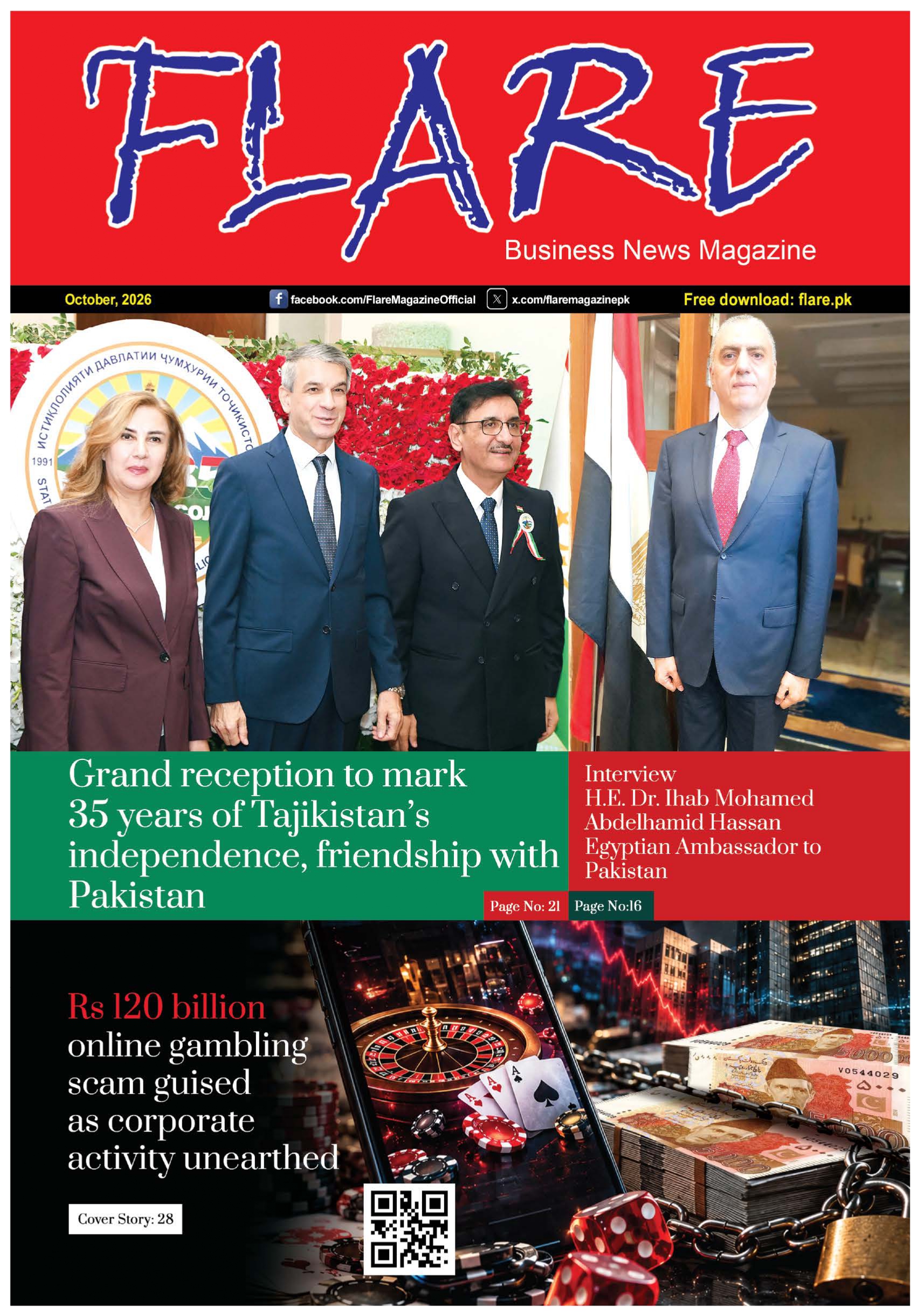

Interview:
H.E. Dr. Ihab Mohamed Abdelhamid Hassan,
Egyptian Ambassador to Pakistan
The Flare team had the opportunity to engage in an exclusive interview with H.E. Dr. Ihab Mohamed Abdelhamid Hassan, the Egyptian Ambassador to Pakistan. He expressed that a significant achievement has been creating increased momentum in the bilateral relationship and laying a strong foundation for a broader and mutually beneficial Egypt-Pakistan partnership. In addition, he has focused on enhancing high-level political dialogue, expanding trade and investment possibilities, strengthening defence and security cooperation, and promoting educational, cultural, and personal exchanges.
Flare: What have been your key diplomatic priorities and major achievements as Ambassador of Egypt to Pakistan?
Ambassador: Since I have taken on the role of Ambassador, my primary objective has been to enhance the robust political alliance between Egypt and Pakistan while converting our remarkable political rapport into more substantial collaborative efforts. As a result, I have concentrated on amplifying high-level political discussions, increasing trade and investment opportunities, intensifying defence and security collaboration, and fostering more educational, cultural, and interpersonal exchanges.
I view the sustained progress of high-level interaction between our nations as particularly noteworthy, especially with the recent trip by Pakistan’s Deputy Prime Minister and Foreign Minister to Cairo, along with the successful 10th Round of Annual Bilateral Consultations. Additionally, we have collaborated closely to explore new avenues for private-sector partnerships and to fortify the institutional structures that facilitate our economic ties. Concurrently, the rise in Al-Azhar scholarships for Pakistani students from 30 to 50 represents a significant step forward in our educational and cultural connections. In summary, I believe one of our key accomplishments has been to generate greater momentum within our relationship and establish a solid groundwork for a more extensive and mutually advantageous Egypt-Pakistan alliance.
Flare: What outcomes are expected from the 10th Round of Annual Bilateral Consultations, and what high-level visits are planned?
Ambassador: The 10th Round of Annual Bilateral Consultations served as a significant occasion to thoroughly assess our bilateral relationship and, crucially, to convert our political understanding into specific areas of collaboration. The dialogue addressed various topics, including trade and investment, education, culture, science, information technology, and people-to-people interactions, alongside regional and international matters. Both parties recognised the necessity of enhancing and diversifying cooperation further while sustaining the momentum of high-level interactions. We also determined that the next round of consultations would take place in Cairo, underscoring our dedication to maintaining a regular institutional dialogue.
At the leadership level, President El-Sisi has accepted Prime Minister Shehbaz Sharif’s invitation to visit Pakistan at a mutually suitable time, which underscores the strength and positive direction of our bilateral relations. Regarding other visits, we are in ongoing communication with the Pakistani side, and any forthcoming visit will be officially announced once the pertinent arrangements have been completed.
Flare: What is the current Pakistan-Egypt trade volume, growth target and key barriers to expanding bilateral trade?
Ambassador: I fully agree that our trade relationship has not yet reached the level that corresponds to the strength of our political relations or the size and potential of our economies. Bilateral trade in recent years has remained below $300 million, which shows stability but also demonstrates how much room there is for growth. In my view, we should first aim to double our trade and reach at least $500 million, while creating the conditions to move towards the $1 billion level over the longer term.
The main challenge is not the absence of opportunities, but rather the need to connect our private sectors more effectively, diversify the products we trade, improve market access, and address practical issues related to customs, logistics, regulations, and business information. We also need more business delegations, trade fairs and direct engagement between companies. If we can move from government-to-government relations towards stronger business-to-business relations, I believe the trade relationship can grow considerably faster.
Flare: Which sectors offer the greatest opportunities for Egyptian and Pakistani businesses, and what new investments or joint ventures are being considered?
Ambassador: There is considerable complementarity between the two economies, and I see opportunities across almost all of the sectors mentioned. Agriculture and food security are particularly promising, as are pharmaceuticals, textiles, energy, construction, information technology and tourism. Pakistan has strong capabilities in agriculture, textiles, pharmaceuticals and IT, while Egypt offers a large market, a strategic geographic location, a developed infrastructure base and access to Arab, African and European markets.
We are also particularly interested in encouraging joint ventures and investment rather than limiting the relationship to the exchange of goods. There are ongoing discussions and expressions of interest involving sectors such as textiles, food processing, batteries, electric mobility, telecommunications and other areas. Egypt is also keen to encourage Pakistani investors to explore opportunities in the Suez Canal Economic Zone, while Egyptian companies can benefit from opportunities available in Pakistan. Our objective is to move progressively from simply trading with each other towards producing, investing and creating value together.
Flare: Direct air connectivity could enhance tourism, trade and relations. Is there any plan for direct flights between Cairo and Islamabad, Karachi or Lahore, and what actions are being taken to promote tourism both ways?
Ambassador: I completely agree that direct air connectivity would be a major catalyst for our bilateral relationship. At present, there are no direct scheduled flights between Cairo and Islamabad, and improving connectivity remains an important objective because easier travel would benefit tourism, business, education and people-to-people contacts simultaneously. Establishing a direct route, however, requires coordination between the relevant aviation authorities and airlines and must be based on commercially and operationally viable arrangements.
In parallel, we are working to promote tourism through greater engagement between tourism authorities, travel agencies and the private sector, as well as through cultural and promotional activities. Egypt has strong appeal for Pakistani visitors because of its history, Islamic heritage and Red Sea destinations, while Pakistan has enormous potential for Egyptian visitors because of its natural beauty, historical heritage and cultural diversity. So, while direct connectivity would certainly be desirable, we should also continue building the tourism relationship through the channels available to us today.
Flare: Al-Azhar University has longstanding educational and religious links with Pakistan. How many scholarships are currently offered, and what opportunities exist for expanding university partnerships, research, student exchanges, cultural activities and media cooperation?
Ambassador: Al-Azhar represents one of the most enduring and important bridges between Egypt and Pakistan. The relationship is not only educational; it has created generations of human connections between our two countries. Most recently, Al-Azhar increased the number of scholarships available to Pakistani students from 30 to 50 annually, which is a positive development that reflects Egypt’s commitment to strengthening this longstanding relationship.
However, I believe our educational cooperation should go beyond scholarships. There is considerable scope for developing partnerships between universities, joint research programmes, academic exchanges, Arabic-language programmes and cooperation in science and technology. We can also strengthen cultural and media cooperation to give our peoples a better understanding of each other’s societies and history. Education is one of the areas where the investment we make today produces benefits for the relationship for decades to come.
Flare: Pakistan and Egypt collaborate via the United Nations, OIC, D-8 and other international platforms. How can they enhance cooperation in defence, counterterrorism, maritime security and regional stability in South Asia, the Middle East and the Red Sea?
Ambassador: Egypt and Pakistan occupy strategically important positions in their respective regions, and this gives our cooperation a significance that goes beyond the bilateral relationship. In defence and counterterrorism, we can further strengthen military exchanges, joint exercises, training and the sharing of experience in confronting common security threats. Maritime security is another area where there is significant potential, particularly given Egypt’s position on the Suez Canal and Red Sea and Pakistan’s strategic position on the Arabian Sea. Greater cooperation in maritime security, protection of international shipping routes and combating transnational crime can contribute to the security of international trade and regional stability.
At the diplomatic level, our coordination through the United Nations, OIC and D-8 allows us to exchange assessments and support positions that promote peace and stability. I believe Egypt and Pakistan can serve as important bridges between the Middle East and South Asia, and closer strategic coordination between us can contribute to stability in both regions. Recent ministerial consultations have also reaffirmed the two countries’ commitment to strengthening security and defence cooperation.
Flare: How can Pakistan and Egypt strengthen cooperation on Gaza, humanitarian access, reconstruction and a lasting political solution?
Ambassador: Egypt highly values Pakistan’s principled and consistent support for the legitimate rights of the Palestinian people and its longstanding commitment to the Palestinian cause. Our two countries share the fundamental position that the Palestinian issue cannot be resolved through humanitarian assistance alone; it requires a credible political process leading to a just and lasting peace. Egypt will continue to play its role in facilitating humanitarian assistance and supporting efforts to alleviate the suffering of the Palestinian people, and we welcome Pakistan’s support in this regard.
There is also considerable scope for our two countries to coordinate more closely in international forums, particularly the United Nations and the OIC, to mobilise greater international support for humanitarian access and reconstruction. At the same time, Egypt can support Pakistan’s humanitarian efforts aimed at establishing the necessary conditions for reconstruction and restoring essential services in Gaza. Ultimately, however, the objective must remain a political solution based on international law and the relevant United Nations resolutions, leading to an independent Palestinian state with East Jerusalem as its capital.
Flare: What are the current Egyptian visa fees and procedures for Pakistani travellers, including processing times, refunds, tracking and complaints?
Ambassador: I fully understand the importance of this question, as visa procedures directly impact tourism, education, business and people-to-people contacts. I would like to stress that visa fees are collected only upon the approval of the application, not prior to that. The standard processing time is approximately two to three weeks.
Regarding the visa fee structure, we have three main categories:
- Single-entry tourist visa: PKR 12,000
- Multiple-entry tourist visa: PKR 26,000
- Single-entry visit/business visa: PKR 26,000
Additionally, to facilitate travel, Pakistani travellers holding a valid and used visa for the United States, the United Kingdom, the Schengen Area, Australia, Canada, Japan or New Zealand are eligible to obtain a visa on arrival.
Flare: Looking ahead, what are your main priorities for Pakistan-Egypt relations over the next three to five years, and what message would you like to convey to the Government, business community and people of Pakistan?
Ambassador: Looking at the next three to five years, I would like to see Egypt-Pakistan relations move from a strong traditional friendship into an even more dynamic and comprehensive strategic partnership. Our priorities should be clear: substantially increase bilateral trade and investment, strengthen private-sector and joint-venture cooperation, improve air and tourism connectivity, expand educational and cultural exchanges, and deepen defence and security cooperation.
We should also make greater use of the strategic positions of Egypt and Pakistan to connect our respective regions and open new channels for trade, investment and economic cooperation. At the political level, we will continue our close consultations on regional and international issues, particularly those affecting peace and stability in the Middle East and South Asia.
My message to the government and people of Pakistan is that Egypt sees Pakistan not only as a longstanding friend, but as a partner with whom we can build much more in the future. We have the political will, the historical foundations and the economic complementarities, and what we need now is to translate these advantages into concrete projects, stronger business links and greater contact between our peoples. I am confident that, if we maintain this momentum, the next chapter of Egypt-Pakistan relations can be significantly stronger than the last.