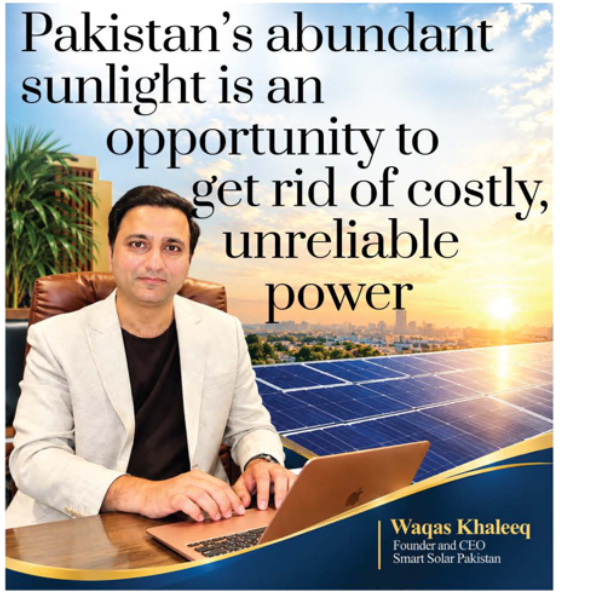

Waqas Khaleeq
Founder and CEO
Smart Solar Pakistan
Pull Quote:
“The Flare team had an opportunity to talk to Waqas Khaleeq, the Founder and CEO of Smart Solar Pakistan. He mentioned that Pakistan requires steady policies, clear net-billing rules, enforceable safety and product standards, certified installer systems, and quicker approval processes. Banks need to create useful green-finance options, and the industry must improve responsibility for design quality and after sales support”
Interview Transcript
Flare: What inspired you to establish Smart Solar?
Waqas Khaleeq: My professional journey began with a simple observation: Pakistan has abundant sunlight, yet families and businesses face expensive and unreliable electricity. I founded Smart Solar in 2010 to turn this conflict into an opportunity. My mathematics background helped me approach energy problems analytically, while working with customers taught me that technology alone is not enough; execution, transparency, and dependable after-sales support matter equally. My motivation remains to make clean energy practical, trustworthy, and accessible.
Flare: How do you assess Pakistan’s solar sector and its next five years?
Waqas Khaleeq: Pakistan’s solar sector has moved from early adoption to mass-market relevance. High tariffs, grid constraints, and falling technology costs have made solar an economic decision, not merely an environmental preference. The next five years will focus less on panel sales and more on complete energy solutions, including hybrid inverters, battery storage, intelligent load management, and commercial and industrial systems. The opportunity is enormous, but rapid growth also attracts underqualified installers and low-quality products.
Flare: How is Smart Solar supporting Pakistan’s transition to clean energy?
Waqas Khaleeq: Smart Solar helps customers move from electricity dependence towards energy control. We design and deliver grid-tied, hybrid, and storage-backed systems for homes, farms, offices, and industries based on actual consumption and operational priorities. For industrial clients, we focus on reducing energy costs without compromising safety, uptime, or power quality. For households, we explain realistic savings, backup capability, and changing net-billing rules. This combination of EPC execution and public education encourages informed adoption.
Flare: What distinguishes Smart Solar from other providers?
Waqas Khaleeq: We operate as an engineering, procurement, and construction company, not simply an equipment reseller. We assess site conditions, load profiles, shading, structures, protection, future expansion, and financial objectives before recommending a system. Our teams use professional design and simulation tools, select bankable equipment, follow documented installation practices, and provide monitoring and after-sales support. Our experience across Pakistan means our processes reflect different climates, grid conditions, and customer needs. Most importantly, we communicate limitations honestly.
Flare: How is Smart Solar using digital technology and smart energy management?
Waqas Khaleeq: We use digital design, simulation, and remote monitoring platforms throughout the project cycle. Software helps assess generation, losses, shading, and equipment compatibility, while online monitoring identifies performance trends and faults. We are also integrating smarter energy management to prioritise solar consumption, battery charging, backup loads, and grid interaction. Digital workflows improve surveying, coordination, documentation, and service response.
Flare: What challenges Pakistan’s renewable-energy sector, and what reforms are needed?
Waqas Khaleeq: Key challenges include policy uncertainty, weak financing, inconsistent standards, variable equipment quality and a shortage of skilled installers. Pakistan needs stable policies, transparent net-billing rules, stronger safety standards, certified installers, streamlined approvals and accessible green financing. Industry must also ensure quality design and after sales service.
Flare: What advice would you give first-time solar customers?
Waqas Khaleeq: Start with 12 months of electricity data, not a salesperson’s package. Identify daytime and nighttime loads and decide whether your priority is savings, backup, or energy independence. Compare proposals on engineering, safety, warranties, installation, and service—not just price per watt. Verify the installer, product authenticity, and system compatibility. Industrial customers should also assess structural capacity, power quality, shutdown planning, and expected generation through a proper feasibility study.
Flare: How does Smart Solar contribute to sustainability and climate goals?
Waqas Khaleeq: Every well-performing solar installation displaces electricity that would otherwise come from fossil-fuel-based generation and reduces pressure on energy imports. Through more than 130 MW of delivered capacity, Smart Solar has helped homes and businesses reduce operating emissions while improving energy resilience. We promote high-efficiency equipment, responsible system sizing, long service life, and preventive maintenance because sustainability depends on lifetime performance. Our public education also encourages energy conservation and informed adoption.
Flare: How will AI, battery storage, and smart grids shape Pakistan’s renewable energy future?
Waqas Khaleeq: These technologies will reshape the sector. Battery storage can turn solar into a more flexible source of backup and energy independence. AI can improve demand forecasting, fault detection, predictive maintenance, and decisions about when to charge, consume, or export energy. Smart grids can coordinate distributed assets while maintaining network stability. However, software cannot compensate for poor hardware or unsafe installation. Pakistan needs interoperable standards, cybersecurity, accurate metering, trained technicians, and sensible tariff signals.
Flare: How is Smart Solar developing skilled professionals and employment?
Waqas Khaleeq: Smart Solar has built multidisciplinary teams in engineering, project management, procurement, sales, monitoring, and field services. We train employees through live projects, safety procedures, manufacturer knowledge, design tools, and supervision. Our projects also create indirect jobs for technicians, fabricators, transporters, and local service partners. Through educational content and industry engagement, I also help young professionals understand solar technologies and practices.
Flare: How can government, industry, finance, and education accelerate renewable energy adoption?
Waqas Khaleeq: Government needs stable rules and standards; industry must ensure quality and transparency; financial institutions should improve affordability; and educational institutions must develop skilled professionals and local research. Collaboration should focus on certified installers, accessible financing, shared performance data, and storage and smart grid pilots. Universities and banks can also work with EPC companies using real project data and verified performance criteria.
Flare: What is your message to businesses, policymakers, investors, and young entrepreneurs about clean energy?
Waqas Khaleeq: Clean energy is becoming core economic infrastructure. Businesses should view efficiency and distributed generation as competitiveness tools, while policymakers need consistency. Investors can explore EPC, storage, financing, software, recycling, and local technical capabilities. For young entrepreneurs, the sector offers strong potential, but success requires knowledge, ethics, and execution. Pakistan has the sunlight, demand, and talent to build a strong clean-energy economy.