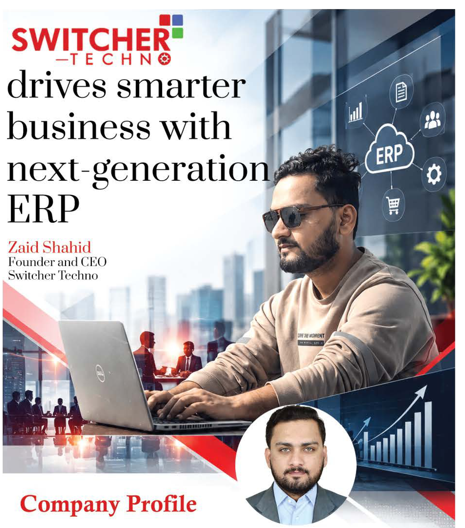

Zaid Shahid
Founder and CEO
Switcher Techno

Company Profile & Interview Transcript
AmalERP is an all-in-one cloud ERP developed by Karachi-based Switcher Techno, operating since 2010. It integrates accounting, inventory, offline-capable POS, manufacturing, payroll, and business intelligence in one browser-based system for small and mid-sized businesses.
The platform offers built-in tax compliance for Pakistan, Saudi Arabia, and the UAE, WhatsApp-enabled business documents, and POS billing during internet outages. Pricing starts at Rs 2,500 per month, billed annually, with a seven-day free trial and no implementation fee.
Its AI features include a business assistant, AI-assisted data entry, cash-flow forecasting, inventory intelligence, and risk alerts. More than 500 businesses across Pakistan and the Gulf use AmalERP, including the Hashwani Group, Gota Plastic Industry, Popular Marble Industries and Star Chem Pakistan.
Switcher Techno is registered with PSEB and PASHA and is an FBR- and SRB-registered company.
Here is a Q&A session Flare held with Zaid Shahid, Founder and CEO of Switcher Techno.
Flare: What gap did you address when you founded Switcher Techno in 2010?
Zaid Shahid: I started Switcher Techno after seeing small and mid-sized businesses relying on registers, files, and Excel. Owners knew their businesses, but obtaining accurate sales, stock, or earnings figures could take days.
For a decade, we developed desktop software for retail, restaurants, manufacturing, distribution, hospitals, schools and pharmacies, as well as FBR digital invoicing. AmalERP emerged when the desktop model became limiting: data was tied to individual machines, branches operated separately and tax changes required physical visits. It represents 15 years of domain knowledge rebuilt for the cloud and Pakistani business practices.
Flare: Why did SMEs need a local ERP?
Zaid Shahid: Three problems stood out. Accounts often lagged behind reality, international ERPs were too costly and complex, and local tax compliance such as FBR digital invoicing and SRB needed to be built into the system rather than added later.
Pakistani businesses also rely heavily on WhatsApp for orders, payments and customer queries. Software must reflect that reality.
Flare: How does AmalERP differ from international solutions?
Zaid Shahid: FBR digital invoicing and SRB are built into the core. Invoices, receipts and statements can be sent via WhatsApp as branded PDFs, while the POS continues billing during internet outages and syncs afterwards.
Pricing starts at Rs 2,500 per month, billed annually, with no implementation fee. Customers receive a seven-day free trial without a credit card and remote onboarding. SAP and Oracle are excellent systems, but they are not our competition. We compete with registers, Excel and outdated desktop software.
Flare: How do you address cost, complexity and resistance to change?
Zaid Shahid: Pricing is published openly, while our modular approach lets businesses start with what they need and add modules as they grow.
Resistance to change is addressed by meeting users where they are. A shopkeeper may not know accounting software but is comfortable with WhatsApp. When an invoice reaches a customer through WhatsApp in the business’s branding, the value becomes clear. That first success encourages wider adoption.
Flare: Who uses AmalERP, and what results have they achieved?
Zaid Shahid: More than 500 businesses use AmalERP across manufacturing, textiles, retail, wholesale, marble and stone, plastics, pharmacies, restaurants, food processing and IT services in Pakistan and the Gulf, including Kuwait and Bahrain.
The Hashwani Group’s eight export companies and 140 users across 11 locations reduced group consolidation from 12 days to 40 minutes. Month-end closing fell from 15 days to five, export documentation from six hours to 20 minutes, and the shipment-to-LC payment cycle from 45 days to 15. Stock variance fell from nine per cent to 0.9 per cent, around PKR 80 million in working capital was released from inventory, and monthly tax compliance work dropped from 60 hours to six. The investment paid for itself in four months.
At Popular Marble Industries, stock is tracked by size in square feet, improving item and size level profitability. At Gota Plastic industry, one ledger covers raw material purchases, production, costing and payroll without re-entry.
Flare: How does AmalERP protect customer data?
Zaid Shahid: AmalERP runs on Google Cloud and Firebase, with daily backups. Security includes two-factor authentication, role-based permissions and a complete audit trail. Posted invoices cannot simply be deleted; corrections are made through credit and debit notes. Switcher Techno is registered with PSEB and PASHA and is an FBR- and SRB-registered company. Formal information security certification remains on our roadmap.
Flare: How is AI shaping AmalERP?
Zaid Shahid: AI is already live through an assistant that answers questions about business data, AI Studio, AI-assisted data entry, cash-flow forecasting, inventory intelligence and automated risk alerts.
We are also developing a WhatsApp-native ERP, allowing users to enter data and manage their business through WhatsApp. They could record sales, check customer balances or analyse margin changes without learning another interface.
Flare: What is holding Pakistan back as a SaaS exporter?
Zaid Shahid: Four issues stand out: payment gateways, funding, marketing and the shortage of sustainable product companies. Collecting recurring international payments remains difficult, while product companies need patient capital.
We also need stronger global positioning, content and distribution. Pakistan has excellent developers and freelancers, but needs more companies with the structure and staying power to support products for a decade or more. Building software is not the hardest part; sustaining a product is.
Flare: Is AmalERP primarily a Pakistani or international company?
Zaid Shahid: Our long-term objective is regional and international, but Pakistan is where the product earns its right to expand. We already have customers in Kuwait and Bahrain. Saudi Arabia is our immediate priority, with ZATCA Phases 1 and 2 and Fatoora integration, followed by the UAE with FTA VAT compliance.
The Gulf has a large base of SMEs seeking simpler, affordable alternatives to enterprise systems, including many Pakistani and Indian business owners familiar with the way our product works.
Flare: What is your three-to-five-year vision for AmalERP?
Zaid Shahid: I want AmalERP to become Pakistan’s Odoo: a full ERP built outside Silicon Valley, offered globally at an honest price and trusted by businesses of different sizes. Our goal is to become the natural choice for Pakistani SMEs moving beyond registers and spreadsheets while becoming a serious Gulf SME solution. The key milestone will be generating a meaningful share of revenue outside Pakistan, marking our transition from a local software house that exports occasionally to a Pakistani product company competing internationally.