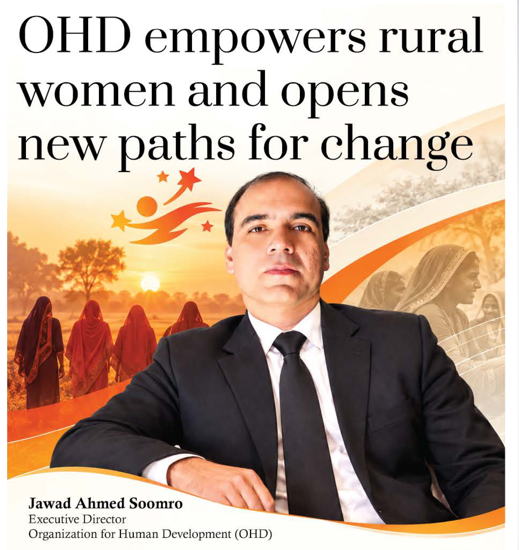

Jawad Ahmed Soomro
Executive Director
Organization for Human Development (OHD)
Pull Quote:
“Here is a Q&A session Flare held with Jawad Ahmed Soomro, Executive Director, Organization for Human Development (OHD). He stated that OHD was founded on the belief that everyone deserves dignity, equal opportunities and essential services. In rural Sindh, poverty, limited education and gender inequality remain major challenges.”
Profile & Interview Transcript
Profile:
Jawad Ahmed Soomro is Executive Director of the Organization for Human Development (OHD), Pakistan, with over 20 years of experience in the development sector and a Master’s degree in Economics.
Associated with OHD for 14 years, he has contributed to organisational development and community-focused initiatives, particularly in rural Sindh.
Under his leadership, OHD promotes education, gender equality, women’s leadership, social justice and community empowerment. Its initiatives address women’s rights, community mediation, peaceful dispute resolution, access to public services and educational opportunities for underserved communities.
Committed to integrity, collaboration and community participation, Soomro encourages local leadership and constructive partnerships to promote sustainable change. Through OHD’s Women Leadership Circles under the Amn Rang III initiative in District Shikarpur, he supports women’s leadership, rights awareness, peaceful dispute resolution and access to national identity registration services. He continues to work with communities, government institutions, civil society and development partners to build more inclusive and equitable communities.
Flare: What inspired OHD’s establishment, and what unmet needs in rural Sindh are you determined to address?
Jawad Ahmed Soomro: The Organization for Human Development (OHD) was founded on the belief that everyone deserves dignity, equal opportunities and essential services. In rural Sindh, poverty, limited education and gender inequality remain major challenges. OHD promotes education, women’s rights, community participation and peaceful dispute resolution. Through the Women Leadership Circles under Amn Rang III in Shikarpur, we strengthen women’s leadership, raise awareness of domestic violence and inheritance rights, and improve access to identity documents, education, particularly for girls and disadvantaged children, remains a priority, building on our experience of operating a school in Shikarpur for over eight years.
Flare: How has Amn Rang III improved women’s participation in decision-making and dispute resolution?
Jawad Ahmed Soomro: OHD established two Women Leadership Circles in Shikarpur, engaging 35 women and training 30 in leadership, mediation and women’s rights. Through 20 Social Action Projects, they reached 268 women, raising awareness of domestic violence, inheritance rights, girls’ education and public services. Women leaders have helped address family and property disputes in Shikarpur city, Abdoo village and Garhi Yaseen. An OHD dialogue in June 2026 brought together 55 participants to discuss women’s role in local governance. Mediation must never compromise women’s legal rights or access to formal justice, particularly in cases of violence or abuse.
Flare: Which Social Action Projects produced the most meaningful results, and how do you assess lasting impact?
Jawad Ahmed Soomro: Through 20 Social Action Projects, the Women Leadership Circles reached 268 women across four tehsils, helping them raise concerns and engage community elders and local representatives on women’s rights and dispute resolution. We measure lasting impact by assessing women’s confidence in asserting their rights and communities’ responses to their concerns. Follow-up discussions, case documentation and stakeholder feedback help determine whether trained women continue providing support, facilitating dialogue and making appropriate referrals. We aim to sustain women’s leadership through local ownership and partnerships with government departments and civil society.
Flare: What barriers do rural women face in obtaining identity documents, and how can the government help?
Jawad Ahmed Soomro: Rural women face distance, transport costs, mobility restrictions, household duties and missing documents when accessing NADRA services. Without identity cards, they may struggle to access government assistance, open bank accounts and exercise their civic and economic rights. Under AMN RANG III, OHD coordinated with NADRA mobile teams in Rustam (Lakhi Ghulam Shah) and Nim Shareef (Garhi Yaseen), facilitating 140 registrations—102 women and 38 men. Regular mobile services, simpler procedures, local-language information and targeted outreach can improve access. Civil society can assist applicants, but lasting progress requires institutional commitment to ensure women’s access to identity documents and public services.
Flare: How do you balance community mediation with women’s legal rights, safety and access to formal justice?
Jawad Ahmed Soomro: Community mediation can resolve disputes but must never compromise women’s rights, dignity or safety. Through the Women Leadership Circles, we raise awareness of women’s rights and encourage engagement with families and community elders. Cases involving domestic violence, threats, coercion or serious abuse require protection and access to legal advice, police assistance or formal justice. Women must never be pressured into reconciliation or surrendering their rights. Support must respect confidentiality, informed consent and women’s choices, with referrals to legal aid and protection services where needed.
Flare: Why do children, especially girls, remain out of school in rural Sindh, and what is OHD’s education plan?
Jawad Ahmed Soomro: Poverty, distance, inadequate facilities, early marriage, household responsibilities and a shortage of female teachers keep many children, particularly girls, out of school. OHD operated the British English Grammar School in Shikarpur for over eight years before financial pressures forced its closure. In District Dadu, OHD assessed 500 children across 14 locations, including 310 girls and 190 boys. We aim to expand flexible, non-formal and post-primary learning through partnerships with families, education authorities and development partners, measuring progress through attendance, learning and retention.
Flare: What funding challenges do local organisations face, and how can partners help?
Jawad Ahmed Soomro: Local organisations understand community needs but often lack long-term funding, making it difficult to retain staff and sustain projects. Under Amn Rang III, OHD established two Women Leadership Circles, conducted 20 Social Action Projects reaching 268 women, and facilitated 140 identity registrations, including 102 for women. Government agencies should involve local organisations in planning, development partners provide long-term funding, and businesses support education, vocational training and livelihoods. Trust, transparency and accountability are essential for lasting partnerships.
Flare: What are OHD’s future priorities, and what message do you have for policymakers and Flare readers?
Jawad Ahmed Soomro: OHD aims to expand rural education, strengthen women’s leadership and improve access to identity documents and public services, especially for out-of-school girls. I urge policymakers to involve communities and local organisations in development planning. Greater investment in education, women’s rights and accessible services is essential to reduce inequality and ensure every child receives an education, every woman enjoys equal rights, and every community has a voice.