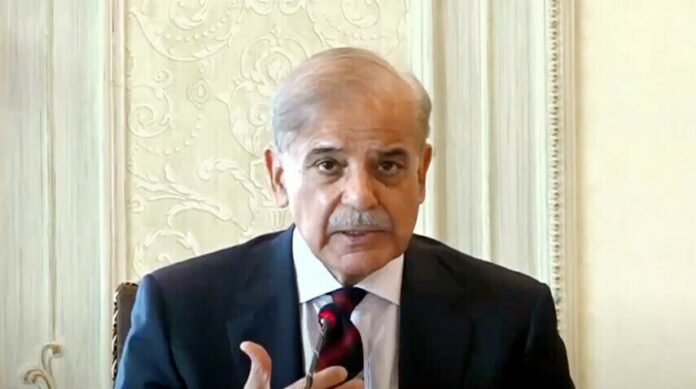

ISLAMABAD: Zubair Kasuri: Prime Minister Shehbaz Sharif has assured American investors of full protection of their investments in Pakistan, saying the government is taking measures to curb corruption, reform the taxation system, address energy sector challenges and eliminate unnecessary bureaucratic hurdles affecting business activities.
Speaking at a gathering organised by the American Business Council (ABC) at a local hotel in Islamabad on Tuesday, the prime minister said his government was committed to creating a transparent, predictable and investor-friendly business environment to encourage greater foreign investment in the country.
Deputy Prime Minister and Foreign Minister Ishaq Dar, Federal Minister for Commerce Jam Kamal Khan, Federal Minister for Planning and Development Ahsan Iqbal, senior government officials, representatives of the American business community and chief executives of leading multinational companies attended the event.
During his detailed address, the prime minister discussed Pakistan’s economic situation, investment opportunities, taxation reforms, energy-related challenges and issues confronting the automobile and other industrial sectors.
He also interacted extensively with members of the American business delegation, listened to their concerns and responded to questions regarding the government’s economic policies and measures being taken to facilitate foreign investors.
The prime minister said improving the business environment and restoring investor confidence remained among the government’s key priorities. He emphasised that foreign companies operating in Pakistan would be provided with the necessary support to expand their operations and contribute to economic growth.
Referring to corruption and administrative inefficiencies, Shehbaz Sharif said the government was pursuing reforms aimed at improving transparency, accountability and the performance of public institutions.
He also discussed ongoing reforms in the Federal Board of Revenue (FBR), acknowledging the need to simplify tax procedures and reduce unnecessary complications faced by businesses.
The prime minister referred to taxation issues, including concerns over super tax, and highlighted the government’s efforts to address investors’ grievances and improve the overall tax administration system.
Discussing challenges facing the energy sector, the prime minister acknowledged the difficulties experienced by industries because of energy costs and other structural issues. He said improving the competitiveness of Pakistan’s industrial sector was essential for attracting investment, increasing exports and creating employment opportunities.
He also discussed the automobile industry and other manufacturing sectors, stressing the importance of industrial development and a conducive policy environment.
The prime minister highlighted the government’s measures to reduce unnecessary public expenditure and eliminate the financial burden of inefficient state institutions.
Referring to decisions concerning the Pakistan Public Works Department (PWD) and Utility Stores Corporation, he said the government could not continue supporting institutions that placed an unnecessary burden on the national exchequer.
He maintained that economic reforms, fiscal discipline and improved governance were necessary to achieve sustainable economic growth.
Earlier, addressing the gathering, American Business Council Pakistan President Adnan Asad appreciated Prime Minister Shehbaz Sharif and his government’s handling of difficult economic and regional circumstances over the past eight to nine months.
He said Pakistan had faced considerable challenges during this period, but the government’s response had helped restore confidence and improve the country’s international standing.
Asad also appreciated the positive approach adopted by members of the federal cabinet and federal secretaries in addressing issues raised by the business community.
However, he made it clear that despite improvements in economic indicators, considerable work remained to be done to make Pakistan a genuinely business-friendly country.
The ABC president said approximately 80 American member companies were operating in Pakistan, including several belonging to the world’s Fortune 500 corporations.
He said a few companies had exited Pakistan because of global strategic decisions, but most American companies continued to generate profits and remained satisfied with the performance of their local operations.
“These companies are among Pakistan’s largest employers, taxpayers and contributors to exports,” he said, describing American businesses as important economic ambassadors for Pakistan.
He explained that potential international investors frequently approached existing multinational companies to assess the investment climate before making decisions about entering Pakistan.
Asad acknowledged that Pakistan’s economy had shown signs of stability, the exchange rate had remained relatively stable, remittances had not faced major disruptions and the Pakistan Stock Exchange had emerged among the world’s better-performing markets.
Nevertheless, he said these positive developments were insufficient unless practical difficulties faced by businesses were addressed.
In a significant observation made in the presence of the prime minister, Asad said major companies operating in Pakistan continued to face interventions from as many as 20 to 25 government agencies.
He said excessive regulatory scrutiny, repeated visits by officials and unnecessary notices had created serious difficulties for businesses.
The ABC president particularly criticised the growing number of tax notices issued to companies, saying their volume had more than doubled rather than declining following the introduction of automated systems.
He said companies were frequently required to respond to notices that were subsequently found to be invalid or unjustified.
According to Asad, responding to a single incorrect tax notice could cost a company at least Rs500,000 in professional fees and administrative expenses.
He suggested that officials issuing incorrect or unjustified notices without conducting proper scrutiny should also be held accountable.
“Perhaps there should be a penalty on the officer who issued the notice without doing the homework,” he observed.
The ABC president said leading multinational companies, including Philip Morris, Coca-Cola, Pepsi, Abbott, McDonald’s, Pizza Hut, Papa John’s and Tim Hortons, were operating in Pakistan and contributing substantially to government revenues and employment.
He said these companies were profitable and happy with their operations, but not entirely satisfied with the overall business environment.
Asad observed that Pakistan’s position in the international business community would improve considerably when multinational companies could confidently describe the country as an attractive and convenient destination for investment.
He also appreciated the prime minister’s crackdown on smuggling and illicit trade, saying American companies were willing to support the government’s enforcement efforts.
He disclosed that the American Business Council had responded positively to a request from the Punjab government for 100 electric motorcycles.
According to Asad, 50 electric motorcycles would be donated with the support of Philip Morris to facilitate enforcement activities against smuggling and illegal trade.
He said similar cooperation could be extended to other provincial governments.
The ABC president also announced plans to establish self-testing kiosks for HIV and hepatitis C through the council’s platform as part of its corporate social responsibility initiatives.
Highlighting another proposed initiative, Asad said the American Business Council had decided to support the establishment of roadside convenience facilities along the route from the Islamabad GT Road junction towards the Chinese border.
He said the plan envisaged facilities at intervals of approximately 20 kilometres, including clean washrooms and small shops for travellers and tourists.
Under the proposed arrangement, shops would be provided free of cost to deserving local residents, enabling them to earn livelihoods while maintaining the adjoining public facilities.
He described the initiative as a corporate social responsibility project involving an estimated investment of $3 million.
Turning to Pakistan’s dependence on external financial assistance, Asad questioned why a country blessed with extensive natural resources, mountains, historical attractions and tourism potential continued to rely on financial support from the International Monetary Fund and friendly countries.
He cited the example of Orlando, Florida, saying the American city attracted approximately 80 million tourists annually because of effective governance, investor-friendly policies, security and well-developed tourism infrastructure.
According to the figures he presented, average spending of $1,500 per visitor would represent approximately $120 billion in annual tourism-related economic activity.
He argued that Pakistan possessed enormous untapped tourism potential and could generate substantial foreign exchange earnings if the sector was opened to investment and supported by improved infrastructure, security and governance.
Asad offered the American Business Council’s advisory support to the federal government in developing tourism, improving investment policies and identifying opportunities for greater private-sector participation.
The event also provided an opportunity for senior government officials and representatives of American companies to exchange views on economic reforms, regulatory challenges, investment protection and future business opportunities in Pakistan.
Members of the American business community emphasised the importance of predictable taxation policies, reduced bureaucratic intervention, efficient government institutions and greater regulatory transparency to encourage additional investment in the country.