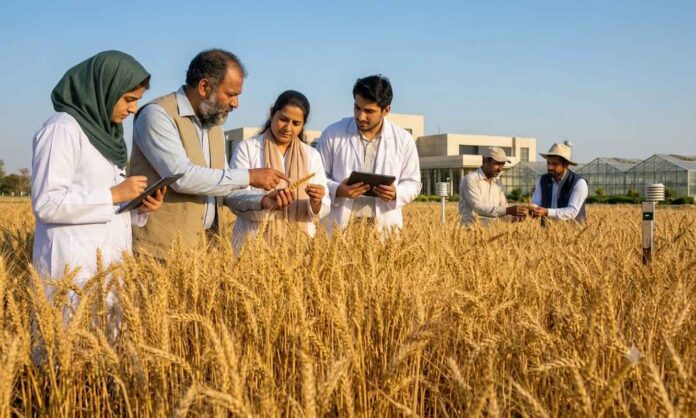

Pakistan has achieved a significant breakthrough in agricultural research with the development and approval of a new disease-resistant wheat variety that promises to improve crop productivity, enhance food security, and strengthen the country’s agricultural sector. The newly approved wheat variety represents years of scientific research and innovation aimed at addressing some of the most pressing challenges facing wheat farmers.
As wheat remains the most important staple crop in Pakistan, any advancement that improves yield potential, disease resistance, climate adaptability, and nutritional quality carries major implications for farmers, consumers, and the national economy. The approval of the new wheat variety is being viewed as a milestone achievement that could contribute to sustainable agricultural growth and help strengthen Pakistan’s food production capacity in the years ahead.
The development comes at a critical time when agricultural systems worldwide are facing increasing pressure from climate change, water scarcity, rising production costs, and evolving plant diseases. Researchers have focused on creating a wheat variety capable of meeting these challenges while ensuring stable production and improved nutritional outcomes.
The newly approved variety combines several desirable traits, including high yield potential, resistance to common wheat diseases, tolerance to colder temperatures, improved nutritional content, and excellent flour quality for traditional food products. These characteristics make it a valuable addition to Pakistan’s wheat production system and provide farmers with a stronger tool for achieving better harvests.
A Major Milestone in Agricultural Research
The approval of the new wheat variety marks a significant accomplishment for agricultural scientists working to improve crop performance through modern breeding techniques and scientific innovation.
Agricultural research plays a vital role in ensuring food security and supporting economic development. New crop varieties are often the result of years of experimentation, field testing, genetic selection, and performance evaluations conducted under varying environmental conditions.
Researchers continually work to identify traits that can help crops withstand disease pressures, environmental stress, and changing climatic conditions. The successful development of a disease-resistant wheat variety demonstrates the growing capability of Pakistan’s scientific community to address agricultural challenges through locally developed solutions.
The approval process for new crop varieties typically involves extensive testing to verify performance, stability, adaptability, and resistance characteristics. Only varieties that consistently demonstrate superior results under multiple conditions receive official approval for cultivation.
The successful completion of this process confirms the variety’s potential to deliver tangible benefits to farmers and agricultural stakeholders.
Why Wheat Remains Critical to Pakistan’s Economy
Wheat is one of the most important agricultural commodities in Pakistan and serves as the primary staple food for millions of people. It occupies a significant share of cultivated agricultural land and contributes substantially to rural livelihoods, employment, and national food security.
The crop is central to the country’s agricultural economy because it supports farmers, food processors, transportation networks, and related industries. Any improvement in wheat productivity can therefore generate positive effects throughout the economy.
Maintaining strong wheat production is essential for reducing dependence on imports, stabilizing food prices, and ensuring an adequate supply of affordable food products for consumers.
However, wheat cultivation faces numerous challenges, including disease outbreaks, weather extremes, declining soil fertility, and water management issues. These factors can significantly affect yields and create uncertainty for farmers.
The introduction of improved wheat varieties offers one of the most effective ways to address these challenges while increasing productivity and profitability.
Disease Resistance Offers Significant Advantages
One of the most valuable features of the newly developed wheat variety is its resistance to major crop diseases.
Plant diseases remain among the most serious threats to agricultural productivity worldwide. Wheat crops are vulnerable to a range of fungal infections, rust diseases, and other pathogens that can significantly reduce yields and damage grain quality.
Disease outbreaks often force farmers to spend additional resources on pesticides and crop protection measures. In severe cases, entire harvests may be affected, resulting in financial losses and reduced food production.
Disease-resistant varieties provide a more sustainable solution by enabling crops to withstand infections naturally. This reduces dependence on chemical treatments while improving productivity and lowering production costs.
For farmers, disease resistance translates into greater confidence and stability. Crops that can better resist common diseases are more likely to achieve consistent yields even under challenging conditions.
The introduction of disease-resistant wheat can therefore play an important role in supporting sustainable agricultural practices and improving farm profitability.
Higher Yield Potential for Farmers
Yield improvement remains one of the primary objectives of agricultural research programs around the world.
As populations continue to grow and demand for food increases, agricultural systems must produce more output from limited land and water resources. High-yielding crop varieties help address this challenge by increasing production efficiency.
The newly approved wheat variety has been developed with a focus on maximizing productivity while maintaining quality and resilience.
Higher yields provide several important benefits. Farmers can generate greater income from the same area of cultivated land, improving economic returns and supporting rural development.
Increased productivity also contributes to national food security by boosting overall wheat production and helping meet domestic demand.
When combined with disease resistance and environmental adaptability, higher yield potential becomes even more valuable because it allows farmers to achieve stronger results under a wider range of growing conditions.
The variety’s productivity characteristics make it particularly attractive for commercial cultivation across major wheat-growing regions.
Cold Tolerance Supports Climate Resilience
Climate variability has emerged as one of the most significant challenges facing agriculture globally.
Unexpected temperature fluctuations, changing rainfall patterns, and extreme weather events can negatively affect crop performance and reduce yields.
Cold tolerance is an increasingly important trait because temperature stress during critical growth stages can impact crop development and productivity.
The newly approved wheat variety has demonstrated strong tolerance to colder conditions, enabling it to perform effectively in environments where temperature fluctuations may otherwise affect production.
This adaptability enhances crop resilience and provides farmers with greater flexibility in managing planting schedules and growing conditions.
Climate-resilient crop varieties are becoming essential components of modern agricultural strategies because they help reduce vulnerability to environmental risks.
By incorporating cold tolerance into the variety’s genetic profile, researchers have improved its ability to support stable production under varying climatic conditions.
Enhanced Nutritional Value for Consumers
Modern agricultural research increasingly focuses not only on productivity but also on nutritional quality.
Food security is no longer measured solely by the availability of food. It also includes access to nutritious foods that support healthy diets and improve public health outcomes.
The newly developed wheat variety offers enhanced zinc content, making it a valuable nutritional improvement over conventional varieties.
Zinc is an essential micronutrient that plays a critical role in human health, supporting immune function, growth, and overall well-being.
Micronutrient deficiencies remain a challenge in many developing countries, affecting millions of people and contributing to health problems.
Biofortified crops that contain higher levels of important nutrients provide an effective way to improve dietary quality through everyday food consumption.
By combining nutritional enhancement with high productivity and disease resistance, the new wheat variety delivers benefits that extend from farms to households.
Maintaining Quality for Traditional Foods
In addition to yield and nutritional improvements, the new wheat variety has been developed with a strong emphasis on flour and food quality.
Wheat quality is particularly important in Pakistan because it directly affects the preparation of traditional foods consumed daily across the country.
Consumers often evaluate wheat varieties based on characteristics such as texture, taste, dough performance, and cooking quality.
The newly approved variety has demonstrated excellent suitability for producing traditional flatbreads, ensuring that quality standards remain high while productivity improves.
Maintaining food quality is essential for encouraging farmer adoption and ensuring consumer acceptance.
A wheat variety that delivers superior yields but fails to meet quality expectations may struggle to gain widespread popularity.
The combination of productivity, nutrition, disease resistance, and food quality significantly enhances the commercial potential of the new variety.
Supporting Sustainable Agriculture
Sustainability has become a central objective of modern agricultural development.
Farmers increasingly need crop varieties that can produce strong yields while minimizing environmental impacts and reducing dependence on costly inputs.
Disease-resistant varieties contribute to sustainability by lowering the need for pesticide applications and reducing production costs.
Improved productivity helps maximize output from existing farmland, reducing pressure on natural resources and supporting efficient land use.
Climate-resilient characteristics further strengthen sustainability by enabling crops to perform under changing environmental conditions.
The newly approved wheat variety aligns with these goals by offering a combination of traits that support environmentally responsible and economically viable farming practices.
Its adoption could contribute to more sustainable agricultural systems while helping farmers improve profitability and productivity.
Strengthening National Food Security
Food security remains one of the most important policy priorities for developing economies.
Ensuring a reliable supply of staple crops is essential for maintaining stable food markets, controlling inflation, and supporting economic stability.
Wheat occupies a particularly important position because it serves as the foundation of daily diets for millions of households.
Any increase in wheat productivity can contribute directly to national food security objectives.
Higher yields, stronger disease resistance, and improved climate adaptability reduce the risk of production losses and help maintain stable supplies.
The newly approved variety therefore has the potential to support broader efforts aimed at strengthening agricultural resilience and reducing vulnerability to supply disruptions.
Its adoption across wheat-growing regions could contribute to higher overall production levels and improved food availability in the coming years.
A Promising Future for Agricultural Innovation
The approval of this disease-resistant wheat variety demonstrates the growing importance of scientific research and innovation in addressing agricultural challenges.
As climate change, population growth, and resource constraints continue to reshape global agriculture, investment in research will become increasingly critical.
New crop varieties represent one of the most effective tools available for improving productivity, sustainability, and food security.
The success of this wheat variety highlights the value of long-term research programs and the contribution of scientists working to develop practical solutions for farmers.
It also reinforces the importance of collaboration between researchers, policymakers, agricultural institutions, and farming communities.
The development provides a strong example of how locally driven innovation can generate meaningful benefits for the agricultural sector and the wider economy.
With its combination of disease resistance, high yield potential, cold tolerance, enhanced nutrition, and excellent food quality, the newly approved wheat variety represents a major advancement for Pakistan’s agricultural future. Its widespread adoption has the potential to improve farmer incomes, strengthen food security, support sustainable agriculture, and contribute to the long-term growth of the country’s farming sector.
Read More