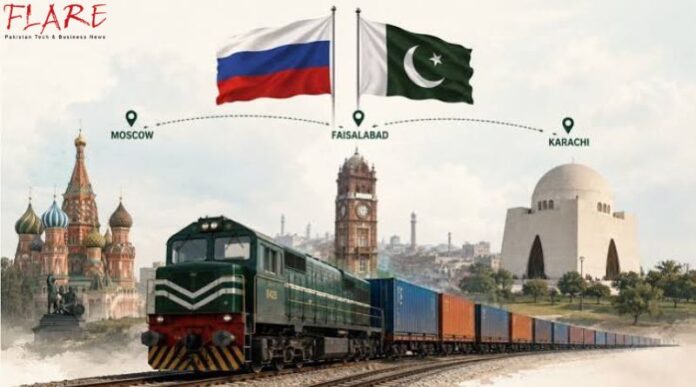

Russia and Pakistan are preparing to open a new chapter in their trade and transport relations with the launch of their first direct freight rail service. The planned train service is expected to make it easier for goods to move between the two countries and could give a fresh boost to trade across the region.
The new rail link is part of wider efforts by Pakistan and Russia to improve economic cooperation. Officials from both countries have been working on better transport connections because reliable and affordable movement of goods is important for increasing business between the two sides.
According to Russian Deputy Prime Minister Alexei Overchuk, the first train was planned as a trial service. He said the train would carry containers and would mark the first bilateral railway connection between Russia and Pakistan.
A New Rail Link Between Russia and Pakistan
For many years, Pakistan and Russia have had trade and diplomatic relations, but there has not been a direct railway service connecting the two countries. Goods moving between the two markets have generally depended on other transport routes and several transit points.
The planned freight train is important because it can provide another option for moving products between Russia and Pakistan. Rail transport can be useful for large shipments because it can carry many containers at one time and can offer a more organised route for long-distance trade.
The service is expected to begin on a trial basis before both countries decide how it can be expanded. The first train will carry containers, although Russian officials did not initially provide details about the exact amount of cargo.
This first journey will also allow officials and transport companies to study how the route works in real conditions. They can check border procedures, customs work, railway connections and the time needed to move cargo from one country to the other.
The Route Will Pass Through Several Countries
The Russia-Pakistan freight connection is not a simple railway line running directly from one country to the other. The planned route will use existing railway networks across several countries in Central Asia and the region.
Earlier plans said the service would use the eastern route of the International North-South Transport Corridor. The route is expected to pass through Kazakhstan, Turkmenistan and Iran before reaching Pakistan. One important advantage of this route is that it avoids Afghanistan.
Using an established regional route can help Pakistan and Russia connect their markets without depending on a single transport system.
The route also has wider importance because it connects South Asia with Central Asia, Russia and other parts of the region. If the service becomes regular, it could support more trade between countries along the route.
Why Rail Transport Matters
Moving goods across long distances can be expensive and time-consuming. Businesses need transport systems that are reliable, reasonably priced and able to handle large amounts of cargo.
Railways can play an important role in this area. Freight trains can carry large numbers of containers and are often suitable for goods that need to travel long distances.
For Pakistan, a stronger rail connection with Russia could provide another way to bring products from the northern part of Eurasia into the country. It could also help Pakistani exporters reach markets in Russia and Central Asia.
For Russia, the new connection could create another route into South Asia. This may help Russian businesses explore Pakistan’s market while also giving them a possible connection to other countries in the region.
A Chance to Increase Bilateral Trade
One of the main goals of the new railway service is to increase trade between Pakistan and Russia.
Both countries have been looking for ways to improve economic relations. Trade can grow when businesses have better transport options and fewer problems moving goods across borders.
A direct freight rail service could support the movement of different types of products. Depending on demand and future agreements, the route could eventually be used for food products, industrial goods, machinery, raw materials and other items.
The first train is only a trial, so it would be too early to say how large the service will become. However, the launch itself is an important step because it gives both countries a chance to test a new trade route.
Pakistan Could Become a Regional Transit Hub
The railway project could also support Pakistan’s wider goal of becoming a regional trade and transit hub.
Pakistan has a useful geographical position. It is located close to Central Asia, China, Iran and the Arabian Sea. Better transport links can help the country connect markets that are far from each other.
If freight from Russia and Central Asia can move smoothly through Pakistan, the country could benefit from transit fees and related business activity. Transport companies, warehouses, customs services and other businesses could also see more activity.
Pakistan’s ports could become an important part of this wider network. Goods arriving by rail could potentially move toward seaports and then be shipped to other international markets.
This would require continued investment in railways, roads, customs facilities and storage services. A railway route can only become successful when the complete supply chain works properly.
The International North-South Transport Corridor
The planned service is also connected with the wider International North-South Transport Corridor, commonly known as INSTC.
The corridor is designed to improve trade connections between countries in northern Eurasia and markets farther south. Different road, rail and sea routes are involved in the larger network.
For Pakistan, participation in such regional transport systems could provide access to new markets. It could also reduce the country’s dependence on a limited number of trade routes.
The eastern route is particularly important because it creates a connection through Central Asia and Iran. The planned Russia-Pakistan freight service would make use of this regional network.
The success of the project will depend on how smoothly each country along the route manages railway operations, customs checks and border crossings.
The First Train Will Be a Test
The first freight train should be seen as a test rather than the final form of the service.
Officials will need to examine several parts of the journey. These include the loading of containers, movement between railway networks, customs clearance and border procedures.
Transit time will also be important. Businesses want to know how long it takes for goods to travel from one location to another. If the journey takes too long or faces frequent delays, companies may continue using other transport options.
The cost will be another major factor. Rail transport needs to be competitive with road and sea shipping if it is to attract private businesses.
The trial run can help both governments identify problems before a regular service is introduced.
Possible Benefits for Pakistani Businesses
Pakistani companies could benefit from easier access to Russian markets if the rail service becomes regular.
Pakistan exports a wide range of products, including textiles, agricultural goods, sports goods, leather products and other manufactured items. Better transport connections could make it easier for some exporters to reach Russian buyers.
A reliable freight route could also help businesses plan their shipments more confidently. When companies know that trains operate according to a fixed schedule, they can better manage their stock and deliveries.
Importers could also benefit. Pakistani businesses that buy machinery, industrial materials or other products from Russia may have another option for bringing those goods into the country.
However, the actual benefits will depend on freight prices, travel times, customs rules and the availability of regular train services.
Russia Could Gain Better Access to South Asia
The railway project is also useful for Russia because it can strengthen its connection with South Asian markets.
Pakistan is a large consumer market and is also connected to important regional trade routes. A railway link can provide Russian companies with another way to reach Pakistan.
Russian businesses may be interested in selling energy-related products, machinery, industrial goods, agricultural products and other items in Pakistan.
At the same time, Pakistan could use the route to increase its exports to Russia.
This two-way movement of goods is important. A successful freight railway should not depend only on cargo moving in one direction. Both countries need enough trade to keep trains running regularly.
The Route Could Eventually Connect Further
The Russian side has also shown interest in extending railway connections beyond Pakistan.
Russian Deputy Prime Minister Alexei Overchuk said there was interest in extending the railway service and connecting it with India as another possible development.
If such plans move forward in the future, the route could become part of a much larger regional trade network.
Pakistan could then become an important part of a railway system linking Russia with South Asia. However, such expansion would require agreements between several countries and improvements in transport infrastructure.
For now, the main focus is on successfully operating the first Russia-Pakistan freight service.
Pakistan and the Eurasian Economic Union
The railway project is also linked to wider discussions between Pakistan and the Eurasian Economic Union, or EAEU.
The EAEU includes several countries in the region and aims to support economic cooperation among its members. Pakistan has shown interest in stronger economic ties with the group, including discussions about a possible free trade arrangement.
Better transport links would make such economic cooperation more useful. Trade agreements can reduce barriers, but businesses still need affordable ways to move their products.
A stronger railway network could therefore support future trade agreements between Pakistan and Eurasian markets.
Challenges That Need to Be Solved
Although the new rail service offers many opportunities, there are also challenges.
The biggest challenge is the long route. Goods will cross several countries before reaching their final destination. Every border crossing can involve customs checks, paperwork and changes in railway operations.
Any delay at one point can affect the entire journey.
Another issue is railway infrastructure. The countries along the route need suitable tracks, terminals and container facilities to handle international freight.
Security is also important. Freight companies need confidence that their goods will reach their destination safely.
Cost is another major concern. If rail freight is too expensive compared with other options, businesses may not use the service regularly.
These issues do not mean the project cannot succeed. They simply show why the trial journey is important.
A Step Toward Stronger Regional Trade
The planned Russia-Pakistan freight train is more than just a railway project. It is part of a larger effort to improve regional trade connections.
Pakistan has been working to strengthen its links with Central Asia and other nearby markets. Russia is also looking for stronger trade routes with countries outside its traditional markets.
A successful railway connection could support these goals.
It could also encourage private companies to explore new business opportunities. More trade can create demand for transport, storage, customs services and other logistics businesses.
Over time, this can support economic activity in different parts of the region.
What Happens Next?
The first step is to complete the trial freight journey and examine its results.
Officials will need to look at the travel time, cost, customs process and overall performance of the route. If the trial goes well, the next step could be the development of a regular freight service.
The number of trains could increase as demand grows. More types of goods could also be added to the service.
For businesses, the most important thing will be reliability. A successful international freight service needs regular schedules and smooth border procedures.
If Pakistan and Russia can solve these practical issues, the railway connection could become an important part of their future trade relationship.
A Promising Development for Pakistan
The planned direct freight rail service between Russia and Pakistan is a significant development for both countries. It is the first railway connection of its kind between the two sides and could open new opportunities for trade.
The initial train will serve as a test of the route and its systems. Its performance will help officials decide how the service can be expanded in the future.
For Pakistan, the project could improve access to Russian and Central Asian markets while supporting the country’s ambition to become a regional transit hub. For Russia, it could provide a stronger route toward Pakistan and wider South Asian markets.
The railway service will not solve every trade and transport problem overnight. However, it can provide a new foundation for closer economic cooperation.
If the route becomes regular, affordable and reliable, it could benefit exporters, importers and transport companies in both countries. More importantly, it could strengthen Pakistan’s role in the growing network of trade routes connecting South Asia with Central Asia, Iran and Russia.
The launch of the first freight train is therefore an important starting point. Its success could determine whether this new railway connection grows into a major trade route in the years ahead.
Read Also : check