
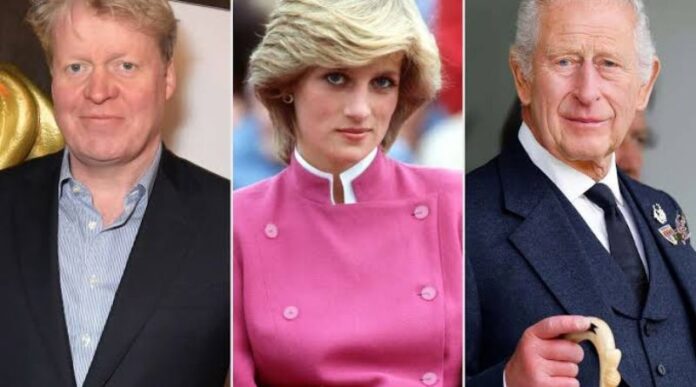

A new book by Princess Diana’s younger brother, Charles Spencer, has created fresh controversy around the British royal family. The memoir, titled Swan Song: Diana, My Sister, looks back at Diana’s life, her difficult marriage to the then-Prince Charles, and the events surrounding her death in 1997.
Only selected parts of the book have been published before its official release, but those extracts have already attracted major attention. They include Spencer’s personal memories of conversations with King Charles, his thoughts about Diana’s marriage, and his concerns about how the royal family handled the period after her death.
The book is expected to be published on September 22, 2026, and comes as the 30th anniversary of Diana’s death approaches. Spencer has said that he wanted to tell the story of his sister from his own point of view and share memories that he believes are important to understanding her life.
Here are five of the major claims from the book that have received the most attention.
1. Spencer Says King Charles Seemed Extremely Happy After Diana’s Death
One of the strongest claims in the book concerns the reaction of the then-Prince Charles after Diana died in a car crash in Paris on August 31, 1997.
According to Spencer, he spoke to Charles by telephone after learning that his sister had died. Spencer recalls Charles as sounding unusually happy during the conversation.
In his account, Spencer described Charles as sounding “giddily elated” and compared the tone to someone who had won a lottery.
Spencer then shared his own interpretation of what may have been going through Charles’s mind. He claimed that the prince’s first thoughts may have been about the possibility of marrying Camilla Parker Bowles, whom Charles had been involved with before and during his marriage to Diana.
This is Spencer’s recollection and interpretation of the conversation, rather than an independently established fact about Charles’s private thoughts.
The claim has attracted particular attention because Diana’s death was followed by a huge public wave of grief in Britain and around the world. Her death at the age of 36 shocked millions of people, while the royal family faced intense public attention over how it responded.
Buckingham Palace has pushed back against Spencer’s wider claims. A palace spokesperson said the King was mindful that the pain of family grief could affect memory, judgment and the way events are remembered many years later.
2. Spencer Claims Charles Told Him Diana Would Soon Be Forgotten
Another major part of the book concerns an argument between Spencer and Charles over Diana’s funeral.
After Diana’s death, there was a major discussion about the funeral procession and whether her sons, Prince William and Prince Harry, should walk behind their mother’s coffin.
At that time, William was 15 and Harry was 12.
Spencer writes that he disagreed with the idea of making the two boys walk behind their mother’s coffin. He says the discussion with Charles became heated.
According to Spencer’s account, Charles became angry during a telephone conversation. Spencer says that after a pause, Charles made a comment suggesting that Diana would soon be forgotten.
The alleged words have become one of the biggest headlines from the book.
Spencer says he was shocked by what he heard and ended the conversation shortly afterwards.
The claim is especially sensitive because Diana remained one of the most popular members of the British royal family after her death. Her funeral attracted worldwide attention, and millions of people watched the procession.
Buckingham Palace responded to the claim in an unusually direct statement. The palace did not specifically say that Charles never made the alleged remark. Instead, it referred to the possible effects of grief on memory and judgment.
Spencer has since defended his account and said he believes he is telling the truth.
3. Spencer Says Diana Wanted to End Her Engagement
The memoir also looks back at the early stages of Diana’s relationship with Charles.
Spencer claims that Diana became deeply upset before her wedding because she believed Charles did not truly love her.
According to his account, Diana became particularly unhappy after an event connected to Charles’s brother Andrew. Spencer says Diana felt that Charles had shown very little interest in her that evening.
He claims that Diana later went to their father and said she could not continue with the planned marriage because she believed Charles did not love her.
However, Spencer says their father rejected the idea of cancelling the engagement. He reportedly believed that ending such a major royal marriage arrangement was no longer possible.
Spencer also claims that Diana had discovered a bracelet that Charles had bought for Camilla. According to the memoir, this discovery added to Diana’s concerns about the relationship.
The book further claims that Charles told Diana shortly before their wedding that he was happy to marry her but was not actually in love with her.
These details are based on Spencer’s account of what Diana told him and what he says he learned from people close to her. They offer a personal version of events surrounding one of the most famous royal marriages of the 20th century.
4. Spencer Links a Comment About Diana’s Body to Her Bulimia
Another emotional section of the memoir deals with Diana’s struggles with her body image and eating disorder.
Spencer claims that, shortly after the engagement, Charles squeezed Diana’s waist and made a comment about her being slightly overweight.
According to Spencer, Diana was deeply hurt by the remark.
He says Diana later told him that her waist became much smaller between her engagement and wedding. Spencer connects this change to the pressure and emotional distress she was experiencing at the time.
Diana publicly spoke about her struggle with bulimia during her lifetime. Her openness about the eating disorder helped bring wider attention to an issue that was often kept private.
In the book, Spencer presents the incident as one example of the emotional difficulties Diana experienced during her relationship with Charles.
However, the claim that one particular comment caused or directly contributed to Diana’s eating disorder is Spencer’s interpretation and should not be treated as an independently proven medical conclusion.
The story nevertheless shows how Spencer remembers the pressure Diana faced before entering royal life.
Her wedding to Charles took place in 1981 when she was only 20 years old. The marriage later became deeply troubled, and the couple separated in 1992 before divorcing in 1996.
5. Spencer Says Queen Elizabeth Offered to Restore Diana’s HRH Title
A further claim in the memoir concerns Diana’s royal title.
After Diana and Charles divorced, she lost the style “Her Royal Highness,” commonly known as HRH. She continued to be known as Diana, Princess of Wales, but no longer held the HRH style.
Spencer claims that after Diana’s death, Queen Elizabeth II offered to restore the HRH title.
According to Spencer, he believed Diana would not have wanted such an offer after her death. He says he saw it as too little and too late.
He recalls discussing the matter with Robert Fellowes, the Queen’s private secretary. Spencer says he questioned the value of restoring the title when Diana was already dead.
The claim provides another example of the complicated relationship between Diana’s family and the royal institution.
Diana’s title had been an important issue after her divorce. Her loss of HRH status was part of the changes that followed the end of her marriage to Charles.
Spencer says Diana had been deeply upset by the removal of the title while she was alive. Because of that, he believed she would not have welcomed having it restored after her death.
Again, this is Spencer’s recollection of events and his judgment about how Diana might have viewed the offer.
A Book That Has Already Created a Royal Dispute
The claims in Swan Song: Diana, My Sister have caused a public disagreement between Spencer and Buckingham Palace before the book has even reached readers.
The palace normally avoids commenting on books about members of the royal family. This time, however, it issued a statement after the extracts were published.
The palace said that grief within a family can affect judgment and memory, particularly when people are remembering events many years later.
Spencer has rejected the suggestion that his memories are unreliable. In recent interviews, he has strongly defended the claims in his memoir and said he is telling the truth. He has also criticised the palace response.
The disagreement has brought old questions about Diana’s marriage and her relationship with the royal family back into the public discussion.
Why Spencer Decided to Write the Book
Spencer has explained that the book is not simply an attempt to revisit royal controversy.
He has said that he wanted to tell the story of Diana from a brother’s perspective. He has described his sister as a special and loving person and said he wanted to put his own memories and thoughts on record.
The book also comes at an important time because 2027 will mark 30 years since Diana’s death.
Over the years, many books, documentaries and television programmes have examined Diana’s life. Her marriage, charity work, relationship with the media and death have remained subjects of worldwide interest.
Spencer’s memoir adds another personal account from someone who knew her throughout her life.
Unlike many previous books about Diana, this one comes directly from her brother, who was closely involved with the family and played a major role at her funeral.
The Impact of Diana’s Death
Diana died on August 31, 1997, after a car crash in Paris. Her death shocked Britain and many countries around the world.
At the time, Prince William and Prince Harry were still children. The way the young princes dealt with the loss became one of the most emotional parts of the royal family’s history.
Spencer writes about his concerns for the boys and the difficult days that followed their mother’s death.
He has also revisited the decision for William and Harry to walk behind Diana’s coffin during the funeral procession. The issue has been discussed by both princes in later years, with William describing it as a difficult family decision. Harry also wrote about the experience in his 2023 memoir, Spare.
What Readers Should Keep in Mind
The claims in Spencer’s book are based largely on his memories, conversations and personal understanding of Diana’s life.
Some of the events described happened nearly three decades ago. Other details are based on what Diana reportedly told her brother or people close to her.
That means readers should distinguish between documented historical events and Spencer’s personal recollections or interpretations.
The palace has already challenged the way Spencer remembers some events, while Spencer continues to stand by his account.
The release of Swan Song is therefore likely to bring renewed discussion about Diana, her marriage to Charles and the difficult relationship between her family and the royal household.
For many people, Diana remains an important figure whose life continues to attract enormous public interest. Spencer’s new memoir now offers his own version of her story, including painful memories from her marriage and the days surrounding her death.
As the complete book reaches readers, more details may emerge and provide additional context for the claims that have already caused a major royal controversy.
Read Also: check