
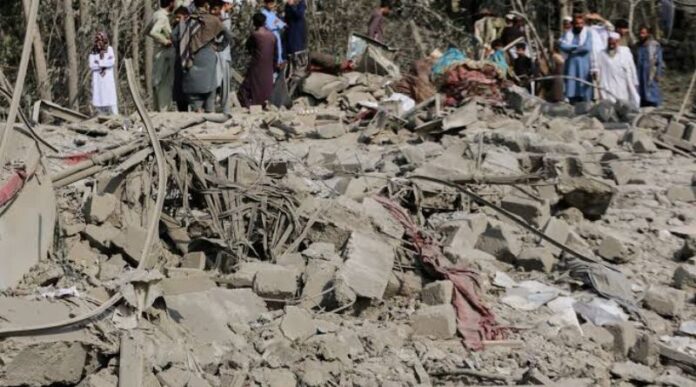

Pakistan has carried out airstrikes against what it described as militant camps and hideouts in the border region with Afghanistan, following a series of deadly attacks in Khyber Pakhtunkhwa.
According to Pakistan’s Ministry of Information and Broadcasting, the strikes were conducted after intelligence-based operations against militants in Kohat and Hangu. The ministry said the combined ground and air operations killed 37 militants, including 28 who were targeted in camps and hideouts near the Afghanistan border.
The latest military action has added to already serious tensions between Islamabad and Kabul. Pakistan has repeatedly raised concerns about militant groups operating from Afghan territory, while Afghanistan has rejected accusations that it is providing safe havens to groups involved in attacks inside Pakistan.
The situation remains sensitive, with both sides giving different accounts of the latest strikes and casualties.
Pakistan Targets Militant Camps Near Afghan Border
Pakistan’s Information Ministry said that three militant targets were destroyed during the latest airstrikes.
The ministry described the strikes as carefully planned and based on credible intelligence. It said the targets included a centre used for training suicide bombers. According to the Pakistani statement, several suicide bombers were also among those killed.
Officials further said that large quantities of weapons and ammunition stored at the targeted locations were destroyed.
The Pakistani government said the operation was aimed at groups responsible for recent attacks in Khyber Pakhtunkhwa. It described the strikes as part of the country’s continuing counterterrorism campaign.
The ministry also said that special care was taken to avoid civilian casualties and that the targets were selected with precision.
However, Afghan officials have presented a different account of what happened.
Afghanistan Reports Civilian Deaths
Afghan authorities said Pakistani aircraft struck areas in Kunar and Paktika provinces.
Afghan officials said at least three people were killed in the strikes and accused Pakistan of hitting civilian property. According to Afghan authorities, a house in Kunar was destroyed, killing three members of the same family and injuring four others.
Afghan officials also reported damage to a shop and an empty house in Paktika. They condemned the strikes and described them as an attack on Afghan territory.
These claims are different from Pakistan’s account, which says the strikes hit militant locations and that precautions were taken to prevent civilian casualties.
The conflicting accounts could not immediately be independently verified.
Recent Attacks in Khyber Pakhtunkhwa
The strikes came after several serious security incidents in Khyber Pakhtunkhwa.
Pakistan has faced a renewed wave of militant violence in areas close to the Afghan border. Officials say recent attacks have targeted both civilians and security personnel.
On September 20, Pakistani security forces carried out an intelligence-based ground operation in Kohat and Hangu. The Ministry of Information said nine militants were killed during the operation, while several others were injured.
The operation followed a deadly attack in Hangu in which Pakistani security personnel were killed.
A day earlier, a major attack had also taken place in Kohat. Reports said a suicide bomber attacked a mosque inside a police compound, followed by an armed assault on security facilities. The incident led to a long gun battle and a significant number of casualties.
Pakistan has linked the recent rise in violence to militant networks that it says operate from locations across the Afghan border.
Pakistan Says Afghan Territory Is Being Used by Militants
Islamabad has repeatedly accused militant groups of using Afghan territory as a base for planning and carrying out attacks inside Pakistan.
Pakistani authorities have particularly focused on the Tehreek-e-Taliban Pakistan, commonly known as the TTP, and other groups that Islamabad says are connected to attacks in the country.
Pakistan says militants are able to cross the border, find shelter and prepare attacks from areas outside the reach of Pakistani security forces.
The Pakistani government has urged Afghan authorities to take action against these groups and prevent Afghan soil from being used for attacks against Pakistan.
The Afghan Taliban government, however, has rejected these accusations. Kabul has maintained that Pakistan’s security problems are an internal matter and has denied allowing militant groups to use Afghanistan as a base for attacks on Pakistan.
This disagreement has remained one of the biggest problems between the two neighbouring countries.
Military Action Increases Pressure on Kabul
The latest strikes send a clear message that Pakistan is prepared to take military action against militant targets it believes are located across the border.
Pakistan has previously carried out strikes inside Afghanistan, but each such operation increases pressure on relations between the two countries.
The border between Pakistan and Afghanistan has long been a difficult security area. Militants, refugees, traders and local communities have historically moved across the region, making it challenging for authorities on either side to completely control movement.
The situation became more complicated after the Afghan Taliban returned to power in 2021.
Pakistan had hoped that the new Afghan government would help control groups threatening Pakistan. However, Islamabad has continued to complain about attacks allegedly planned from Afghan territory.
Kabul has denied these accusations, creating repeated diplomatic and military disputes.
Why the Border Region Is Important
The Afghanistan-Pakistan border is one of the most sensitive areas in the region.
Khyber Pakhtunkhwa shares a long border with Afghanistan, and several districts have experienced militant attacks over the years. The mountainous terrain also makes security operations difficult.
For Pakistan, controlling militant activity along the border is a major national security issue.
The government says that militant groups operating near the border can threaten civilians, police, military personnel and government facilities inside Pakistan.
Afghanistan, meanwhile, has repeatedly raised concerns about Pakistani military operations on Afghan soil. Afghan officials argue that cross-border strikes can damage relations and create further instability.
The latest incident therefore involves not only a military operation but also a wider dispute over border security and responsibility.
What Pakistan Says Was Destroyed
According to Pakistan’s Ministry of Information, the latest strikes destroyed three militant targets.
One of the targets was described as a training centre for suicide bombers. Pakistani officials said that weapons and ammunition stored at the locations were also destroyed.
The ministry said 28 militants, including several suicide bombers, were killed in the airstrikes.
This figure forms part of the government’s overall claim that 37 militants were killed during the combined ground and air operations. Nine militants were reported killed during the separate ground operation in Kohat and Hangu.
Independent confirmation of the Pakistani casualty figures was not immediately available.
Afghanistan Gives a Different Account
Afghan authorities have disputed Pakistan’s description of the targets and casualties.
Afghan officials said the strikes hit locations in Kunar and Paktika. They reported civilian deaths and damage to homes and other property.
According to Afghan authorities, one house in Kunar was destroyed, killing three members of one family and injuring four others. They also reported that a shop and an empty house were damaged in Paktika.
Pakistan, on the other hand, has said that its targets were militant facilities and that maximum precautions were taken to avoid civilian harm.
Because access to the affected areas is limited, independent verification of the competing claims remains difficult.
Growing Tensions Between Islamabad and Kabul
The latest strikes come at a time when relations between Pakistan and Afghanistan are already under severe pressure.
Both countries have accused each other of failing to address security concerns.
Pakistan says Afghan-based militant groups are responsible for attacks inside Pakistan. Afghanistan says Pakistan should not conduct military operations inside Afghan territory.
These disagreements have also affected border trade and movement.
Whenever violence increases, the border can become more difficult for ordinary people, traders and transporters. Any prolonged tension can also create economic problems for communities that depend on cross-border business.
For people living in border districts, security developments in either country can have a direct effect on daily life.
Regional Countries Face a Difficult Situation
The continuing tension between Pakistan and Afghanistan is also a concern for neighbouring countries.
Regional powers have previously encouraged Islamabad and Kabul to resolve their differences through dialogue instead of repeated military confrontation.
China has been among the countries involved in efforts to improve relations between the two sides. Other countries have also encouraged both governments to find ways to reduce cross-border violence.
The latest strikes could make those diplomatic efforts more difficult.
At the same time, Pakistan argues that dialogue alone cannot solve the problem if militant attacks continue inside the country.
Pakistan Says Its Security Comes First
The Ministry of Information said Pakistan’s main priority is the safety of its citizens.
The government has presented the latest military action as part of a wider campaign against militant groups. It says security forces will continue operations against organisations considered a threat to Pakistan.
The ministry also linked the latest operations to Pakistan’s broader counterterrorism campaign and said efforts against militant networks would continue.
The government maintains that action is necessary when intelligence points to militant camps or hideouts involved in attacks against Pakistan.
A Difficult Path Ahead
The latest strikes show how quickly tensions between Pakistan and Afghanistan can turn into military action.
Pakistan faces the challenge of stopping attacks on its territory while also managing its relationship with its neighbour. Afghanistan, meanwhile, faces pressure over accusations that militant groups are operating from its territory.
Both sides have strong disagreements over what is happening along the border.
The most immediate concern is whether the latest strikes will remain a limited military operation or lead to another period of cross-border confrontation.
For civilians living near the border, the priority remains peace and safety. Continued fighting or further military action could put additional pressure on communities already affected by insecurity.
At the same time, Pakistan’s government has made it clear that it intends to continue operations against militant groups it believes are behind attacks inside the country.
Conclusion
Pakistan’s latest strikes against suspected militant hideouts near the Afghanistan border mark another serious development in the already strained relationship between Islamabad and Kabul.
Pakistan says its forces destroyed three militant targets, including a suicide bomber training centre, and killed 28 militants in the airstrikes. Together with a separate ground operation in Kohat and Hangu, Pakistani authorities reported 37 militant deaths.
Afghan officials dispute Pakistan’s account and say the strikes killed civilians and damaged homes and other property. These competing claims have not been independently verified.
The latest action follows a series of deadly attacks in Khyber Pakhtunkhwa and growing Pakistani concerns about militants allegedly operating from Afghanistan.
The situation highlights the continuing security challenges along the Pakistan-Afghanistan border. While Pakistan says military action is needed to protect its citizens, Afghanistan has condemned the strikes and rejected accusations that it is supporting militants.
As tensions continue, future developments will depend heavily on whether the two sides can address their security differences through direct talks and other diplomatic channels while preventing further militant attacks and cross-border violence.
Read Also: check