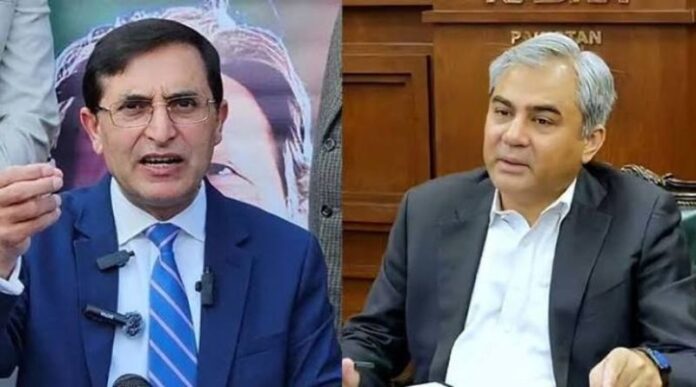

As March begins, political tensions remain high, but efforts to keep communication open between the government and Pakistan Tehreek-e-Insaf (PTI) have not completely ended. The backchannel contact involving PTI Chairman Barrister Gohar Ali Khan and Interior Minister Mohsin Naqvi is still being maintained, even as both sides continue to disagree on several important political issues.
The continued contact between Gohar and Naqvi shows that political communication has not fully stopped. While there may be no major breakthrough at the moment, the two sides appear to understand the need to keep some form of dialogue alive.
The situation remains sensitive because PTI has been demanding political relief, including steps related to its leadership and workers. The government, meanwhile, has remained cautious and has not shown any clear willingness to accept all of PTI’s demands.
Backchannel Contact Continues
Political discussions do not always take place through formal meetings. At times, senior politicians use informal channels to communicate, understand the other side’s position and avoid further tension. The Gohar-Naqvi contact is seen in this context.
Barrister Gohar Ali Khan has remained one of the important political faces of PTI, particularly during periods when the party has faced pressure and restrictions. Mohsin Naqvi, as interior minister, has also remained a key government figure in matters involving security, protests and political activity.
Their contact provides a possible way for both sides to share messages without immediately turning every discussion into a public political debate.
This does not mean that the government and PTI have reached an agreement. Instead, it suggests that communication has remained possible despite differences.
For political observers, keeping this channel open can be important because political situations can change quickly. A contact that appears small today can become useful later if both sides decide to move toward formal talks.
No Major Breakthrough Yet
Despite the continued backchannel, there has been no major breakthrough between PTI and the government.
PTI has repeatedly called for political issues to be addressed and has raised concerns about its leadership, workers and political space. The party believes that meaningful political engagement is needed to reduce tensions.
The government, on the other hand, has its own concerns. Officials have repeatedly stressed the importance of maintaining law and order and have taken a firm position on matters involving protests and political activity.
Because the positions of both sides remain different, reaching an immediate agreement is difficult.
The continued communication should therefore not be seen as proof that a political deal is close. It is better understood as an effort to prevent communication from completely breaking down.
Why the Gohar-Naqvi Contact Matters
The importance of the Gohar-Naqvi channel comes from the fact that both men can play a role in keeping communication moving.
Gohar has remained active in PTI’s political matters and has represented the party’s position on several important issues. His position allows him to communicate the concerns of the party leadership.
Naqvi, meanwhile, holds an important position within the government and has access to senior officials. His role also puts him close to issues involving security and internal political developments.
When two political sides are unable to sit together openly, communication through trusted individuals can sometimes help reduce misunderstandings.
Such channels can also help both sides understand what the other party may accept and what it may reject.
March Could Bring New Political Pressure
The beginning of March comes at a time when political uncertainty remains significant. PTI continues to push for its political demands, while the government is trying to manage pressure from different sides.
As the month moves forward, political developments could increase pressure on both parties to find some form of understanding.
PTI has a strong political presence and continues to demand space for its leadership and workers. At the same time, the government has to balance political demands with security concerns and its wider responsibilities.
This creates a difficult situation for both sides.
If communication remains open, it could provide a way to discuss sensitive matters before they become larger political disputes.
Informal Talks Can Prevent a Complete Deadlock
Backchannel communication is not unusual in politics. In many situations, formal talks become difficult because both sides face pressure from their supporters.
Public statements can also make negotiations harder. Once a political leader announces a position publicly, changing that position can become politically costly.
Informal contact gives leaders more room to discuss possible solutions without making immediate public commitments.
The Gohar-Naqvi channel could serve this purpose.
It allows messages to move between the two sides and can help determine whether there is enough common ground for more formal discussions.
However, the success of such communication depends on trust. If either side believes that discussions are being used only to gain political advantage, the channel can quickly lose its value.
PTI Wants Political Issues Addressed
PTI has been facing a number of political and legal challenges, and the party has continued to raise these issues with the government.
Its leadership wants political concerns to be addressed through dialogue rather than allowing tensions to continue indefinitely.
The party has also repeatedly highlighted the situation of its workers and leaders. From PTI’s point of view, political stability cannot be achieved if one of the country’s major political parties remains under constant pressure.
This is why the party has continued to look for opportunities to communicate with the government.
The backchannel involving Gohar could therefore be important for PTI because it keeps a line of communication available even when public relations between the two sides remain tense.
Government Faces Its Own Challenges
The government also has to deal with several challenges.
It must maintain law and order while managing political pressure. It also has to consider the views of its coalition partners and other political groups.
Any major concession to PTI could create political problems for the government. At the same time, refusing to engage with the opposition completely could allow tensions to grow.
This is why informal communication can be useful.
The government can hear PTI’s concerns without immediately agreeing to them. Similarly, PTI can communicate its position without making every discussion a public confrontation.
No Clear Sign of a Final Deal
Although the backchannel remains open, there is currently no clear indication that a final political agreement has been reached.
This distinction is important.
Political communication and political settlement are two different things. Two sides can remain in contact while still being far apart on major issues.
The current situation appears to be more about keeping communication alive than announcing a major political settlement.
This may change if both sides find areas where they can cooperate. But for now, expectations of a major deal should be kept limited.
A Possible Opening for Future Talks
One of the biggest benefits of keeping the channel open is that it leaves the door open for future negotiations.
If political circumstances change, both sides will already have a communication route available. This could make it easier to move toward formal talks.
For example, if pressure increases for political reconciliation, the existing contact could help arrange meetings between senior representatives.
Likewise, if tensions rise again, backchannel communication could help prevent misunderstandings and allow both sides to exchange messages quickly.
This makes the Gohar-Naqvi connection important even if it does not produce immediate results.
Political Stability Remains the Bigger Question
The wider issue is political stability in Pakistan.
Political uncertainty can affect many areas of national life. Businesses, investors and ordinary citizens generally prefer a stable environment where political disputes do not repeatedly lead to protests, clashes or uncertainty.
A reduction in political tension could therefore benefit not only the government and PTI but also the wider country.
However, lasting stability requires more than informal contacts. It requires political parties to agree on basic rules of engagement and respect democratic processes.
The government and opposition both have a role to play in this regard.
What Could Happen Next?
The coming weeks may provide a clearer picture of where the political situation is heading.
If Gohar and Naqvi continue their communication, there may be opportunities for more detailed discussions. The two sides could use the backchannel to identify issues where progress is possible.
At the same time, political statements from both sides will remain important. Strong public criticism can make private discussions more difficult, while softer statements could create space for further engagement.
Much will depend on whether PTI and the government are willing to show flexibility.
Neither side is likely to get everything it wants. Political negotiations usually require both sides to make some adjustments.
Backchannel May Prove Useful
The fact that the Gohar-Naqvi channel remains open as March begins is significant because it means communication has not completely stopped.
There is no guarantee that the contact will result in a political agreement. There is also no clear sign that a major settlement is immediately around the corner.
Still, keeping communication alive can be valuable in a tense political environment.
For PTI, it provides a way to convey its concerns directly to an important government figure. For the government, it provides an opportunity to understand PTI’s position and assess whether there is room for progress.
As March unfolds, attention will remain focused on whether this informal contact develops into more serious political engagement.
For now, the key point is simple: despite continued differences between PTI and the government, the door to communication has not been completely closed. The Gohar-Naqvi backchannel remains open, and that could become important if both sides decide that dialogue is the best way forward.
The coming weeks will show whether this contact remains limited to exchanging messages or eventually develops into formal political talks. Until then, the continued communication offers at least a small opening in an otherwise tense political situation.
Read Also: check