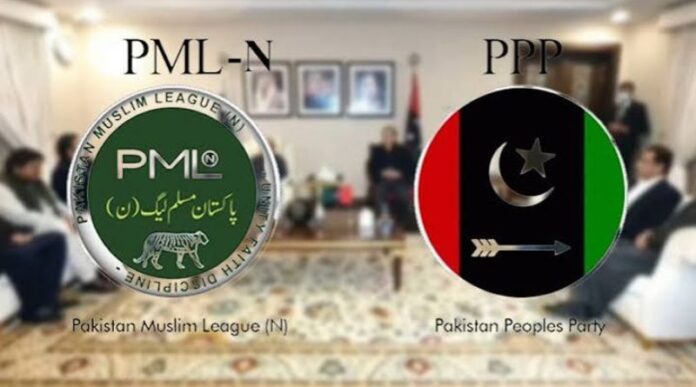

The Pakistan Muslim League-Nawaz (PML-N) and Pakistan Peoples Party (PPP) have agreed to work together on important legislation linked to Pakistan’s commitments under the International Monetary Fund (IMF) programme.
The two coalition partners held detailed discussions on Wednesday about laws that the government plans to bring before Parliament. According to reports, both sides agreed to support legislation that they consider to be in the national interest.
The development comes as the federal government prepares to call sessions of both the National Assembly and Senate next week. Several proposed legal changes are connected with reforms required under Pakistan’s IMF programme.
The meeting was held in the chamber of National Assembly Speaker Sardar Ayaz Sadiq. Federal Law Minister Azam Nazeer Tarar, Federal Minister for Parliamentary Affairs Tariq Fazal Chaudhry, Minister of State Bilal Azhar Kayani, and PPP leaders Sherry Rehman and Naveed Qamar attended the meeting.
Senior officials from the Ministry of Law, Ministry of Parliamentary Affairs and the National Assembly Secretariat were also present.
Coalition Partners Discuss Important Bills
The main focus of the meeting was legislation that needs to be considered by Parliament in light of Pakistan’s commitments under the IMF programme.
Sources said the government is preparing amendments to more than a dozen laws connected with government-owned organisations and other areas. Changes related to maritime affairs are also part of the planned legislation.
The discussions between the PML-N and PPP were aimed at building agreement before the bills are formally presented in Parliament.
The IMF programme includes several structural reforms covering public finances, taxation, energy, governance and the role of state-owned organisations. Pakistan has been working on these reforms as part of its financial arrangements with the IMF.
The latest discussions show that the government wants to coordinate with its coalition partner before moving ahead with legislation.
National Assembly and Senate Sessions to Be Called
During the meeting, the two parties also discussed the upcoming parliamentary sessions.
The government plans to summon both the National Assembly and Senate next week so that important bills can be taken up.
The Ministry of Parliamentary Affairs is expected to send a summary to the president within the next one or two days for the formal process of calling the sessions.
This will allow the government to present the proposed legislation and begin the parliamentary process.
Passing legislation related to IMF commitments is important because some reforms require changes in existing laws. While some IMF conditions can be implemented through government decisions, regulations or administrative measures, others require approval from Parliament.
The government therefore needs enough political support to move such bills through the legislative process.
Four Bills Under Discussion
According to a report by Dawn, four major bills were discussed in connection with the upcoming National Assembly session.
These include the Port Qasim Authority (Amendment) Bill, Gwadar Port Authority (Amendment) Bill, Karachi Port Authority (Amendment) Bill and Life Insurance Nationalization (Amendment) Bill.
Sources said the PPP agreed to three of the bills while one was not accepted.
The proposed changes are part of wider legal and institutional reforms being considered by the government.
Port-related laws are particularly important because Pakistan has several major ports that play a key role in trade, shipping and economic activity. Changes to the legal framework governing these institutions can affect how they operate and how responsibilities are divided.
The Life Insurance Nationalization law is another area where amendments are being considered.
Details of every proposed amendment have not yet been made public in full. The bills will become clearer once they are formally presented before Parliament.
Why IMF-Linked Legislation Matters
Pakistan is currently implementing a multi-year IMF programme aimed at improving economic stability and strengthening public finances.
The IMF’s current programme includes reforms related to government finances, taxation, energy-sector performance, governance and other structural areas.
In March 2026, the IMF announced that its staff had reached an agreement with Pakistan on the third review of the 37-month Extended Fund Facility and the second review under the Resilience and Sustainability Facility. The agreement was subject to approval by the IMF Executive Board and involved around $1 billion under the EFF and about $210 million under the RSF.
The IMF’s programme includes several targets and reform measures that Pakistan has committed to carrying out.
The IMF’s April 2026 country report listed structural measures involving tax collection, fuel pricing, parliamentary oversight, agriculture income tax, FBR reforms, governance and public disclosure of assets, among other areas.
Some of these reforms require changes to laws, which is why parliamentary legislation remains an important part of the programme.
Government Wants Political Support
The latest PML-N and PPP meeting is also important because the federal government needs cooperation from its coalition partners to pass legislation.
The PPP is part of the federal governing arrangement, making its support important for bills that require parliamentary approval.
The discussions at the Speaker’s chamber were therefore not limited to the technical details of legislation. The two sides also discussed the broader parliamentary schedule and issues that could affect upcoming sessions.
The government wants to avoid delays when the bills are introduced in Parliament.
The agreement to support legislation considered to be in the national interest provides a basis for moving forward with the proposed laws.
However, individual bills will still have to go through the normal parliamentary process.
Broader Political Issues Also Discussed
The meeting took place at a time when the federal government is also dealing with political and security issues, particularly the situation in Khyber Pakhtunkhwa.
After the meeting, Law Minister Azam Nazeer Tarar told journalists that the consultation was related to legislation. He also clarified that there had been no decision in the meeting to impose governor’s rule or an emergency in Khyber Pakhtunkhwa.
According to the minister, constitutional procedures would apply if such a step were considered.
The government has separately been discussing the security situation in Khyber Pakhtunkhwa, where authorities have reported serious security challenges.
Dawn reported that the federal government was consulting the PPP on the situation, while PPP leaders have also spoken about constitutional procedures and political dialogue.
These issues were taking place alongside the discussions on legislation.
PPP Position on Parliamentary Legislation
The PPP leadership has continued to participate in consultations with the federal government on matters of national importance.
Its representatives attended the meeting with PML-N leaders and government officials to discuss the bills expected to come before Parliament.
The party’s participation is significant because several of the proposed measures involve changes to existing laws.
The two sides may continue discussions on individual bills before they are formally presented. Such consultations can help identify areas of agreement and disagreement before parliamentary debate begins.
The final form of the legislation will depend on the parliamentary process.
Reforms Involving State-Owned Organisations
One major part of the planned legislation involves laws connected with government-owned entities.
Pakistan has been working for years to improve the performance of state-owned organisations and reduce the financial pressure created by loss-making public institutions.
The IMF programme also includes measures aimed at reducing the government’s footprint and improving the management of public resources.
The IMF’s latest country report includes structural measures related to reducing the federal government’s footprint and improving governance and transparency.
Legal changes can provide the framework needed to implement these reforms.
For the government, the challenge is to pass the required laws while also ensuring that Parliament has enough time to examine and debate them.
Importance of Maritime Laws
The proposed legislation also includes amendments related to maritime affairs.
Pakistan’s ports are important for international trade because a large share of the country’s imports and exports moves through sea routes.
Port Qasim, Karachi Port and Gwadar Port each have their own legal and administrative structures.
Changes to the laws governing these institutions can influence their management, responsibilities and future operations.
The government’s decision to include amendments concerning Port Qasim and Gwadar in the planned parliamentary legislation indicates that maritime institutions are part of the wider reform agenda.
The exact impact of each amendment will become clearer after the government presents the bills and lawmakers debate their provisions.
Parliament to Play Key Role
The next sessions of the National Assembly and Senate are expected to be important for the government’s legislative programme.
Once the sessions are formally summoned, the government can introduce the proposed bills and begin the parliamentary process.
Members of Parliament will then have an opportunity to discuss the proposed changes.
Bills generally pass through several stages before becoming law. They may be introduced, debated, examined by committees and then voted upon.
The Senate and National Assembly may also consider amendments during the process.
This means that the agreement between the PML-N and PPP provides political support for the legislation, but the final outcome will still depend on parliamentary proceedings.
IMF Programme Remains a Major Economic Focus
Pakistan’s IMF programme remains closely linked with the government’s efforts to improve fiscal management and strengthen the country’s economic position.
The programme includes targets covering government revenue, spending, energy reforms, governance and other areas.
The IMF has also stressed the need for continued structural reforms rather than relying only on short-term financial measures.
For Pakistan, completing these reforms is important for maintaining the programme and accessing financial support under the agreed arrangements.
The government has therefore been working on both administrative measures and legislation to meet its commitments.
The latest agreement between the PML-N and PPP is part of this broader process.
What Happens Next?
The immediate next step is expected to be the formal summoning of the National Assembly and Senate.
After the sessions begin, the government can present the proposed bills before Parliament.
The PML-N and PPP are expected to continue coordinating on the legislation as the parliamentary process moves forward.
The government will also have to address any concerns raised by lawmakers during debate and committee discussions.
For the IMF-linked measures, implementation will remain important after legislation is passed. Passing a law is only one part of a wider reform process. Government departments will also need to apply the new rules and meet the targets connected with them.
The IMF has previously monitored Pakistan’s progress through formal reviews. Its March 2026 staff-level agreement noted continued efforts to strengthen public finances, improve the energy sector, maintain price stability and advance structural reforms.
Conclusion
The PML-N and PPP have reached an understanding to cooperate on important legislation connected with Pakistan’s IMF commitments. The two coalition partners discussed proposed amendments to several laws and agreed to support legislation that they consider to be in the national interest.
The government is preparing to call sessions of the National Assembly and Senate next week, where the proposed bills are expected to be presented.
Among the legislation under discussion are amendments concerning Port Qasim Authority, Gwadar Port Authority, Karachi Port Authority and Life Insurance Nationalization. Other laws involving government-owned entities and maritime affairs may also be included.
The development comes as Pakistan continues implementing reforms under its IMF programme. Some of these reforms require changes to existing laws and therefore need parliamentary approval.
The upcoming parliamentary sessions will show how the proposed legislation develops and what changes lawmakers make before the bills are passed.
For now, the agreement between the PML-N and PPP provides a basis for the government to move ahead with its planned IMF-related legislative agenda.
Read Also: check