
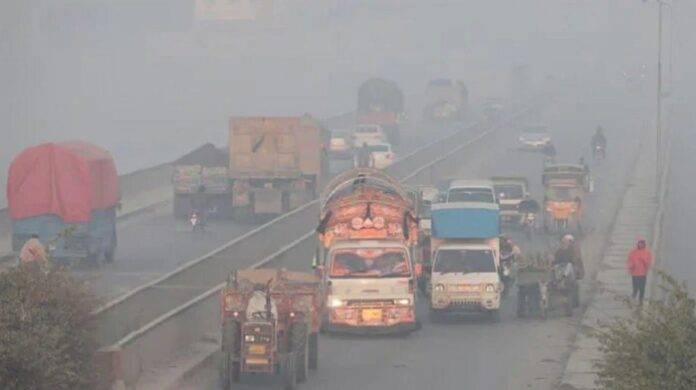

The worsening smog situation in Punjab every year demands that the government take timely and sustained preventive measures before winter weather turns hazardous to human life. Rising to the occasion, the Punjab government, as a first step, is requiring vehicles to undergo mandatory smoke emission tests to prevent smog from thickening on the roads, particularly during November and December. This is indeed a step in the right direction, but it alone is not sufficient to check the spread of smog or prevent it from becoming hazardous to human health. As far as vehicle fitness and smoke emissions are concerned, the success of this initiative depends not on the number of fitness stickers issued but on effective enforcement, reliable testing and a broader strategy to curb air pollution.
The provincial government has directed owners of government and private vehicles to obtain fitness certificates to control vehicular emissions, a major contributor to deteriorating air quality. It has instructed relevant authorities, including provincial secretaries and divisional commissioners, to ensure compliance.
The urgency of the measure is evident from the long queues at vehicle fitness centres across Lahore. Motorists continued to visit testing facilities even on a holiday, rushing to obtain green fitness stickers despite a one-month extension of the deadline. Emission testing is being conducted at 12 centres across the city.
Authorities have warned of strict action against vehicles that fail to meet prescribed fitness standards from November 15. Vehicles failing the smoke emission test will be fine. The QR-coded fitness stickers will remain valid for one year. Under the prescribed rules, cars with engine capacities of up to 1,000cc are exempt from the requirement for five years from their date of manufacture.
At the same time, public awareness is equally important. Motorists should be encouraged to maintain their engines, service their vehicles regularly and avoid practices that increase emissions. Authorities, meanwhile, must ensure that testing equipment is properly calibrated and that inspections cannot be bypassed through favouritism or malpractice.
While these measures may encourage motorists to maintain their vehicles and reduce harmful emissions, enforcement must be fair, transparent and consistent. Testing centres need adequate capacity to prevent long queues, while vehicle owners should have access to clear guidelines and reliable testing facilities. Fitness certificates must reflect actual emission performance rather than become another administrative formality. However, this measure alone cannot effectively reduce smog levels, as many other sources also contribute significantly to air pollution.
Poor response to public complaints
I would like to draw the attention of Punjab Chief Minister Maryam Nawaz to the deteriorating state of her public service initiative, as the relevant departments have failed to address citizens’ complaints.
I have lodged several complaints regarding stray dogs and heaps of garbage on Main 80 Road, Block D, Jubilee Town, Lahore, but no effective action has been taken. Many illegal shops have reportedly been established, allegedly in league with LDA staff, while makeshift shops have been set up on vacant plots. The occupants dump garbage on these plots, creating foul smells and serious health hazards for nearby residents.
I urge the Chief Minister and the concerned authorities to take immediate notice of the situation, investigate the alleged encroachments, ensure proper waste disposal and address the issue of stray dogs without further delay. – Aftab Ahmad, Lahore
Children risking their lives
Many children are forced to work to support their families. Children aged 7 to 15 often work in hazardous conditions, endure physical and mental abuse, and receive unfairly low wages, depriving them of their right to a safe and healthy childhood. Child labour also prevents them from attending school and developing the skills needed for a better future.
Poverty and inadequate social protection leave these children vulnerable, particularly during economic crises. Society must change its mindset and work collectively to end child labour. Pakistan needs better living standards, stronger protection for vulnerable families and access to quality education so that no child is forced to work for survival. The government must also enforce labour laws and support struggling households. Every child deserves the opportunity to learn, grow and build a brighter future. – Yawar Shaikh, Lahore.
Barriers to girls’ education
Education is essential for national development, and girls deserve equal opportunities to learn. However, Pakistan continues to face serious challenges in female education, with millions of children out of school and girls particularly disadvantaged.
Religious misinterpretations, gender discrimination, and the belief that girls do not need education beyond puberty prevent many from continuing their studies. Some parents also fear sexual harassment at educational institutions and during their daughters’ journeys to and from educational institutions.
Educating girls benefits families, communities and the nation. The government must strengthen education policies, ensure girls’ safety and raise awareness at the community level. Equal access to quality education is essential for Pakistan’s progress. – Javeriya Khan, Karachi.
Rising inflation makes daily life difficult
For millions of Pakistani families, rising prices of food, transport, electricity, healthcare and education have made daily expenses increasingly difficult to manage, leaving little room to meet the expenses for unexpected and emergency situations.
According to the Pakistan Bureau of Statistics, inflation reached 11.1 percent year-on-year in August 2026, rising to 12.2 percent in rural areas against 10.4 percent in urban areas. The Sensitive Price Indicator recorded a 10.64 percent annual increase in the week ending September 17, 2026.
Behind these figures, households are cutting nutritious food, delaying medical treatment and limiting educational expenses. Small businesses and daily-wagers also face mounting costs, while low-income families have few savings to cushion the impact.
The government must curb hoarding and profiteering, improve supply chains, reduce unnecessary costs and strengthen targeted support for vulnerable households. Ultimately, the true measure of inflation is its impact on daily life. Protecting purchasing power and keeping essential goods and services affordable must remain a policy priority. – Asma Tanveer, Islamabad.
AI dependence weakens independent thinking
Artificial Intelligence (AI) is transforming workplaces, education, healthcare and businesses. While it improves efficiency, it also raises concerns about job losses, skills gaps and responsible use.
AI can automate repetitive tasks while creating new opportunities in technology and digital services. Governments, businesses and educational institutions should provide affordable training to help workers adapt and develop technical, communication and problem-solving skills.
In education, AI can help students understand complex subjects and assist teachers in preparing lessons. However, excessive dependence on AI can weaken independent thinking. Students must learn to verify information, protect their privacy and use technology responsibly.
Access to electricity, the internet and digital devices is also essential to prevent AI from widening educational inequalities.
Rather than viewing AI solely as a threat, society should embrace its benefits while preparing people for technological change through digital literacy, critical thinking and lifelong learning. – Fatima Naeem, Multan.
Internet’s dark side
The internet has transformed how children learn, communicate, and entertain themselves, but unrestricted, unsupervised use can expose them to serious risks. The aim should not be to keep children away from technology, but to teach them to use it safely and responsibly.
Excessive screen time can disrupt sleep, studies, physical activity and family interaction, while limiting opportunities for outdoor activities and face-to-face communication. Children may also encounter inappropriate content, misinformation, online scams, cyberbullying and attempts to obtain their personal information.
Parents and teachers should educate children about digital safety, privacy protection and responsible internet use. Children must learn to safeguard passwords and personal information, recognise misleading content and avoid risky interactions with strangers. Reasonable screen-time limits and open discussions about online experiences are equally important.
Schools should strengthen digital literacy to help students think critically and behave responsibly online. With parental guidance, effective education, responsible platform practices and public awareness, children can benefit from technology while minimising its risks. – Shazia Saleem, Absor.