
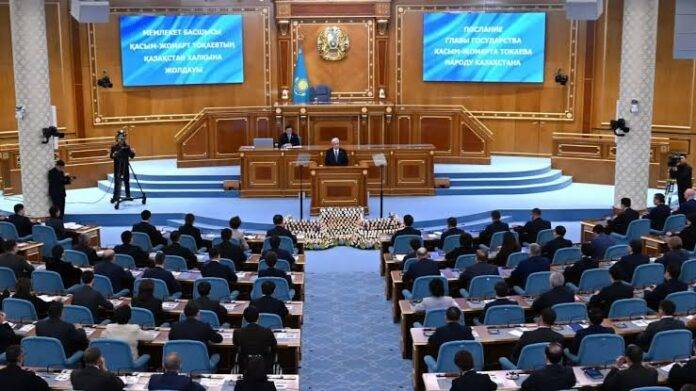

ASTANA, October 28: Kazakhstan’s President Kassym-Jomart Tokayev has announced plans to allocate approximately 6.5 trillion tenge from the National Fund to infrastructure development through 2029, placing large-scale construction and an artificial intelligence-powered digital economy at the centre of the country’s development agenda.
Delivering his State of the Nation Address, titled “Kazakhstan’s Current Priorities in a New Historical Cycle,” Tokayev instructed the government to prepare an Infrastructure Modernisation Plan covering social facilities, transport networks and utilities across every region.
The initiative, named “People’s Construction,” would receive 1.5 trillion tenge for social projects in 2026 and the first two months of 2027. Its first phase envisages approximately 70 healthcare facilities and around 50 educational, sporting and cultural facilities.
Tokayev also proposed declaring 2027 the Year of Nationwide Large-Scale Construction.
Digital Economy and AI Take Centre Stage
The president called for a shift from providing digital services to helping citizens use technology to earn incomes, build businesses and access investment opportunities.
“Our goal is to build a truly people’s digital economy,” he said.
According to the address, Kazakhstan has launched two supercomputers, with a third expected to enter service before the end of the year. Tokayev said the fibre-optic backbone across the Caspian seabed had been completed, while data centre construction was under way.
However, he cautioned that digitalisation should deliver practical economic benefits, rather than revolve around events or expensive software purchases.
The government was tasked with establishing a simplified legal framework for digital employment by the end of 2026. Pilot projects planned for next year would connect rural producers with sales channels through partnerships involving marketplaces, banks, logistics companies and digital service providers.
Tokayev also called for further work on asset tokenisation to broaden investment participation and help businesses raise capital.
Energy Expansion to Support Technology Growth
Linking technological ambitions to electricity availability, Tokayev set a target for Kazakhstan to achieve a sustained electricity surplus by 2029.
He said annual electricity generation of 123 billion kilowatt-hours was insufficient to meet the country’s industrial expansion and plans for widespread AI adoption and data centres.
The proposed response includes new power plants, modernisation of existing facilities and transmission networks, and further development of nuclear and renewable energy.
Tokayev said construction of the Balkhash Nuclear Power Plant could potentially begin next year and called for negotiations to advance the Moyynkum nuclear project.
Transport Links and Business Support
The address also prioritised Kazakhstan’s position as a Eurasian transport hub, with investment in railways, roads, airports and border crossings.
Tokayev said the Bakhty–Ayagoz railway was expected to become operational in 2027, adding 20 million tonnes of freight capacity on routes towards China. He also demanded comprehensive digitalisation of transport operations and international freight documentation.
For businesses, he proposed discussion of a three-year moratorium on inspections of micro and small enterprises from January 1, 2027, alongside targeted tax amendments and expanded access to long-term financing.
The president instructed the government to raise the minimum wage from 85,000 to 110,000 tenge from January 2027, a measure he said would benefit nearly 1.8 million people.
Throughout the address, Tokayev emphasised that public investment, digital reform and infrastructure development should be measured by their contribution to household incomes, productivity and living standards.