

Introduction
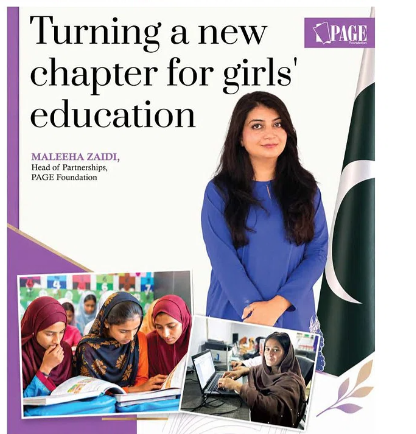
The Flare panel conducted an interview with Maleeha Zaidi, the Head of Partnerships at the PAGE Foundation. She emphasised that education provides girls with enhanced opportunities, paving the way for advanced schooling, career options, business endeavours, and leadership roles. Consequently, investing in girls’ education serves as a pragmatic approach to securing Pakistan’s future, benefiting not only the girls themselves but also their families and the wider community.
Q&A Section (Question & Answer)
Flare: What is PAGE’s core mission and what are its principal areas of work today?
Maleeha Zaidi: PAGE Foundation, formerly the Pakistan Alliance for Girls Education, began in 2014 to help girls and other out-of-school children return to learning and access better opportunities.
We work with governments, schools, communities, donors and partners to advance girls’ education. Our Star Schools offer accelerated primary education, particularly for girls, while Digital Inclusion Hubs provide women and girls with computers, internet access and digital skills. Our leadership and life-skills programmes also build confidence and practical skills among adolescent girls and young women.
Flare: What are the most serious barriers to education and opportunity for girls and under-served children in Pakistan?
Maleeha Zaidi: Poverty, limited access to schools and social and cultural expectations remain major barriers. Climate-related disasters, floods and displacement add further pressure, often affecting girls the most. We have seen this particularly in flood-affected districts of Sindh and Balochistan and among Afghan refugee families in Pakistan, where children can lose months or years of education.
Flare: Which PAGE programmes have produced the strongest measurable impact, and what results can you share?
Maleeha Zaidi: Star Schools has been one of our strongest programmes and was recognised as a Laureate of the 2023 UNESCO Prize for Girls’ and Women’s Education. It provides three years of accelerated primary education, helping out-of-school children catch up and transition into formal schools. Thousands of children have completed primary education through the programme, with a majority subsequently entering formal education.
Achieve Pakistan has also delivered encouraging results, with almost all participating girls reporting improvements in confidence, problem-solving and group participation. In 2025, we launched a cricket skills programme, training more than 50 girls through top PCB coaches; its second phase is now expanding.
Our Digital Inclusion Hubs are also helping women and girls in rural Sindh gain computer, internet and online-service skills.
Flare: How does PAGE identify communities and beneficiaries most in need of support?
Maleeha Zaidi: We combine data with local knowledge. PAGE works with government education departments and partners and uses information from organisations including the Pakistan Institute of Education, Pakistan Bureau of Statistics, UNICEF and the World Bank.
Our teams also conduct field assessments and work with communities and Village Education Committees to identify out-of-school children. For Achieve, government departments nominate schools where they see the greatest need.
Flare: What role do digital learning, technology and innovation play in PAGE’s current strategy?
Maleeha Zaidi: Digital access is increasingly central to our work. Our Digital Inclusion Hubs provide computers, internet access and training, including basic digital skills and safe internet use. We also work with organisations such as eCornell to provide women with online career and leadership training, enabling them to gain recognised skills without travelling long distances.
Flare: How does PAGE work with government, schools, communities, donors and the private sector?
Maleeha Zaidi: Partnerships are central to PAGE’s work. We collaborate with government organisations including the Federal Directorate of Education, Sindh Education & Literacy Department, KP Elementary and Secondary Education Foundation, Punjab Education Foundation and National Commission for Human Development.
Our funding partners include Education Cannot Wait, Alight, L’Oréal Fund for Women, Malala Fund, King’s Trust International, Bat for a Chance and UN Women. We also work with Pakistani companies and banks, including Zindigi by JS Bank and Bank of Punjab.
Our Peer-Learning programme also connects students from private-sector universities and schools with children in our community schools.
Flare: What are the biggest funding and implementation challenges facing education-focused NGOs in Pakistan?
Maleeha Zaidi: Continuity is one of the biggest challenges. Education takes time, and programmes such as Star Schools require multi-year funding to help children catch up effectively.
Short-term grants and gaps between funding cycles can disrupt planning and affect schools and students. We also need more education partners and student volunteers in areas such as Qambar Shahdadkot, Dadu and Jacobabad.
Flare: What are PAGE’s expansion priorities for the next two to three years?
Maleeha Zaidi: We aim to expand Star Schools, particularly in rural areas with large numbers of out-of-school children. We also want to extend the Achieve Programme to help more girls develop the confidence and skills needed for education and employment. Expanding digital access for women is another priority, particularly through skills that can lead to freelance and remote work.
Flare: How can Pakistan’s corporate sector and overseas Pakistanis contribute more effectively to your mission?
Maleeha Zaidi: Corporate organisations can provide multi-year funding, while individuals can sponsor children or support specific programmes. PAGE has partnered with organisations including Bank of Punjab, Zindigi by JS Bank, Parco Gunvor and National Bank of Pakistan, and welcomes similar partnerships.
Through our Global Ambassadors programme, we also engage overseas Pakistanis through campaigns, including zakat-eligible donations and matched funding. Those interested can contact [email protected].
Flare: What message would you like to give Flare readers about investing in education and girls’ empowerment?
Maleeha Zaidi: Education should be available to every child, yet many children in Pakistan remain excluded. We meet girls working in fields or brick kilns, carrying household responsibilities or walking long distances to school—yet many remain determined to learn.
Education gives girls greater choices, opening pathways to further education, employment, entrepreneurship and leadership. Supporting girls’ education is therefore a practical investment in Pakistan’s future, benefiting not only individual girls but their families and communities.


