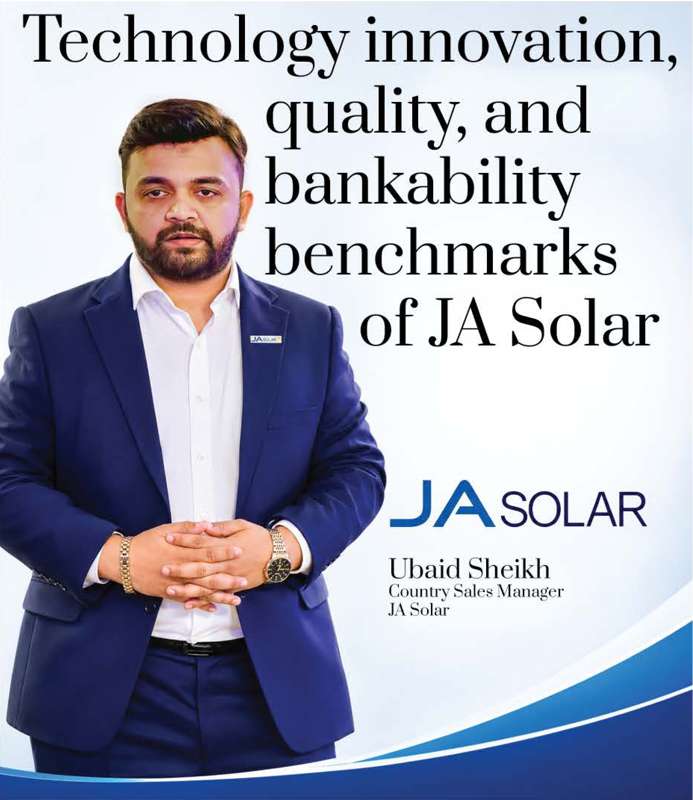

The Flare panel had the opportunity to interview Ubaid Sheikh, the Country Sales Manager at JA Solar. He shares insights into the solar industry, highlighting the remarkable growth of Pakistan’s solar energy market. Initially seen mainly as a residential option, it has quickly transformed into a significant movement in the commercial, industrial, and agricultural sectors.
Flare: Share your professional journey in the solar energy industry and the experiences that led you to your current role as Country Sales Manager at JA Solar Pakistan?
Ubaid Sheikh: My professional journey in renewable energy has been driven by a strong belief in the transformative power of clean technology. Over the years, I have witnessed solar evolve from an alternative luxury into an economic and environmental necessity. Working with market dynamics, distribution networks, and large-scale projects has given me a comprehensive understanding of emerging markets. Becoming Country Sales Manager at JA Solar, a global Tier-1 leader, was a natural progression, allowing me to align my strategic vision with an organisation committed to shaping Pakistan’s sustainable energy future.
Flare: How would you assess the current growth of Pakistan’s solar energy market, and what major factors are driving increasing adoption?
Ubaid Sheikh: Pakistan’s solar energy market is experiencing unprecedented growth. What began primarily as a residential alternative has evolved into a mainstream commercial, industrial, and agricultural movement. The main driver is economics: soaring grid electricity tariffs have made solar not just an environmentally friendly choice but a viable financial strategy for businesses and households. Improved technology efficiency and falling global module costs have also shortened return-on-investment periods, enabling consumers to improve their energy security.
Flare: What distinguishes JA Solar’s products, business philosophy, and market approach in Pakistan’s competitive solar industry?
Ubaid Sheikh: JA Solar’s market leadership stems from its commitment to technological innovation, quality, and bankability. As a BloombergNEF Tier-1 manufacturer, our DeepBlue series modules offer higher energy yields, superior low-light performance, and long-term reliability in harsh climatic conditions. Our philosophy centres on customer satisfaction and sustainable partnerships. In Pakistan, we differentiate ourselves not merely by selling panels but by providing technological reliability, long-term value, and strong after-sales support.
Flare: What are the major challenges facing Pakistan’s solar sector, particularly regarding import policies, taxation, regulatory uncertainty, financing, and competition?
Ubaid Sheikh: Despite rapid growth, the market faces significant challenges. Regulatory unpredictability, changing import policies, and sudden taxation adjustments complicate planning for distributors and developers. Bureaucratic delays and fluctuating customs duties disrupt supply chains. Limited access to affordable, long-term local financing also constrains large commercial and industrial projects. Meanwhile, unverified and substandard products create unfair pricing pressure, making consumer education about quality and authentic warranties increasingly important.
Flare: How will changes in net metering and net billing regulations affect future solar investment? What policy measures would encourage consumers and protect investor confidence?
Ubaid Sheikh: Changes to net metering and net billing frameworks may create temporary market uncertainty, but solar’s economic fundamentals remain strong because grid electricity is expensive. Regulatory stability is essential to maintaining investor confidence. Policymakers should engage industry stakeholders to develop predictable, transparent frameworks that fairly compensate distributed generation while addressing grid management concerns. Long-term certainty would encourage residential and commercial consumers to continue investing without fearing sudden policy reversals.
Flare: What opportunities exist for Pakistan’s industrial, commercial, agricultural, and corporate sectors to reduce energy costs through solar, and how can JA Solar support this transition?
Ubaid Sheikh: The potential for cost savings across Pakistan’s key sectors is substantial.
- Industrial and Corporate: Captive solar installations can significantly reduce manufacturing costs and improve export competitiveness.
- Agricultural: Solar tube wells offer reliable daytime pumping power, reducing dependence on diesel and erratic grid supplies.
JA Solar supports this transition by supplying high-efficiency modules for utility-scale projects, commercial rooftops, and agricultural installations, alongside technical guidance to optimise plant performance.
Flare: How important are local distributors, EPC companies, installers, and strategic partners in expanding JA Solar’s presence, and what opportunities exist for stronger collaboration?
Ubaid Sheikh: Local distributors, EPC contractors, and installers are the backbone of JA Solar’s presence in Pakistan, connecting our global manufacturing capabilities with end-users. Expanding our market share depends on strengthening these relationships through transparent policies, technical training, and joint marketing. Closer industry collaboration will help maintain quality standards from the warehouse to the final rooftop installation.
Flare: How does JA Solar contribute to Pakistan-China clean energy cooperation, and are there opportunities for local manufacturing, technology transfer, training, or further investment?
Ubaid Sheikh: JA Solar reflects the strong economic and technological cooperation between Pakistan and China. We consider Pakistan a strategically important market with long-term potential. As the market matures, we continue evaluating opportunities for deeper engagement, including localised technical support, capacity-building workshops for engineers, and knowledge transfer in solar engineering, operations, and maintenance.
Flare: As Country Sales Manager, what are your key business priorities for expanding JA Solar’s market share?
Ubaid Sheikh: My priorities stay on three pillars:
- Market Consolidation: Strengthening our Tier-1 positioning and expanding our authorised distribution network across underserved areas of Pakistan.
- Brand Integrity: Protecting consumers from counterfeit products through robust authentication mechanisms.
- Strategic Diversification: Expanding into utility-scale projects and large industrial captive solar portfolios while maintaining our presence in residential and commercial markets.
Flare: What message would you share with Pakistan’s policymakers, solar industry professionals, and consumers about building a reliable, high-quality, and sustainable solar ecosystem?
Ubaid Sheikh: Solar energy is no longer merely an alternative for Pakistan; it is central to national energy independence and economic resilience. I urge policymakers to ensure consistent, forward-looking regulations that protect investments. Industry professionals and partners must prioritise quality over short-term margins, as sustainable growth depends on trust. Consumers should invest in proven, high-quality technology for long-term energy security. Together, we can build a cleaner, brighter, and more self-reliant Pakistan.
Source: Flare Magazine, November 2026