
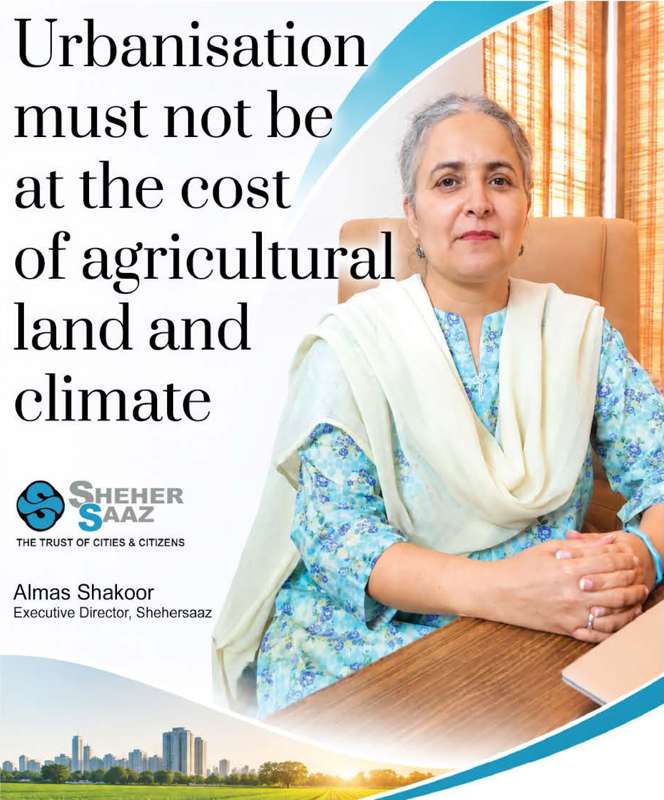

The Flare editorial team interviewed Almas Shakoor, Executive Director of Shehersaaz. She pointed out that a major issue for cities in Pakistan is the absence of effective urban planning. As people flock to cities for improved healthcare, education, transportation, and jobs, the insufficient growth of these services to match the rising population leads to significant challenges.
Flare: What inspired your career in urban development, and what is Shehersaaz’s central mission today?
Almas Shakoor: I was inspired to work in urban development because, despite its growing importance, relatively few organisations focus on the challenges our cities face. More people are migrating to urban areas for better healthcare, education, transport and livelihood opportunities. Cities drive our economy, but agriculture sustains our population. Urban growth must not come at the expense of agricultural land and the natural environment. We must ask whether our cities can accommodate this growing population. COVID-19 also highlighted the vulnerability of urban communities when essential services and living conditions are inadequate. Climate change makes these challenges even more urgent. Infrastructure is important, but lasting change also requires awareness, preparedness and a shift in mindset.
Flare: Based on your 26 years of experience, what are the most pressing challenges facing Pakistan’s rapidly growing cities?
Almas Shakoor: One of the biggest challenges is the lack of proper urban planning. People move to cities for better healthcare, education, transport and employment, but when facilities cannot keep pace with population growth, serious problems arise. We cannot stop urban migration, nor should we. Instead, we must plan better and ensure infrastructure and public services can accommodate people. Imagine a house built for five people but occupied by fifteen. The same is happening in our cities. When adequate housing and basic services are unavailable, people often settle on the outskirts, where sanitation, waste management, drainage and safe drinking water may be inadequate. Over time, these problems contribute to informal settlements and serious public health and environmental concerns. Cities must grow in a planned, inclusive and climate-resilient manner so people can access the opportunities they seek.
Flare: Which Shehersaaz initiatives have made the most meaningful difference to urban communities?
Almas Shakoor: One of our key initiatives is PUCCAR (Project for Urban Climate Change Adaptation and Resilience), implemented in Rawalpindi and Nowshera with support from the Adaptation Fund and UN-Habitat. The project installed 5,000 household rainwater harvesting units, providing approximately 7.86 million litres of storage capacity. It directly benefited around 105,130 people, with an estimated 200,000 more benefiting indirectly. Another 60 demonstration units were installed in educational institutions to support access to drinking water for children. We also worked on solid waste management, drainage, community awareness and environmental protection. The initiative also helps families manage water, creates opportunities for women to participate and encourages communities to take ownership of their surroundings through greater awareness and preparedness.
Flare: How can Pakistan make its cities more resilient to climate change, flooding and other disasters?
Almas Shakoor: Preparedness is essential. Unfortunately, we often act only after a disaster occurs. We must change this mindset and prepare communities beforehand. At Shehersaaz, we have conducted school safety audits for around 20 years. Recently, we assessed 26 public schools in Rawalpindi to identify infrastructure gaps, potential hazards and weaknesses in emergency arrangements. We also facilitated Rescue 1122-certified training to prepare children for emergencies. These efforts must continue, particularly in communities facing growing risks such as flash floods. Investing in preparedness before disaster strikes can save lives.
Flare: What steps are urgently needed to improve women’s participation in urban planning and local decision-making?
Almas Shakoor: We cannot build inclusive cities without attending to the voice of women. Their everyday experiences highlight overlooked issues, including poor street lighting, unsafe public spaces, transport difficulties and limited livelihood opportunities. An inclusive city enables women to move safely, express themselves within their cultural contexts, access opportunities and participate in decisions affecting their lives, including urban planning and local decision-making.
Flare: How can local governments, civil society and the private sector work together to build safer, more inclusive cities?
Almas Shakoor: Local governments are responsible for essential services, including clean drinking water, sanitation, street lighting and local infrastructure, while parliament focuses on policymaking. Local governments need adequate resources and political support to meet people’s daily needs.
Public-private partnerships can help: the public sector provides governance and infrastructure, the private sector contributes investment and expertise, and civil society connects communities with decision-makers. Women’s participation is equally important. Safer, more inclusive cities require strong local governments, public participation, private investment and the political will to turn policies into action.
Flare: What lessons have you learned from working with UN agencies and development organisations that Pakistan could apply more widely?
Almas Shakoor: Working with UN-Habitat has been valuable. One important lesson is that development must go beyond completing project activities to create meaningful, lasting change. Although projects are often short-term, Shehersaaz treated PUCCAR not merely as a project but as a responsibility towards our communities. Its rainwater harvesting units, for example, helped address water shortages. This experience reinforced my belief that projects should focus on solving real problems, not simply completing activities.
Flare: What are Shehersaaz’s upcoming priorities, and what message would you give policymakers about sustainable urban development?
Almas Shakoor: Our priorities are to build community resilience, promote inclusive urban planning and help cities adapt to climate change. We must also protect agricultural land and green spaces as cities expand, given their importance for food security, water resources and quality of life. At Shehersaaz, we continue to build community capacity and awareness so people can better understand and respond to urban and climate challenges.
Urbanisation cannot be stopped; the real question is how to plan sustainable growth. Climate change will intensify food-security challenges, particularly as agricultural land is converted into housing and infrastructure. If every available space becomes grey, where will our green spaces be? Many local urban problems could become easier to resolve if local governments were empowered to function effectively.
Source: Flare Magazine, November 2026