
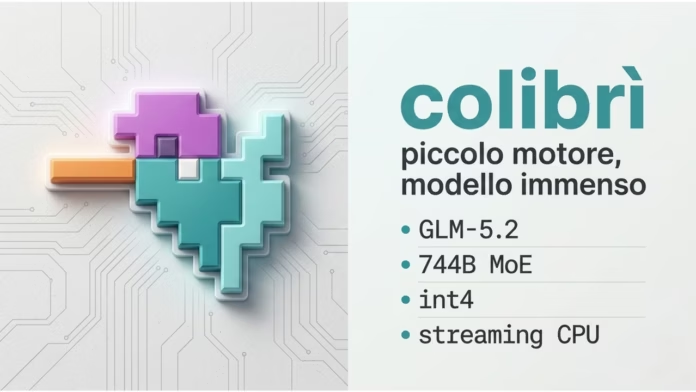

A developer has created a new lightweight AI inference engine called Colibri, making it possible to run Z.ai’s GLM-5.2, a massive 744-billion-parameter Mixture-of-Experts (MoE) AI model, on ordinary consumer hardware without needing an Nvidia GPU.
Normally, AI models of this size require powerful graphics cards, large amounts of memory, and expensive cloud servers. However, Colibri uses a different approach that allows developers to run the model on a computer with around 25GB of RAM, using only the computer’s CPU and a fast SSD storage drive.
One of the biggest reasons Colibri is different is that it does not load the entire AI model into memory at once. Instead, it only loads the parts of the model that are needed for the current task. The remaining model data stays on the SSD and is loaded only when required.
This works much like streaming a movie online. When you watch a video, your device does not download the entire movie before playback starts. Instead, it downloads small parts as you continue watching. Colibri uses the same idea by streaming the AI model’s data from storage while it is running.
The AI model used with Colibri is the GLM-5.2 INT4 version, which has been optimized to work with this system. Although users still need enough SSD storage space and a fast storage drive, the system greatly reduces the amount of RAM needed to run such a large AI model.
However, users should not expect the same speed as high-end computers equipped with powerful Nvidia GPUs. Since the model relies on CPU processing and continuously loads data from storage, it will be slower than GPU-based systems. Even so, it demonstrates that extremely large AI models can run on much more affordable hardware than previously thought.
Another major advantage of Colibri is that it does not require the software tools that most AI models depend on. Traditional AI systems usually need CUDA, PyTorch, and cloud-based GPU infrastructure to work properly. Colibri removes these requirements completely, making it easier for developers to experiment with advanced AI models on their own computers.
The project has been released as open source and is available on GitHub through the JustVugg/colibri repository. Developers can download the software, install the optimized GLM-5.2 INT4 model, connect the model files to Colibri, and start chatting with the AI locally.
Colibri can also work as an OpenAI-compatible API endpoint. This means developers who already have applications built for OpenAI APIs can connect those apps to Colibri by simply changing the Base URL, without rewriting their existing code. This makes it much easier to test large open-source AI models in existing projects.
Although Colibri is an impressive achievement, it is not a replacement for Nvidia GPUs. Large GPU servers are still much faster for commercial AI services, handling multiple users at the same time, and processing heavy workloads. Businesses that need maximum speed and performance will still rely on GPU-powered systems.
Instead, Colibri should be seen as a proof of concept that shows a new way of running massive AI models. Rather than depending entirely on expensive GPU memory (VRAM), the software shifts much of the workload to regular system RAM and SSD storage, making advanced AI more accessible.
This development is important because it lowers the cost of experimenting with very large AI models. Developers, researchers, students, and AI enthusiasts can now explore powerful open-source AI systems without renting costly cloud GPU servers or buying expensive hardware.
The project also gives a glimpse into the future of local artificial intelligence. As AI models become more efficient and inference engines continue to improve, more powerful AI systems could eventually run on ordinary desktop computers and laptops.
Overall, Colibri’s biggest achievement is proving that a 744-billion-parameter AI model can run on consumer hardware using smart memory management instead of relying entirely on powerful GPUs. While it is not designed to replace professional AI servers, it opens the door for more affordable and accessible local AI development in the future