
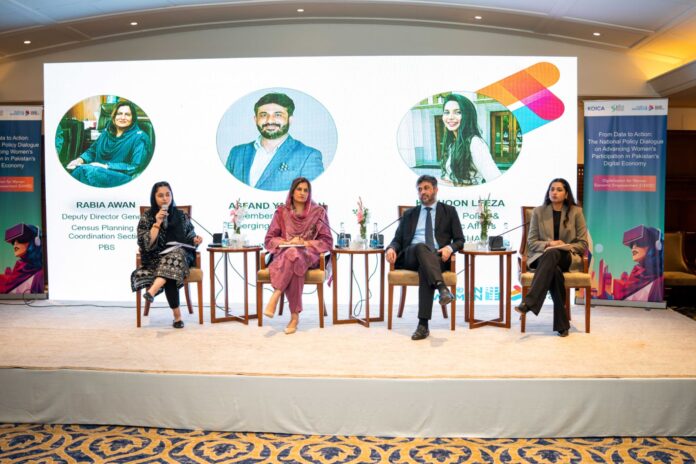

ISLAMABAD, 18 August 2026: UN Women Pakistan, in partnership with the Pakistan Bureau of Statistics (PBS) and with the support of the Korea International Cooperation Agency (KOICA), convened a National Policy Dialogue on Advancing Women’s Participation in Pakistan’s Digital Economy, marking an important step towards building a more inclusive digital future for the country.
The event also marked the launch of “Women in Information and Communication Technology (ICT) in Pakistan,” a comprehensive national report that maps women’s participation across Pakistan’s rapidly evolving digital economy.
The policy dialogue brought together key stakeholders from government, the private sector, the mobile industry and development partners to examine the report’s findings and discuss practical measures to increase women’s participation in Pakistan’s growing ICT sector.
Speaking at the event, Ms. Fahmida Iqbal Khan, Deputy Country Representative, UN Women Pakistan, underscored the importance of turning evidence into coordinated action.
“This report gives us a clear national picture of where women stand in Pakistan’s digital economy and where the gaps remain. The findings are a call to action for all of us. Data alone does not close gender gaps; it is what we do with it, together as government, industry, and development partners, that will determine whether Pakistan’s digital transformation truly includes women.”
Produced under the Digitalization for Women Economic Empowerment (D4WEE) project, the report provides new gender-disaggregated evidence across four critical dimensions of Pakistan’s ICT ecosystem: education and digital skills, employment, entrepreneurship and leadership.
The report highlights that while Pakistan has made meaningful progress in expanding women’s access to digital connectivity, significant structural barriers continue to restrict their participation in one of the country’s fastest-growing economic sectors.
These challenges underscore the need for stronger policies, improved access to digital skills and employment opportunities, greater support for women entrepreneurs, and increased representation of women in leadership positions across the technology and digital economy.
Ms. Rabia Awan, Deputy Director General, Pakistan Bureau of Statistics, highlighted the crucial role of reliable, gender-disaggregated data in shaping effective policies and ensuring that women are adequately represented in Pakistan’s digital progress.
“The report provides a comprehensive understanding of the landscape of women’s participation in Pakistan’s digital economy at the national level. It has strengthened our understanding of where our national data systems need to go to better capture women’s participation and identify existing data gaps.”
She further emphasized that the evidence presented in the report provides an important baseline for future policymaking, adding:
“Reliable, gender-disaggregated statistics are the foundation of sound policymaking, and PBS remains committed to working to close these data gaps so that no woman is left uncounted in Pakistan’s digital progress.”
Following the presentation of the report’s findings, a multi-stakeholder panel discussion, titled “From Data to Action: Advancing Women’s Participation in Pakistan’s ICT Sector,” brought together representatives from the Pakistan Bureau of Statistics, Ministry of Information Technology and Telecommunication (MoITT), GSMA and Pakistan Software Houses Association (P@SHA).
The discussion focused on translating evidence into concrete commitments and identifying areas where government, industry and the mobile sector can work together to create a more enabling environment for women in ICT.
Participants emphasized the importance of coordinated action to address the barriers preventing women from fully benefiting from Pakistan’s digital transformation. Strengthening digital skills, expanding access to decent work, promoting women-led businesses and creating pathways for women to advance into leadership roles were identified as important areas for continued collaboration.
The dialogue comes at a critical time as digital technologies increasingly shape Pakistan’s economy, labour market and future opportunities. Ensuring women can participate meaningfully in this transformation is not only essential for gender equality but also represents an opportunity to unlock a significant source of talent, innovation and economic growth.
UN Women Pakistan reaffirmed its commitment to supporting policies and initiatives that promote women’s digital inclusion and economic empowerment, while contributing to Pakistan’s progress towards the Sustainable Development Goals, particularly SDG 5 on Gender Equality and SDG 8 on Decent Work and Economic Growth.
The launch of the national report and the policy dialogue therefore represent an important step from data to action—strengthening the evidence base while encouraging government, industry and development partners to work together to ensure that Pakistan’s digital transformation leaves no woman behind.


