
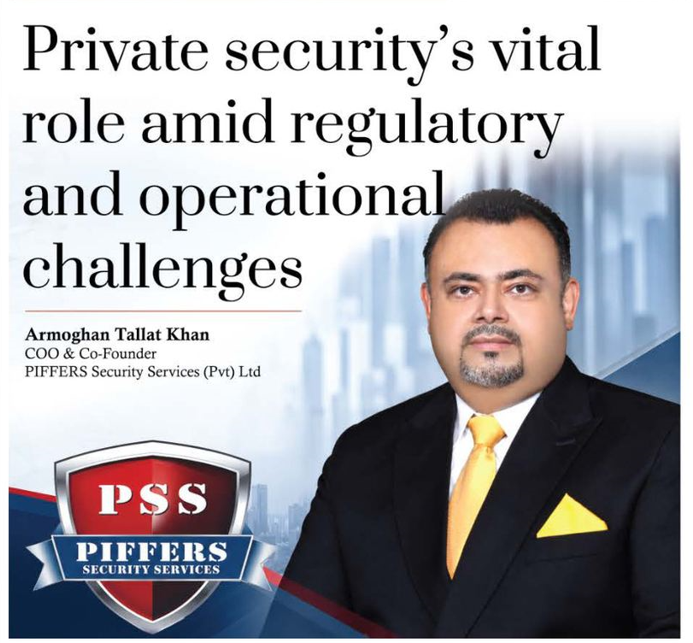

Armoghan Tallat Khan
COO & Co-Founder
PIFFERS Security Services (Pvt) Ltd
Flare panel conducted an interview with Armoghan Tallat Khan, the COO and Co-Founder of PIFFERS Security Services (Private) Limited. He stated that he applied his experience from the UK to implement international standards, innovative strategies, and a systematic approach at PIFFERS. His expertise in marketing and project management enables him to create customised, practical, and cost-effective solutions that effectively mitigate risks and vulnerabilities while aligning with the objectives of clients.
Flare: As COO and Co-Founder of PIFFERS Security Services, how has Pakistan’s private security industry evolved, and what are its biggest operational challenges?
Armoghan Tallat Khan: Pakistan’s private security industry has become more professional and technology-driven, but still faces regulatory and operational challenges, including the lack of standardised licensing, vetting and government support. As COO and Co-Founder, I submitted a roadmap to the Ministry of Interior for a Centralised Security Licensing System, inspired by Dubai’s SIRA and the UK’s SIA. The sector is ready for international standards, but needs stronger government-industry collaboration and a supportive regulatory framework.
Flare: How has your diverse experience shaped your approach to security operations and client solutions?
Armoghan Tallat Khan: My diverse experience allows me to view security as an integrated management function. Drawing on my UK experience, I have introduced international standards, innovative practices and a systematic approach at PIFFERS.
I have strengthened the “Security” component of HSSE by integrating it with risk assessment, safety, technology, client service and business continuity. My marketing and project management experience also helps me develop practical, customised and cost-effective solutions that identify risks, address vulnerabilities and support clients’ wider objectives.
Flare: You have experience in Britain and Pakistan’s security industries. What international practices should Pakistan adopt?
Armoghan Tallat Khan: Pakistan should adopt a centralised licensing and regulatory system for private security professionals, similar to the UK, including background screening, identity verification, certified training and clear professional standards.
A coordinated framework involving the Ministry of Interior, NADRA, provincial home departments, law-enforcement agencies and APSAA should ensure standardised vetting, training and unique, verifiable licences. Companies should also implement continuous professional development, technology-based monitoring, incident reporting, regular audits and role-specific certifications. Given Pakistan’s high exposure to terrorism and crime, private security must no longer be treated as a manpower business but as a regulated, skilled and technology-enabled profession essential to national resilience.
“A coordinated framework involving the Ministry of Interior, NADRA, provincial home departments, law enforcement agencies and APSAA should ensure standardised vetting, training and unique, verifiable licences”
Flare: How does PIFFERS assess a client’s security risks before designing a security plan?
Armoghan Tallat Khan: We first understand the client’s business, assets, workforce, location and existing security arrangements. Our specialists then conduct site surveys, risk assessments and threat evaluations to identify vulnerabilities and potential impacts. Based on these findings, we develop a customised, HSSE-aligned plan covering trained personnel, surveillance, access control, emergency response, evacuation and escalation protocols. We also integrate business continuity to ensure critical operations can continue during disruptions.
Flare: What systems does PIFFERS use for recruiting, vetting, training and supervising security personnel?
Armoghan Tallat Khan: At PIFFERS, we ensure personnel are properly vetted, trained and supervised. Recruitment includes interviews, identity, reference, police and employment checks, plus assessments of fitness, discipline and communication skills. We conduct twice-weekly training in access control, patrolling, reporting, emergency response, fire safety, first aid, customer service and professional conduct, supplemented by external courses. Before deployment, officers receive client-specific briefings, while supervisors conduct regular and surprise inspections. Client feedback, incident reports and performance reviews guide corrective action, counselling and refresher training. Our goal is a professional workforce capable of preventing threats, protecting people and assets, and responding confidently to incidents.
Flare: How will AI, surveillance and data analytics transform private security in Pakistan?
Armoghan Tallat Khan: AI adoption is currently slow, but I expect major transformation by 2030. At PIFFERS, our AI-based Data Image Processing system detects threats and non-compliance, while our Facility Management System enables centralised monitoring of personnel, visitors and incidents.
China is already using robotic dogs for security patrols. AI can monitor continuously without fatigue or distraction, but it will not replace security professionals; it will enhance their performance through faster detection, better data and improved decision-making.
Flare: Which PIFFERS services are in strongest demand, and why?
Armoghan Tallat Khan: Physical guarding remains the highest-demand service, providing visible security and immediate response. However, clients increasingly seek integrated solutions combining trained personnel, AI surveillance, access control, risk analysis, emergency preparedness and centralised monitoring. The future lies in combining technology with skilled manpower.
Flare: What regulatory reforms are needed to professionalise Pakistan’s private security sector, particularly in licensing, training and compliance?
Armoghan Tallat Khan: Pakistan needs an em powered private security regulatory authority under the Ministry of Interior, with a centralised licensing system involving APSAA, NADRA, provincial home departments and law-enforcement agencies.
All security professionals should undergo standardised screening, police verification and certified training before receiving unique, verifiable licences, with categories for specialised roles. The UK’s SIA and Dubai’s SIRA offer useful models. Such a system would ensure uniform standards, stronger compliance, accountability and greater professionalism.
Flare: What emerging security threats should Pakistani businesses prepare for?
Armoghan Tallat Khan: Cyberattacks, including ransomware, phishing, fraud, data theft and insider threats, are among the most serious emerging risks. Businesses must also prepare for organised crime, supply-chain disruption, misinformation and cyber-physical attacks. Strong cybersecurity, employee awareness, access controls, data backups, incident response and business continuity planning are now essential.
Flare: As COO and Co-Founder, what are your priorities for PIFFERS Security Services over the next five years, and how do you see the company evolving from a traditional guarding company into a broader integrated security, risk management and HSSE solutions provider?
Armoghan Tallat Khan: PIFFERS is not a conventional guarding company; we are already investing in automation, AI-based surveillance, Facility Management Systems and advanced operational technologies. Over the next five years, my priority is to further integrate trained personnel with intelligent monitoring, risk assessment, emergency preparedness, business continuity and HSSE solutions.
We aim to strengthen personnel training, expand our technology portfolio and provide clients with centralised, data-driven and customised security solutions. Our vision is to position PIFFERS as a comprehensive security and risk management partner that prevents threats, strengthens operational resilience and delivers measurable value beyond traditional guarding.


