
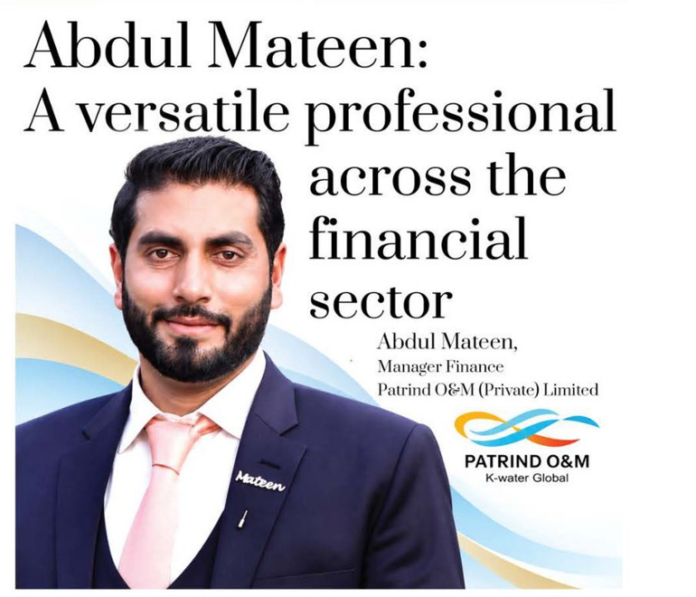

Abdul Mateen
Manager Finance
Patrind O&M (Private) Limited
The Flare panel had the privilege of interviewing Abdul Mateen, the Finance Manager at Patrind O&M (Private) Limited. He shared that his experience in the regulated energy sector encompasses corporate finance, cross border transactions, foreign exchange, taxation, and coordination with regulatory bodies.
Flare: Kindly introduce yourself and your professional journey in finance.
Abdul Mateen: I am a finance professional with over ten years in financial management, internal audit, taxation, budgeting, treasury, compliance, and financial reporting. I am currently the Manager, Finance at Patrind O&M (Private) Limited, which operates the 150 MW Patrind Hydropower Plant and is a subsidiary of Korea Water Resources Corporation (K-water). My regulated energy sector experience includes corporate finance, cross-border transactions, foreign exchange, taxation, and regulatory coordination. I started in internal audit, where six years enhanced my skills in risk assessment, internal controls, compliance, and process improvement. I then transitioned to financial management, expanding my role with broader commercial and strategic responsibilities.
Flare: What inspired your career in finance, and what shaped your journey?
Abdul Mateen: I was drawn to finance for its impact on key organisational decisions. Finance goes beyond recording transactions or preparing statements. It helps management understand performance, manage risks, allocate resources, and make informed future decisions. My current role in the hydropower sector has significantly expanded my perspective. I collaborate with operational teams, senior management, banks, consultants, tax authorities, regulators, and our international parent organisation. This experience has shown me that a successful finance professional must combine technical skills with business judgment, effective communication, and the ability to manage complex stakeholder relationships. A recent valuable experience was participating in K-water’s Capacity Building Program on Water Infrastructure Operation and Management in South Korea from August 21 to 27, 2026. The program included 12 professionals from K-water’s overseas operations in Pakistan, the Philippines, the Solomon Islands, Indonesia, and Vietnam.
Flare: What are your principal areas of expertise and your most significant professional achievements?
Abdul Mateen: My expertise includes financial reporting, budgeting, forecasting, taxation, treasury management, accounts payable and receivable, regulatory compliance, internal controls, and financial-system implementation. A key assignment was my role as Project Manager for SAP Business One’s implementation, which began operating in 2023. The project required understanding the organisation’s financial and operational needs, translating them into system processes, and coordinating across functions. It created a more integrated and reliable financial-management environment.
Flare: How has Pakistan’s financial sector evolved during your career?
Abdul Mateen: Pakistan’s financial sector has changed considerably during my ten-year career. Banking has become increasingly digital, regulatory reporting has expanded, and organisations now expect financial information to be available much more quickly. Transactions that previously depended on cheques, physical documents and repeated branch visits can now be processed through secure cash-management platforms. In our own organisation, the integration of local and foreign-currency accounts into banking portals, along with digital vendor and payroll payments, demonstrates how corporate finance functions are gradually moving away from conventional payment methods. Where different jurisdictions or cross-border transactions are involved, even routine matters can become technically complicated.
Flare: How are digital banking, fintech, data analytics and artificial intelligence changing financial management in Pakistan?
Abdul Mateen: These technologies are transforming finance from a transaction-based function to a more analytical and integrated discipline.
Digital banking offers practical benefits. Our organisation has combined local and foreign bank accounts into cash-management portals. We now make vendor payments and payroll digitally, reducing reliance on cheques while enhancing efficiency, authorisation controls, and transaction traceability.
Integrated financial systems like SAP Business One give management better visibility into transactions, liabilities, assets, and budgets. Data analytics can reveal trends, exceptions, and risks not obvious in standard financial reports. Artificial intelligence has great potential in forecasting, reconciliations, document review, compliance monitoring, and management reporting. It minimises time on repetitive tasks, allowing finance professionals to focus on analysis and decision support.
“My goal is to grow as a finance leader by combining technical expertise with strategic decision-making, stronger controls, financial analysis and responsible technology use”
Flare: What are the main financial and economic challenges currently facing Pakistani businesses and professionals?
Abdul Mateen: Pakistani businesses operate in an environment where economic conditions can change quickly. Exchange-rate volatility, inflation, energy costs, interest rates and taxation can all have a significant effect on cash flows, operating costs and investment decisions. Taxation is another major area of concern. Businesses need regulations that are clear, consistently interpreted and efficiently administered.
Flare: What steps are needed to improve financial inclusion and public financial literacy?
Abdul Mateen: Financial inclusion requires both access and understanding. Opening a bank account or downloading a financial application is only the first step. People must also understand how to save, borrow, invest and use digital financial services safely. Financial education should begin at school and continue through universities, workplaces and community programmes. It should address practical subjects such as household budgeting, responsible borrowing, taxation, insurance, retirement planning, investment risks and protection from digital fraud.
Flare: Which professional values are most important for maintaining trust, transparency and ethical standards in finance?
Abdul Mateen: Integrity is essential in finance. Finance professionals manage sensitive information and influence key decisions. This demands honesty, independence, and consistency. Professional competence is vital as well. Good intentions cannot replace poor knowledge or carelessness. Finance professionals must continually learn, stay informed on regulations, and seek expert advice when necessary. Transparency involves presenting relevant information accurately and promptly, even if it is uncomfortable. Confidentiality, professional scepticism, and accountability are critical too. Professional character is most clearly tested under pressure. Ethical standards matter only when upheld in difficult situations, not just when it is convenient.
Flare: What advice would you give to young professionals who wish to build a successful career in finance?
Abdul Mateen: Build strong fundamentals before focusing on titles. Learn accounting, taxation, financial analysis, controls, and business processes thoroughly. Technology is changing the profession but emphasises the importance of understanding the fundamentals. Young professionals should seek assignments that expose them to real problems and responsibilities. Internal audit, operations, systems implementation, budgeting, banking, and regulatory work offer perspectives not found in textbooks.
Flare: What are your future professional goals or vision for Pakistan’s finance profession?
Abdul Mateen: My goal is to grow as a finance leader by combining technical expertise with strategic decision-making, stronger controls, financial analysis and responsible technology use. Presenting the Patrind Hydropower Project at K-water headquarters was a valuable opportunity to represent our organisation, exchange knowledge internationally and understand its contribution to K-water’s global objectives.


