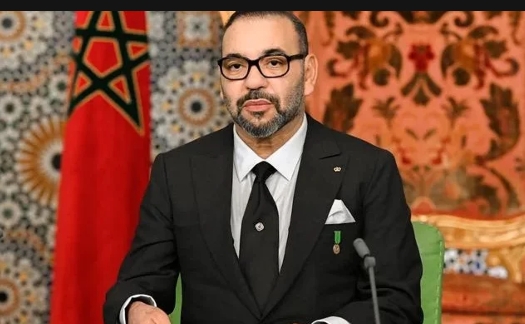

RABAT — King Mohammed VI on Wednesday launched a new phase in the development of the Kingdom’s port infrastructure, reviewing the progress of works at the Nador West Med complex—where the first terminal is scheduled to enter service in the coming days—and overseeing the launch of the Tanger Med 3 port project.
The initiative forms part of a strategy aimed at bolstering Morocco’s logistics, industrial, and energy capabilities while expanding its footprint in global trade, according to a statement issued by the Royal Court. This came as the Moroccan monarch presided over a working session at the Royal Palace in Rabat dedicated to tracking the progress of both projects and outlining the next stages of their implementation, continuing from previous working sessions focused on major port infrastructure schemes, particularly the meeting held on 28 January.
During the session, Fouad Brini, Chairman of the Supervisory Board of the Tanger Med Special Agency (TMSA) and Chairman of the Board of Directors of Nador West Med, delivered a presentation on the progress of works and future development prospects for both facilities.
These projects fall within a royal vision aimed at establishing an efficient port ecosystem capable of enhancing the Kingdom’s competitiveness amid shifts in global value chains. The vision combines economic growth with regional development, mobilising public and private investment, creating employment opportunities, and maximising added value within the affected regions.
The Nador West Med complex represents one of the flagship components of this strategy, with public and private investment reaching 54 billion dirhams to date. The processing capacity of its first container terminal will reach 3.5 million containers per annum once fully operational, whilst the second terminal is expected to enter service in April 2027 with an additional capacity of up to 1.8 million containers annually. Delivering both terminals requires the mobilisation of 8 billion dirhams in private investment.
The scheme extends beyond maritime port activities to encompass industrial, logistics, and energy platforms. These include a hydrocarbons terminal featuring a prospective storage capacity of up to 4 million cubic metres, a liquefied natural gas (LNG) terminal capable of processing up to 5 billion cubic metres per annum, as well as dedicated terminals for solid bulk and general cargo. These elements form part of a broader drive to strengthen the Kingdom’s energy security and expand its storage and processing capabilities for LNG.
On the industrial front, the zone affiliated with the complex already hosts one operational factory, with three others currently under construction. In the near term, the project is anticipated to generate 14,000 direct jobs and 20,000 indirect jobs.
The transport infrastructure required to connect the hub to surrounding regions is also being delivered, notably through the Selouane–Nador West Med railway line, the Guercif–Nador West Med motorway, and upgrades to the existing road network.
In parallel, the expansion of Tanger Med aims to reinforce the complex’s capacity through the creation of Tanger Med 3, situated west of Tanger Med 2. Featuring 1,200 metres of quays, the new facility will add an annual capacity of 4.5 million containers with an investment of around 8 billion dirhams. A concession contract has been signed with Maersk-APM, a global leader in maritime transport, to develop the new container terminal.
The scheme is accompanied by the expansion of the passenger and international road freight transport (TIR) port, as well as the eastern expansion of Tanger Med 2. Upon completion of these projects, the total handling capacity of the Tanger Med complex is expected to reach 20 million containers per annum, advancing Morocco’s ambition to secure a position among the world’s top ten ports.
These investments reflect an ongoing policy to broaden the Kingdom’s logistical foundation and deepen integration between maritime trade, industry, and energy. Furthermore, developing Nador West Med as a complement to Tanger Med highlights an intention to distribute economic activity across multiple regional hubs, extending investment opportunities beyond existing port centres and reinforcing links between international trade and regional spatial development.
However, the wider socio-economic impact of these projects remains contingent upon their ability to convert investment into sustainable employment and foster local talent and business participation in emerging activities. King Mohammed VI underscored that all regions concerned must benefit from the economic and social returns of these schemes, ensuring direct benefits for local populations. The King called for the rapid rollout of training programmes tailored to the requirements of emerging sectors, facilitating the professional integration of young people. This directive places employment, vocational training, and the equitable distribution of investment returns at the top of future priorities.
The development of port infrastructure is treated not merely as a matter of increasing processing capacity or attracting capital, but as an initiative requiring human capital development, better connectivity to the hinterland, and greater retention of economic value within surrounding areas. Ultimately, the success of the Kingdom’s maritime strategy hinges on its capacity to combine international competitiveness with tangible local development gains a target Morocco is actively pursuing through broad, pragmatic frameworks and legitimate ambitions.