
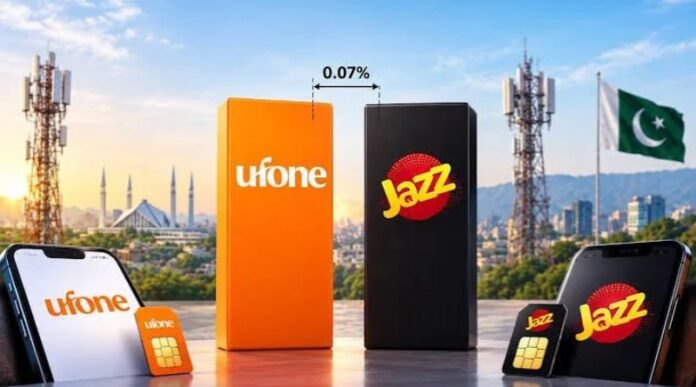

Pakistan’s telecom industry is going through an important change as Ufone continues to strengthen its position in the mobile market following its merger with Telenor Pakistan. The latest market share figures suggest that Ufone is now very close to Jazz, with the difference between the two major telecom operators shrinking to just 0.07%.
This development has attracted attention across Pakistan’s telecom sector. For years, Jazz has maintained a strong position as one of the country’s leading mobile network operators. However, the merger of Ufone and Telenor has changed the competitive situation and created a stronger player in the market.
The shrinking gap shows how the merger could affect the future of mobile services in Pakistan. It also highlights the growing competition between telecom companies as they work to attract more customers and improve their services.
Ufone Gets Closer to Jazz After Telenor Merger
Ufone has made an important move in Pakistan’s telecom market after joining forces with Telenor Pakistan. The merger has brought together two established telecom operators, allowing Ufone to increase its overall market presence.
Before the merger, Ufone and Telenor operated as separate companies and competed with other networks for customers. Both had their own subscribers, network facilities, and business operations.
Following the merger, their combined market position has become much stronger. This has helped Ufone move closer to Jazz, which has traditionally held a leading position in Pakistan’s mobile market.
The reported difference of only 0.07% between Ufone and Jazz indicates how closely the two operators are now competing. Although the exact ranking can change with new subscriber data, the latest figures show that the telecom market is becoming more competitive.
For mobile users, this development could bring more choices and encourage telecom companies to improve their services.
How the Telenor Merger Changed Pakistan’s Telecom Market
The merger between Ufone and Telenor Pakistan is one of the major developments in the country’s telecom industry.
Telenor had built a large customer base over many years. It provided mobile network services to millions of Pakistanis in different cities, towns, and rural areas.
Ufone, meanwhile, was already an established telecom company with its own customers and network services. Bringing the two businesses together created an opportunity to build a stronger telecom operator.
The main benefit of the merger is the combined customer base. Instead of competing separately, the two businesses can now work under a combined structure and focus on improving their market position.
The merger may also help the company use its resources more effectively. Network facilities, business operations, customer support, and other services can be managed with greater coordination.
However, combining two large telecom businesses is not a simple process. It requires careful planning, technical work, and proper management to ensure that customers continue receiving reliable services.
Jazz Faces Stronger Competition
Jazz has remained one of the most recognised mobile network brands in Pakistan. Its wide customer base, network coverage, and digital services have helped it maintain a strong position for many years.
However, the situation is changing after the Ufone and Telenor merger.
With Ufone becoming stronger, Jazz now faces a major competitor with a much larger combined market presence than Ufone previously had on its own.
The reported 0.07% market share gap makes the competition even more interesting. Such a small difference suggests that both companies are operating at almost the same level in terms of the reported market share figures.
This could encourage Jazz to introduce better packages, improve its network, and focus more on customer satisfaction.
Competition between telecom companies is generally good for consumers because operators have to work harder to keep their existing customers and attract new ones.
What Does the 0.07% Market Share Gap Mean?
Market share is an important way to measure the position of a telecom company in the industry. It generally represents the percentage of total mobile connections or subscribers held by a particular operator.
For example, if a company has a large percentage of the country’s mobile connections, it has a stronger market position than operators with smaller shares.
A gap of just 0.07 percentage points between Ufone and Jazz means that their reported market shares are extremely close.
This is important because Jazz has traditionally enjoyed a strong position in Pakistan’s telecom sector. Ufone’s progress following the merger shows how combining two companies can change the competitive balance.
However, market share alone does not tell the complete story. Network quality, internet speed, customer experience, revenue, and service coverage are also important factors when comparing telecom operators.
A company may have a large number of subscribers but still need to improve its services to keep customers satisfied.
Benefits of the Merger for Ufone
The merger has created several opportunities for Ufone. One of the biggest advantages is access to a wider customer base.
With Telenor’s existing subscribers becoming part of the combined business, Ufone has a stronger position in the market. This can help the company compete more effectively with Jazz and other telecom operators.
Another possible benefit is better use of network resources. By combining operations, the company may be able to improve its infrastructure and manage costs more effectively.
The merger could also support investment in new technologies, including 4G improvements and future 5G services.
In addition, a larger customer base may help Ufone develop better digital products and services. These could include mobile internet packages, digital payments, business solutions, and other services.
However, customers will judge the success of the merger through actual improvements rather than market share figures alone.
What Will Happen to Existing Telenor Customers?
One of the biggest questions following the merger is what will happen to existing Telenor users.
Customers usually want to know whether their SIM cards, mobile numbers, packages, balances, and other services will continue working as before.
A major telecom merger requires a gradual process to bring systems and operations together. During this process, companies need to make sure that customers do not face unnecessary problems.
Existing subscribers also expect clear information about any changes to their services.
For many users, keeping their current mobile number is especially important because it is connected to banking accounts, social media profiles, WhatsApp, and other online services.
Ufone will need to focus on customer support and communication while bringing the two businesses together.
A smooth transition could help the company maintain customer trust and strengthen its position in the market.
Will Customers Get Better Mobile Packages?
The stronger competition between Ufone and Jazz could create more opportunities for mobile users.
Telecom companies regularly introduce different packages to attract customers. These offers usually include internet data, on-net minutes, off-net minutes, and SMS bundles.
When competition increases, operators may offer more attractive packages to convince users to stay with their networks.
Ufone could use its stronger market position to introduce new offers and improve existing packages. Jazz may also respond by providing competitive prices and additional benefits.
However, a smaller market share gap does not automatically mean that mobile packages will become cheaper.
Prices depend on several factors, including operating costs, taxes, electricity expenses, network investment, and government policies.
Still, stronger competition can encourage companies to provide better value for money.
Network Coverage and Internet Speed Will Be Important
Market share is only one part of the telecom business. For most mobile users in Pakistan, network coverage and internet speed are equally important.
Customers want reliable signals, fast internet, and fewer connection problems.
People living in major cities may have access to different mobile networks, while users in smaller towns and rural areas may have fewer options.
This means Ufone will need to focus on improving its network across different parts of the country.
The combined business could have an opportunity to improve coverage by making better use of available infrastructure. However, the actual results will depend on network planning, investment, and technical improvements.
Jazz will also need to maintain its network quality to protect its position.
In the coming months, users will likely pay more attention to real-world performance than market share announcements.
Impact on Pakistan’s Telecom Industry
The Ufone and Telenor merger could have a lasting impact on Pakistan’s telecom industry.
For many years, telecom operators have competed to increase their subscriber numbers and expand their services. The merger has changed the market structure by creating a stronger competitor.
This could influence how companies plan their future investments and business strategies.
A stronger Ufone may encourage other operators to improve their services and introduce new offers. It could also increase pressure on telecom companies to expand their networks and provide better customer support.
Another important area is digital connectivity. Pakistan’s demand for mobile internet continues to grow as more people use smartphones for education, business, entertainment, shopping, and communication.
Telecom companies will need to invest in better infrastructure to meet these needs.
The growing use of digital services also makes reliable mobile internet more important than ever.
The Role of 5G in Future Competition
The next major development in Pakistan’s telecom sector is the expansion of advanced mobile network technology, particularly 5G.
Faster mobile internet could support better video streaming, online gaming, remote working, smart devices, and digital business services.
For telecom companies, preparing for this technology requires investment in network equipment, infrastructure, and technical resources.
A stronger combined Ufone business may have more opportunities to compete in this area.
Jazz will also remain an important competitor as telecom operators prepare for the next stage of mobile connectivity.
However, 5G services will require more than just market share. Companies will need suitable spectrum, network investment, and regulatory approval to provide reliable services.
The companies that successfully combine strong coverage with affordable packages could attract more customers in the future.
Challenges Ufone Must Overcome
Although the merger has improved Ufone’s market position, the company still faces several challenges.
First, combining two telecom businesses requires significant technical work. Customer databases, network systems, billing services, and support operations must work together properly.
Second, customer satisfaction will remain a major concern. If users experience network problems or difficulties with their services, they may consider switching to another operator.
Third, maintaining network quality across Pakistan will require continuous investment.
The company will also need to compete on prices without affecting the quality of its services.
Another important challenge is maintaining customer confidence. Subscribers need clear information about service changes and should be able to receive quick assistance when problems occur.
Overcoming these challenges will be important if Ufone wants to turn its stronger market position into long-term success.
What This Means for Mobile Users in Pakistan
For ordinary mobile users, the most important question is whether the changing telecom market will improve their daily experience.
People want affordable internet packages, good call quality, reliable signals, and helpful customer service.
The stronger competition between Ufone and Jazz could encourage both companies to improve their services.
Customers may also benefit from new packages and better digital products as telecom operators look for ways to attract and retain subscribers.
However, users should compare network performance in their own areas before selecting a mobile operator.
A network that works well in Karachi or Lahore may not provide the same experience in a smaller city or rural location.
Therefore, better coverage and service quality should remain the main priorities for telecom companies.
Conclusion
Ufone’s rapid progress following its merger with Telenor Pakistan has created a major development in the country’s telecom industry. The reported market share difference between Ufone and Jazz has dropped to just 0.07%, bringing the two operators extremely close.
This change highlights the impact of the merger and shows how the combination of two established telecom businesses can reshape market competition.
Jazz still remains a major name in Pakistan’s mobile industry, but Ufone’s stronger position could make the competition more intense.
The next stage will be important for both companies. Their ability to improve network coverage, internet speed, customer support, and affordable packages will play a major role in determining their future success.
For Pakistani consumers, increased competition could bring better services and more choices. However, the real benefits will depend on how effectively telecom operators respond to the changing market.
Frequently Asked Questions (FAQs)
1. How close is Ufone to Jazz in Pakistan’s telecom market?
According to the reported figures, the market share gap between Ufone and Jazz has narrowed to just 0.07%, making their positions extremely close.
2. Why has Ufone’s market share increased?
Ufone’s stronger market position follows its merger with Telenor Pakistan, which brought the two businesses together under a combined structure.
3. Has Ufone merged with Telenor Pakistan?
Yes, the merger has brought the two telecom businesses together, changing the competitive structure of Pakistan’s mobile market.
4. Is Ufone now bigger than Jazz?
The reported figures show that Ufone has moved very close to Jazz. However, the exact ranking depends on the latest official market share data.
5. Will Telenor SIM cards continue working?
Customers should follow official company announcements regarding SIM cards, numbers, packages, and any changes to existing services.
6. Will Ufone introduce cheaper internet packages?
The stronger competition may encourage Ufone to offer more attractive internet packages, although future prices will depend on business costs and market conditions.
7. How will the merger affect Jazz?
Jazz now faces stronger competition from the combined Ufone and Telenor business. This may encourage Jazz to improve its network and customer offers.
8. Will mobile network coverage improve after the merger?
The merger creates opportunities to use network resources more effectively. However, actual improvements will depend on investment and technical work.
9. What is the benefit of the Ufone and Telenor merger for customers?
Potential benefits include better network investment, improved services, more competitive packages, and stronger digital offerings.
10. What is the future of Pakistan’s telecom industry?
Pakistan’s telecom industry is expected to focus on better mobile internet, network expansion, digital services, and preparations for advanced technologies such as 5G.
Read Also: check