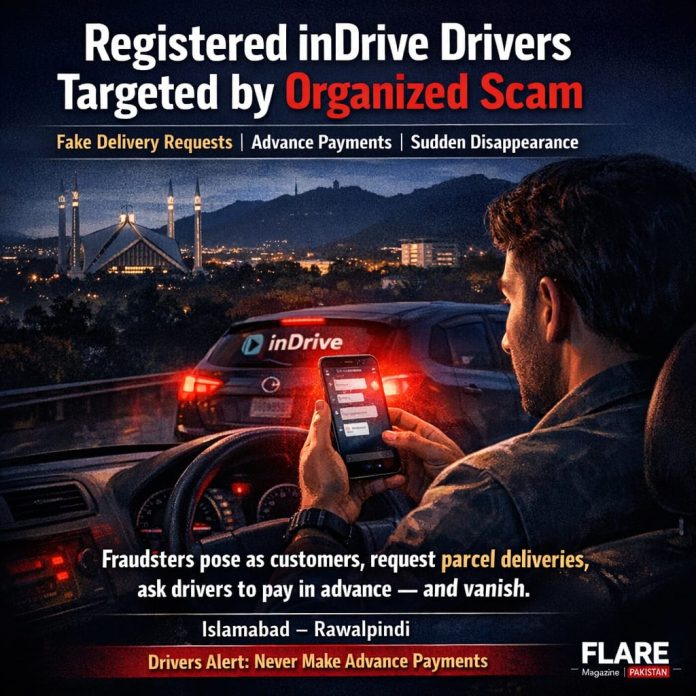

Islamabad has seen the rise of a sophisticated scam targeting registered inDrive drivers, marking a shift from the typical passenger-focused fraud schemes. This scam specifically manipulates drivers, exploiting the platform’s operations to extract money under false pretenses.
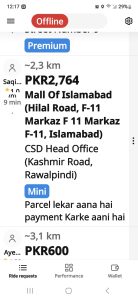
Drivers say the scheme has been active for months, following a predictable pattern, yet accounts linked to the fraud continue to appear despite repeated complaints.
How the Scam Works
Affected drivers describe the scam as follows:
A ride or delivery request appears through the inDrive app.
The “customer” claims that items such as uniforms, documents, or parcels need to be picked up from locations like Rawalpindi and delivered to prominent destinations such as Centaurus Mall or F-11 Markaz.
To gain the driver’s trust, the requester promises immediate reimbursement but asks for upfront payment via mobile wallet or bank transfer.
After the driver sends the money, the requester disappears—ending calls, switching off phones, or vanishing from the inDrive chat.
By the time drivers realize the deception, both the money and the contact have vanished.
Complaints Grow, but Accounts Stay Active
One troubling element of this scam is the recurrence of the same tactic on the platform:
Drivers report multiple complaints lodged against similar accounts.
Some fraudulent accounts complete several “tasks,” giving them an appearance of legitimacy.
Even temporarily restricted accounts often reappear under slightly modified profiles or phone numbers.
This cycle has left many drivers questioning the platform’s monitoring and enforcement measures.
Driver Community Frustration
Frustration is spreading among inDrive drivers, with growing mistrust over the persistence of the scam.
“When the same method keeps surfacing, it’s hard to believe the platform isn’t aware,” one driver told Flare Magazine.
While these are allegations, the volume and similarity of cases point to a systematic vulnerability being exploited.
Social Media Highlights a Broader Issue
Facebook and WhatsApp groups of ride-hailing drivers indicate that Islamabad is not the only city affected. Drivers across other urban centers report identical experiences: delivery requests, pressure for advance payments, and sudden disappearance of the requester. This pattern suggests the scam is well-planned, not opportunistic.
Why Drivers Are at Risk
Industry analysts note several factors that make drivers vulnerable:
Operating under tight schedules and financial pressures.
Small advances may appear low-risk or recoverable.
Delivery requests to busy commercial locations create a false sense of security.
Even experienced drivers can be manipulated under these conditions.
Recommendations for inDrive Drivers
To stay safe, drivers are advised to:
Avoid making advance payments for any ride or delivery task.
Treat parcel or uniform pickup requests with caution.
Keep all communication within the official app.
Save screenshots and transaction records.
Share verified warnings within driver communities to prevent further losses.
Flare Magazine emphasizes that recurring fraud patterns raise concerns beyond individual losses, highlighting the importance of platform accountability and robust driver protection measures. While no verdict is being issued, the situation calls for urgent attention to safeguard inDrive drivers from repeated exploitation.