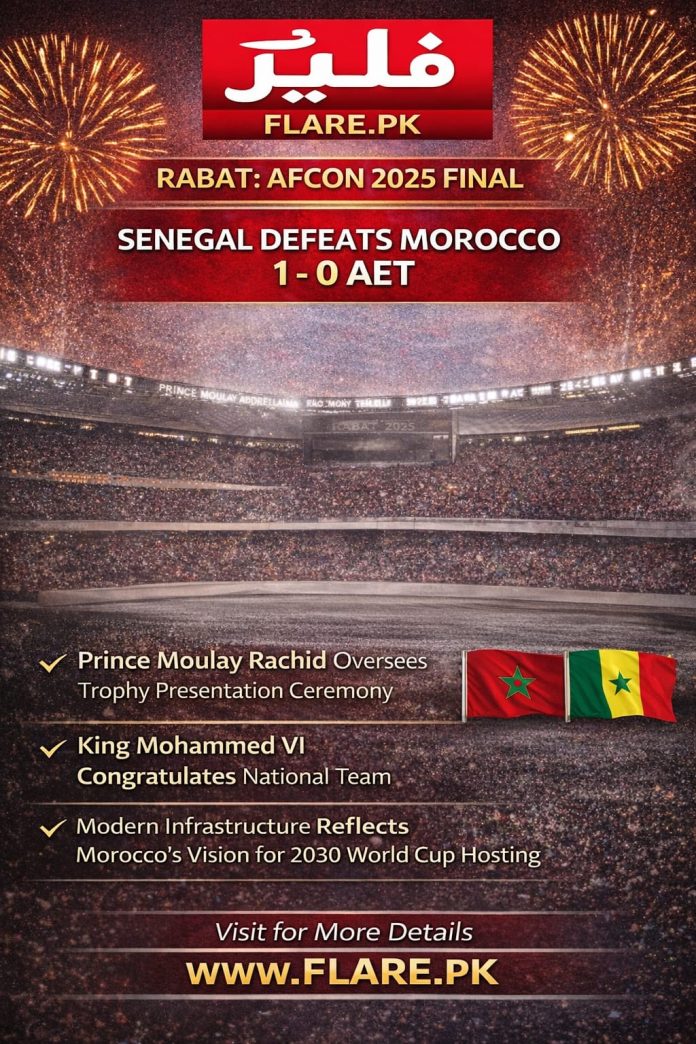

Rabat: Prince Moulay Rachid chaired the final of the 35th edition of the Africa Cup of Nations (AFCON) on Sunday at the Prince Moulay Abdellah Stadium in Rabat, where Senegal claimed the title after defeating Morocco 1-0 after extra time (AET).
The closing ceremony featured vibrant artistic performances celebrating Africa’s cultural richness, the continent’s youthful energy, and the values of unity, cooperation, and competitiveness that defined the tournament. The ceremony marked the conclusion of an edition widely viewed as a major continental football celebration that attracted strong public attention across Africa and beyond.
At the end of the match, Prince Moulay Rachid joined the official podium to hand over medals and trophies to both teams, honoring the Moroccan finalists and the Senegalese squad as champions of this AFCON edition.
Beyond football, AFCON 2025 has been described as a landmark event for Morocco—far more than a sporting tournament. Through its scale, popularity, and organizational quality, it served as a showcase of modern Morocco, highlighting the Kingdom’s growing investment in infrastructure, international image, and global event-hosting capabilities, while also reinforcing its preparations for 2030, when Morocco will co-host the FIFA World Cup with Spain and Portugal.
King Mohammed VI Congratulates the National Team
On this occasion, His Majesty King Mohammed VI sent a congratulatory telegram to the Moroccan national team’s players and staff, praising their achievement in reaching the final of AFCON 2025.
In his message, the King congratulated the players, coaches, technical, medical and administrative teams, and officials of the Royal Moroccan Football Federation for what he described as an honorable continental accomplishment.
The King emphasized that Morocco’s strong performance demonstrated that perseverance, seriousness, and collective spirit are essential for achieving success, adding that the team presented the world with a powerful example of what Moroccan and African youth can achieve through confidence in their abilities.
He further highlighted the importance of Morocco’s strategic vision focused on investing in human capital and modernizing infrastructure, affirming that the Kingdom has proven its readiness on the global stage ahead of hosting the 2030 World Cup.
The telegram also underlined that Morocco’s successful hosting of AFCON reflected both organizational excellence and the nation’s deeply rooted values of hospitality, describing it as a message of hope and confidence from Morocco to Africa—confirming that African talent is capable of excellence and creativity across all fields.
The King concluded by commending the Moroccan supporters who stood behind the team throughout the competition and urged the squad to continue their work toward future achievements that bring honor to Moroccan football internationally.
A Long-Term Vision for Moroccan Football
Morocco has pursued a long-term football development strategy aimed at positioning the country among Africa’s strongest teams and among the world’s best. A key pillar of this vision has been the creation of the Mohammed VI Football Academy, established in 2008 and opened in 2009, designed to reflect elite international training centers.
The academy was launched to strengthen Morocco’s football foundation by discovering and developing young domestic talent, offering both athletic and academic support. The project also represents a shift toward building national success through structured development, rather than relying heavily on dual-nationality players.
With sustained investment and strategic planning, Morocco’s football programme continues to expand its ambition—strengthening the national team’s competitiveness while building the infrastructure needed to welcome major global tournaments in the years ahead.