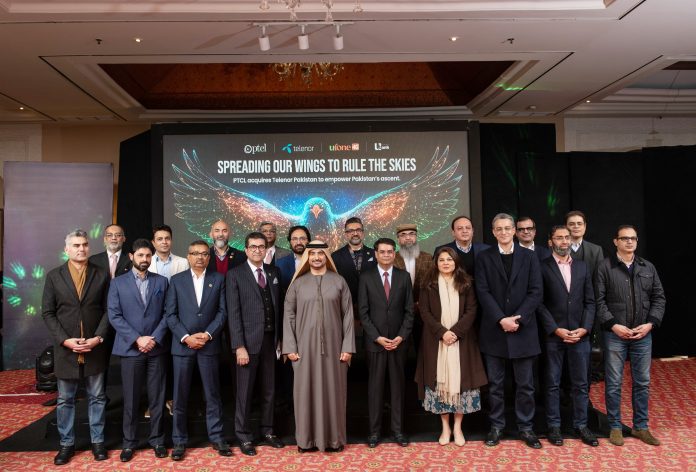

Islamabad, Special report: Pakistan’s telecom industry has entered a decisive new phase as Pakistan Telecommunication Company Limited (PTCL) formally completed the acquisition of 100 percent shareholding of Telenor Pakistan and Orion Towers, effective 31 December 2025. The announcement was made during a high-profile and well-organized event at Serena Hotel Islamabad, marking one of the most significant consolidations in Pakistan’s telecom history.


Under the new structure, Telenor Pakistan and Orion Towers have become wholly owned subsidiaries of PTCL, alongside Pak Telecom Mobile Limited (PTML), commonly known as Ufone 4G, and U Microfinance Bank. During the transition period, Telenor Pakistan will continue operating as a separate legal entity, after which PTML and Telenor Pakistan are expected to integrate into a merged entity (MergeCo), subject to regulatory approvals.
Strategic Vision Meets Market Reality
According to PTCL’s official press release, the acquisition is aimed at strengthening Pakistan’s digital ecosystem by expanding network capabilities, optimizing spectrum usage, and delivering secure, customer-centric digital services at scale. The combined entity is positioned to play a central role in advancing Pakistan’s digital ambitions.
PTCL also acknowledged the contribution of Telenor ASA to Pakistan’s telecom landscape, recognizing its role in expanding connectivity and raising service benchmarks over nearly two decades.
Network Neglect: A Major Challenge Inherited
However, industry experts point out that the acquisition also brings with it serious operational challenges, particularly related to network quality.
Telecom analysts note that Telenor Pakistan has not made meaningful investment in network modernization over the last four years, resulting in deteriorating service quality, capacity constraints, and growing customer dissatisfaction across multiple regions.
This reality presents one of the biggest challenges for Ufone and PTCL going forward. Significant capital expenditure will be required to rehabilitate and upgrade the inherited network infrastructure, improve data speeds, and restore consumer confidence.
Management Failures and the Road to Exit
Industry Analysis
Industry observers further argue that weak management performance played a decisive role in pushing Telenor Pakistan toward divestment.
According to sector insiders, key management functions—including media strategy, marketing, human resources, and overall corporate governance—failed to provide direction or long-term vision.
Rather than focusing on customer experience, network competitiveness, and sustainable growth, critics say the company became increasingly inward-looking. Excessive administrative spending, weak accountability, and internal priorities overshadowed business fundamentals. Analysts suggest that greater attention to executive compensation, foreign postings, and internal alignments came at the cost of market leadership and innovation.
Several industry voices believe that with timely network investment, merit-based management, and sharper market execution, Telenor Pakistan could have remained competitive and profitable. Instead, persistent misalignment between strategy and execution gradually eroded its market position—making the sale not merely a strategic choice, but an inevitable outcome of prolonged underperformance.
Leadership Engagement and Media Transparency
One notable aspect of the Serena Hotel event was the measured and professional engagement with the media. PTCL’s leadership and senior management addressed journalists’ questions with patience, clarity, and transparency—an approach widely appreciated within media circles.
The event itself was described as exceptionally well-organized, reinforcing confidence in PTCL’s institutional capacity to manage a complex transition of this scale.
Regulatory Clarity: Naveed Khalid Butt’s Briefing
PTCL Group’s Chief Regulatory Affairs Officer, Naveed Khalid Butt, played a key role in the briefing. He provided detailed explanations regarding regulatory processes, approvals, and the phased integration roadmap. His clear articulation helped address many of the concerns surrounding compliance, spectrum, and merger timelines.
CEO’s Message: Building a Future-Ready Organization
Speaking on the occasion, PTCL & Ufone 4G President and CEO Hatem Bamatraf described the acquisition as a milestone for both PTCL and Pakistan’s telecom sector. He reaffirmed the company’s commitment to customer-centric services, improved user experience, and responsible integration.
He also assured employees that the transition would prioritize continuity, respect for talent, and the adoption of global best practices—aiming to build a stronger, future-ready organization.
What Comes Next
The PTCL–Ufone–Telenor transaction represents both opportunity and accountability. While the merger has the potential to reshape Pakistan’s telecom landscape and accelerate digital inclusion, its success will depend on how effectively PTCL addresses legacy network weaknesses, enforces stronger governance, and avoids repeating the management failures of the past.
For Pakistan’s telecom sector, this deal stands as a reminder that technology alone does not guarantee success—leadership, discipline, and long-term investment do.
Flare Magazine – Exclusive Insights
This merger is not just a business transaction; it is a test of whether Pakistan’s largest telecom group can turn inherited challenges into sustainable digital leadership.