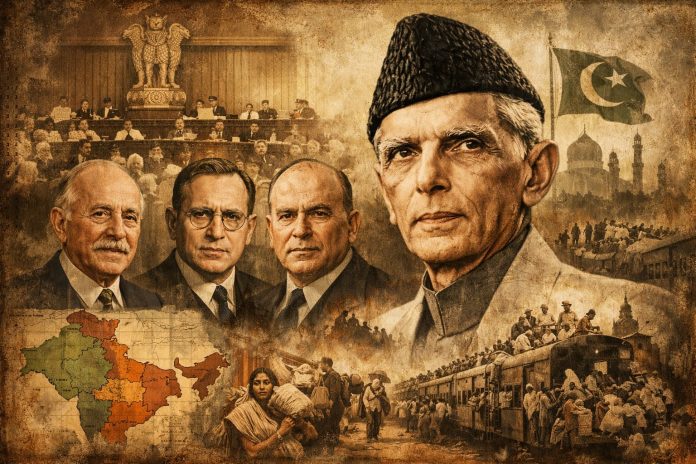

Few moments in South Asian history have been debated as intensely as the failure of the Cabinet Mission Plan in 1946. The discussion is not merely about constitutional design. It is about political intent, leadership, trust, and whether the tragedy of Partition could have been avoided.
Recently, a critique described Muhammad Ali Jinnah as politically opportunistic. The argument suggests that in 1946 he demanded a weak federal center to protect Muslim interests within a united India, yet after the creation of Pakistan in 1947 he insisted on a strong central government. According to this view, the shift reflects hypocrisy rather than strategy.
That charge deserves careful examination.
The Historical Setting
By early 1946, the British government had decided to transfer power. To facilitate a constitutional settlement, it sent a high-level delegation consisting of Frederick Pethick-Lawrence, Stafford Cripps, and A. V. Alexander. Their task was to propose a structure that could keep India united while addressing deep communal anxieties.
The Mission rejected the immediate creation of Pakistan. Instead, it proposed a loose Union of India that would control only three subjects: defense, foreign affairs, and communications, along with the power to raise finances necessary for these functions. All other powers would rest with the provinces.
Provinces were to be grouped into sections reflecting demographic realities, and a Constituent Assembly of 385 members would draft the constitution. On communal matters, special voting safeguards were introduced to ensure that neither major community could be overridden.
In short, the proposal was neither a centralized nation-state nor a fully sovereign confederation. It was a carefully balanced compromise.
Demographic Realities and Political Anxiety
The subcontinent’s demographic composition made constitutional design extraordinarily complex.
In the northwestern provinces—Punjab, Sindh, NWFP, and British Baluchistan—Muslims formed a majority but with substantial non-Muslim minorities. In Bengal and Assam, the numbers were nearly evenly divided. Meanwhile, over 20 million Muslims lived as minorities in Hindu-majority provinces across India.
No political arrangement could ignore these facts.
The Cabinet Mission recognized two competing fears:
Muslims feared permanent majoritarian dominance at the center.
Non-Muslims in Muslim-majority provinces feared marginalization in any Pakistan scheme.
The proposed federal structure was an attempt to reconcile these anxieties without partition.
Jinnah’s Acceptance: Opportunism or Constitutional Strategy?
Critics argue that Jinnah’s acceptance of the Plan was tactical, designed to corner Congress politically. However, it is equally plausible to interpret his decision as consistent with his legal and constitutional temperament.
Jinnah had long framed Muslim demands in constitutional terms. By accepting a united India with a weak center and strong provinces, he secured:
Autonomy for Muslim-majority regions
Safeguards against central domination
A structure that could evolve over time
From his perspective, provincial autonomy was not fragmentation. It was protection.
When Jawaharlal Nehru signaled that the Constituent Assembly would not be bound by group arrangements, the Muslim League viewed this as undermining the core compromise. Trust collapsed.
The result was escalation, Direct Action, and ultimately Partition.
The Question of Federal “Weakness”
Another objection raised at the time was that the proposed Union was too weak.
But federal systems by definition distribute power. Even modern federations typically reserve defense, foreign affairs, and communications for the center, while allowing substantial autonomy to constituent units.
The United States itself began under the Articles of Confederation with an extremely weak center before transitioning to a stronger federal constitution. Federal systems often evolve gradually in response to political and economic pressures.
The Cabinet Mission Plan allowed constitutional revision after ten years. Critics interpreted this as a pathway to disintegration. Supporters viewed it as a safety valve in a deeply divided society.
Whether the center was weak or appropriately limited depends largely on one’s constitutional philosophy.
The Alleged Reversal in Pakistan
The strongest criticism is that Jinnah reversed his principles after Pakistan was created, advocating strong central authority.
Context matters.
In 1946, Muslims were negotiating from minority status within an all-India framework. In 1947, Pakistan emerged as a fragile new state facing:
Massive refugee influx
Administrative vacuum
Economic uncertainty
Security threats
A weak center in that environment could have led to immediate fragmentation.
Political principles often operate within changing structural realities. What appears contradictory across contexts may reflect adaptation to different constitutional needs.
Could Partition Have Been Avoided?
The failure of the Cabinet Mission Plan remains one of history’s great “what if” moments. It was perhaps the last serious attempt to preserve a united India with meaningful autonomy for its diverse regions.
Would it have succeeded? No one can say with certainty.
But its collapse closed the door on a federal compromise and accelerated the momentum toward division.
Legacy and Reflection
It has become common in both India and Pakistan to reduce historical actors to caricatures. Yet figures like Jinnah, Nehru, and others were operating under extraordinary pressures in a moment of irreversible transition.
The Cabinet Mission Plan was not perfect. But it represented a genuine constitutional experiment in reconciling unity with diversity.
Whether one sees Jinnah as opportunistic or strategic depends largely on how one interprets federalism, minority safeguards, and political realism.
What is clear is this: 1946 was not merely a prelude to Partition. It was a crossroads. The choices made in that year reshaped the destiny of the subcontinent.
History still debates those choices. And perhaps it should.
Muhammad Hanif Gul
Civil Servant | Teacher | Human Rights Activist
Published in Flare Magazine