
Pakistan’s smartphone market is growing at a rapid pace as mobile phones have become essential tools for daily life and economic activity. With more than 190 million cellular subscribers and over 125 million mobile broadband users, smartphones are now used for freelancing, ride-hailing services, e-commerce, digital banking, and online education. This digital expansion has created strong demand for affordable access to smartphones across all income groups.
In recent months, installment-based smartphone financing under Buy Now, Pay Later (BNPL) models has increased sharply. Consumers are offered easy approval, low upfront payments, and flexible repayment periods ranging from three to twelve months. These schemes are heavily promoted through advertisements that focus on small monthly installments, making smartphones appear financially accessible even to those with limited savings.
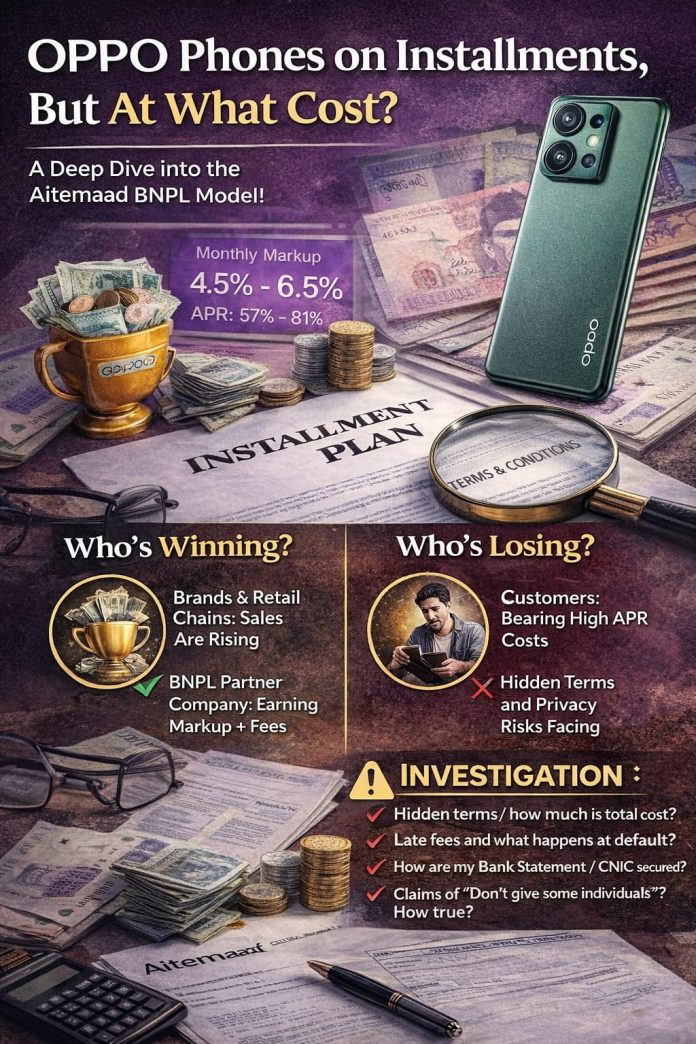
However, financial analysis reveals that the true cost of these installment plans may be much higher than consumers realize. Public disclosures from similar BNPL models show monthly markup rates between 4.5 percent and 6.5 percent. This translates into Annual Percentage Rates (APR) that can range from 57 percent to as high as 81 percent, depending on the customer’s credit profile and repayment schedule. While advertisements emphasize affordability, the total amount repaid by the customer can significantly exceed the original retail price of the smartphone.
Industry experts note that most consumers focus only on the monthly installment amount and do not calculate the total repayment obligation. This total cost often includes markup, service charges, processing fees, and late payment penalties. As a result, buyers may unknowingly enter into high-cost financial commitments without fully understanding their long-term burden.
The primary users of installment-based smartphone financing include middle-income salaried employees, university students, freelancers, gig workers, and young first-time earners. For many of them, smartphones are not luxury items but essential tools for work and income generation. Delivery riders, online sellers, content creators, and remote workers depend on reliable smartphones for their livelihoods, making installment plans attractive despite their high cost.
Regulatory oversight of digital lending in Pakistan falls under two main authorities. The Securities and Exchange Commission of Pakistan regulates non-banking finance companies, while the State Bank of Pakistan supervises banking institutions. The digital lending guidelines issued by SECP require lenders to clearly disclose markup rates, APR, total repayment amounts, Key Fact Statements, privacy policies, and data usage consent terms. Lenders are also prohibited from imposing hidden charges and must communicate penalties and recovery procedures in a transparent manner.
Despite these safeguards, concerns remain about whether consumers truly understand the digital contracts they accept. Many agreements are lengthy and written in technical language that ordinary users may not read or comprehend fully. Applicants are usually required to submit copies of their CNIC, bank statements, and personal financial information through mobile apps and online platforms. Cybersecurity specialists warn that weak data protection practices can expose users to identity theft, fraud, and unauthorized data misuse.
Financial analysts argue that regulators need to strengthen enforcement mechanisms. They recommend making the Total Payable Amount more visible through bold and clear disclosures, conducting regular compliance audits of BNPL providers, and launching nationwide awareness campaigns about effective APR and installment risks. Educating consumers about calculating total repayment costs could help them make informed financial decisions.
As Pakistan’s digital economy continues to grow, installment-based smartphone financing presents both opportunity and danger. On one hand, it promotes financial inclusion by giving more people access to digital tools. On the other hand, without strong transparency and consumer education, it risks creating a new form of high-cost digital debt.
The critical question remains whether consumers are fully aware of the long-term financial implications of purchasing smartphones on installment plans. Without proper understanding, financial inclusion may slowly transform into financial vulnerability for millions of users across the country.