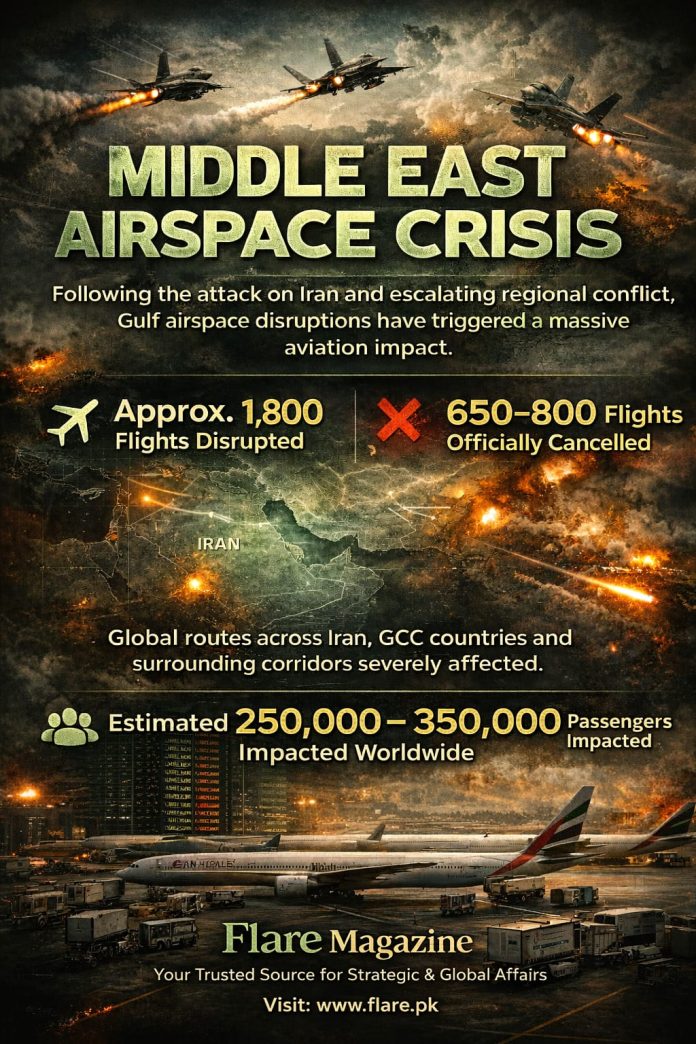

ISLAMABAD / GLOBAL DESK: Escalating tensions following the attack on Iran and subsequent regional military responses have triggered a major aviation disruption across the Middle East, affecting thousands of travelers worldwide.
As multiple countries in the region either closed or restricted their airspace, global aviation networks faced immediate operational challenges. Key air corridors over Iran and surrounding Gulf states were severely impacted, forcing airlines to cancel, delay or reroute flights.
Nearly 1,800 Flights Affected
According to aviation tracking data and airline operational updates, approximately 1,800 flights have been disrupted since the start of the crisis.
Out of these, an estimated 650 to 800 flights have been officially cancelled, while the remainder have either been delayed or diverted to alternate routes.
The disruption extends beyond Iran, affecting key transit hubs and air corridors connecting Europe, Asia and the Middle East. Gulf Cooperation Council (GCC) countries, which serve as major global aviation gateways, have experienced operational strain due to airspace adjustments and precautionary restrictions.
Hundreds of Thousands of Passengers Impacted
Based on standard passenger capacity averages for international flights, aviation analysts estimate that between 250,000 and 350,000 passengers have been directly impacted so far.
This figure includes travelers facing cancellations, long delays, missed connections and forced rerouting.
Major international carriers operating between Europe, Asia and the Gulf region have either suspended services temporarily or modified flight paths to avoid high-risk airspace. The situation remains fluid, with airlines closely monitoring security developments before restoring normal schedules.
Global Aviation on Alert
The Middle East serves as one of the busiest transit corridors in global aviation. Any prolonged airspace closure in the region has ripple effects across international networks, increasing fuel costs, extending flight durations and placing additional pressure on airline operations.
Industry experts warn that if tensions continue, disruptions could expand further, affecting additional routes and increasing the number of cancelled flights in the coming days.
For now, airlines are advising passengers to check with carriers before departure as operational updates continue to evolve.