
Pakistan’s digital payments landscape has reached another major milestone as JazzCash announced that it has successfully onboarded its 1 millionth Raast QR-enabled merchant. The achievement strengthens JazzCash’s position as the country’s largest QR payment ecosystem and supports Prime Minister Shehbaz Sharif’s vision of building a more cashless and digitally connected economy.
The milestone reflects the rapid shift taking place in Pakistan’s financial sector, where more businesses, retailers, and consumers are moving away from cash and adopting digital payment methods. With one million Raast QR-enabled merchants now active on the platform, JazzCash is playing a central role in helping Pakistan formalize its economy and expand access to financial services for millions of people.
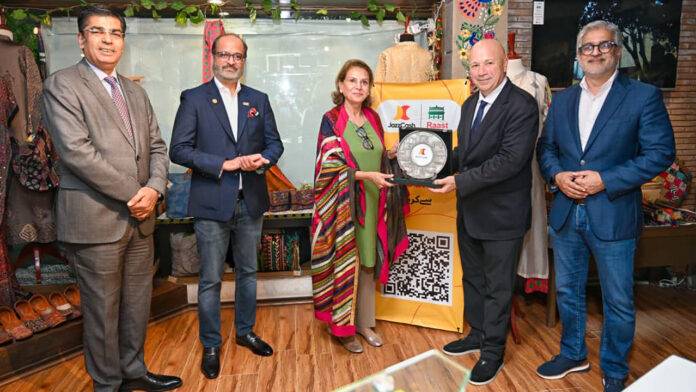
The 1 millionth merchant was onboarded at a retail outlet run by the Behbud Association, a non-profit organization known for supporting women through vocational training, education, and small business opportunities. The decision to mark this milestone at Behbud was symbolic because it highlighted the growing importance of digital payments for women-led enterprises and micro-businesses across Pakistan.
By providing Behbud’s artisans and sellers with access to instant digital payment tools, JazzCash is helping women-owned businesses become part of the formal economy. This is especially important in Pakistan, where many small businesses still rely heavily on cash transactions and often struggle to access banking services or maintain proper financial records.
The ceremony was attended by VEON CEO Kaan Terzioğlu, JazzWorld CEO and JazzCash Chairman Aamir Ibrahim, and JazzCash CEO Murtaza Ali. Their presence highlighted the importance of this milestone not only for JazzCash but also for Pakistan’s broader digital economy.
JazzCash has expanded rapidly over the last few years by simplifying merchant onboarding and using the State Bank of Pakistan’s interoperable Raast payment framework. Raast allows users and businesses to send and receive payments instantly through mobile numbers, QR codes, and bank accounts without the delays or complications often associated with traditional banking systems.
The introduction of Raast QR has made it easier for small retailers, roadside shops, grocery stores, pharmacies, clothing outlets, restaurants, and online sellers to accept payments digitally. Instead of relying only on cash, merchants can now receive instant payments by displaying a QR code that customers can scan through their mobile banking or wallet apps.
Murtaza Ali, CEO of JazzCash, said the achievement is an important step towards making digital payments part of everyday life in Pakistan.
He said that reaching one million QR-enabled merchants shows how digital payments are becoming common across different parts of society, from neighbourhood shops to organizations such as Behbud Association. He added that JazzCash wants to make financial services simple, practical, and accessible for every Pakistani.
Industry experts believe that the rapid growth of QR payments could significantly reduce the country’s dependence on cash. Pakistan remains one of the most cash-heavy economies in the region, with many daily transactions still taking place outside the formal banking system. This creates problems such as undocumented income, lower tax collection, reduced financial transparency, and limited access to credit for small businesses.
By encouraging merchants to use QR payments and digital wallets, platforms like JazzCash can help create a more transparent economy where businesses have a clear transaction history and better access to loans, financial products, and business growth opportunities.
JazzCash’s achievement is particularly significant because of the scale at which the platform now operates. According to company figures, JazzCash currently serves 58 million registered users and processed more than PKR 15 trillion in transactions during 2025. That amount is equivalent to nearly USD 53 billion and represents around 13 percent of Pakistan’s GDP.
These numbers show that JazzCash is no longer simply a mobile wallet service. It has become one of the largest digital financial platforms in the country, supporting payments, transfers, merchant services, digital lending, utility bills, online shopping, insurance, and other financial products.
The growth of JazzCash also supports the State Bank of Pakistan’s efforts to promote financial inclusion. Millions of Pakistanis still do not have access to traditional bank accounts, especially in rural areas and among low-income communities. Mobile wallets and QR payment systems give these users an easier way to join the formal financial system without needing to visit a bank branch.
Raast itself has become one of the most important pillars of Pakistan’s digital payments infrastructure. Introduced by the State Bank of Pakistan in 2021, Raast was designed to allow instant, secure, and interoperable payments between banks, fintechs, and mobile wallet providers.
One of the biggest advantages of Raast is that it reduces the need for people to remember long IBAN numbers. Instead, users can link their mobile numbers to their accounts and receive money directly through Raast IDs. QR payments further simplify the process because customers only need to scan a code and authorize the payment.
JazzCash has also played an important role in promoting QR payments in sectors that traditionally relied on cash. During previous Eid seasons, the company introduced interoperable Raast QR payments at cattle markets across Pakistan. These efforts helped digitize a market worth billions of rupees and encouraged buyers and sellers to use secure digital transactions instead of carrying large amounts of cash.
The company believes that QR payments can be especially useful for micro-businesses and informal retailers because they are easy to set up and do not require expensive hardware or payment terminals. A merchant only needs a smartphone and a printed QR code to start accepting payments.
For customers, QR payments are faster, safer, and more convenient than cash. They reduce the risk of carrying money, make it easier to track expenses, and provide instant confirmation of payments. They can also help reduce fraud and mistakes in manual cash handling.
Despite the positive momentum, there are still challenges that need to be addressed. Some users continue to face confusion about how Raast IDs work, especially when linking the same mobile number to multiple bank accounts or digital wallets. Others have reported delays in de-linking and re-linking Raast IDs between different financial institutions. Community discussions online show that there is still a need for better public awareness and customer support around digital payments and Raast services.
There are also concerns about scams and fraudulent calls targeting digital wallet users. Online users have reported cases where scammers pretended to be JazzCash representatives in an attempt to obtain sensitive information. Experts advise users to avoid sharing PIN codes, OTPs, or personal details over phone calls and to verify all communication through official customer support channels.
Even with these challenges, the overall direction of Pakistan’s digital payments market remains positive. The government, the State Bank of Pakistan, telecom companies, and fintech providers are all working towards the same goal of creating a more inclusive and digitally enabled economy.
The onboarding of one million Raast QR merchants is more than just a business milestone for JazzCash. It is a sign that Pakistan’s financial habits are changing. Small businesses are becoming more comfortable with digital payments, customers are increasingly using mobile wallets, and financial services are becoming accessible to people who were previously excluded from the banking system.
As Pakistan continues to move towards a more digital future, JazzCash’s growing QR ecosystem is expected to play a major role in supporting financial inclusion, promoting economic transparency, and helping the country achieve its long-term cashless economy goals.