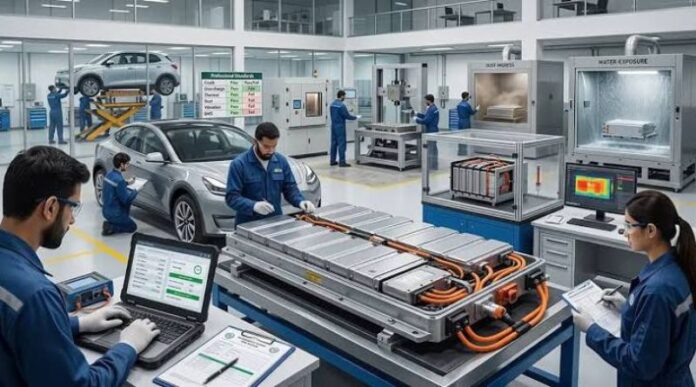

Pakistan is taking steps to improve the safety and quality of batteries used in electric vehicles (EVs). The government has decided to work on dedicated safety standards for lithium-ion batteries as the use of electric vehicles continues to grow across the country.
The move is important because the battery is one of the most important and expensive parts of an electric vehicle. It stores a large amount of electrical energy and directly affects the vehicle’s safety, driving range and performance. If a battery is poorly made, damaged, or not properly tested, it can create serious safety problems.
The government’s latest move comes as Pakistan’s electric vehicle market is slowly expanding. More electric cars, motorcycles, three-wheelers and other EVs are appearing on local roads. At the same time, concerns about battery quality, testing and safety have increased.
According to a recent report, Pakistan is now moving toward establishing specific standards for lithium-ion batteries used in electric vehicles.
Why EV Battery Safety Has Become Important
Electric vehicles are different from traditional petrol and diesel vehicles in many ways, but one of the biggest differences is their power source. Instead of using a fuel tank and an engine powered by petrol or diesel, an EV mainly depends on a large battery pack and an electric motor.
Modern EV batteries can store a large amount of energy in a relatively small space. This makes them useful for electric transport, but it also means that battery quality must be taken seriously.
A good battery needs to work safely in different conditions. It may face high temperatures during summer, long charging periods, heavy use, road vibrations and physical shocks. The battery should continue to perform safely under these conditions.
Poor-quality cells or weak battery parts can increase the risk of overheating, short circuits and other problems. This is why countries around the world have introduced different rules and testing systems for EV batteries.
Pakistan is now looking to build a stronger system of its own.
Government Wants Clear Rules for Lithium-Ion Batteries
The government’s decision focuses on developing dPakistan Moves to Develop Safety Standards for EV Batteriesedicated standards for lithium-ion batteries. These batteries are widely used in modern electric vehicles because they can store a large amount of energy while remaining relatively compact.
However, not every battery available in the market has the same quality. Different manufacturers may use different battery cells, battery management systems and other components.
A proper national standard can help set a basic level of safety and performance that manufacturers and importers must follow.
This could make it easier for authorities to check whether a battery is suitable for use in an electric vehicle. It could also help consumers identify vehicles that use tested and reliable battery systems.
The development of clear standards may also support local manufacturers. Companies that want to produce EVs in Pakistan would have a better understanding of the safety requirements they need to meet before bringing their products to the market.
Battery Quality Directly Affects Consumer Safety
For an EV owner, the battery is much more than just a source of power. It is a major part of the vehicle’s overall safety.
A battery that does not meet proper quality requirements may perform poorly or become unsafe under certain conditions. Problems can become more serious if a vehicle is involved in an accident or if the battery is exposed to extreme heat.
International EV safety rules often look at issues such as electrical safety, overheating, battery protection and safety after a crash. For example, global vehicle safety work includes requirements designed to reduce electric shock and fire risks linked to high-voltage battery systems.
Pakistan’s planned standards could help bring similar safety thinking into the local EV market.
The goal should not simply be to test whether a battery can power a vehicle. It should also be checked to make sure it can operate safely throughout its expected life.
Battery Management Systems Are Also Important
The battery cells are only one part of an EV battery system. Another important component is the Battery Management System, commonly known as BMS.
The BMS monitors important battery conditions such as temperature, voltage and charging levels. It helps protect the battery from conditions that could damage it.
If a battery becomes too hot or receives too much electrical power, the system should be able to respond properly. A good battery management system can help reduce the risk of serious battery problems.
International standards and testing systems already consider areas such as overcharging, over-discharge, over-current, short circuits, excessive temperature and voltage control.
For Pakistan, including such safety checks in a clear national framework could improve the quality of EVs available to consumers.
Pakistan’s EV Market Is Growing
The government’s decision comes at a time when interest in electric vehicles is increasing in Pakistan.
People are looking at EVs for several reasons. Petrol prices, fuel costs, maintenance expenses and environmental concerns have encouraged some consumers to consider electric transport.
Electric motorcycles and other smaller EVs are also becoming more visible in the local market. Electric cars are slowly gaining attention as more companies introduce new models.
As the number of EVs increases, the need for proper safety rules becomes more important.
A small EV market can sometimes operate with limited oversight because the number of vehicles is low. But as sales increase, weak standards can create bigger problems.
The government therefore needs to make sure that battery safety develops alongside EV adoption.
Better Standards Can Increase Public Confidence
One of the biggest challenges for electric vehicles in Pakistan is consumer confidence.
Many people are still learning about EV technology. Some potential buyers have questions about battery life, charging, maintenance, replacement costs and safety.
Reports of poor-quality batteries can make these concerns even stronger.
If the government introduces clear testing and certification rules, consumers may feel more comfortable buying electric vehicles.
A buyer should be able to expect that the battery installed in a new EV has passed the required safety checks. This can create greater trust between consumers, manufacturers and importers.
Strong rules can also help responsible companies compete fairly. If one company spends more money on good-quality battery systems while another uses cheaper and lower-quality parts, the second company could gain an unfair price advantage.
Proper enforcement can reduce this problem.
Standards Could Help Local EV Manufacturing
Pakistan has been trying to encourage local production and investment in the electric vehicle sector. Better battery standards could support this effort.
Clear rules can give local manufacturers a proper roadmap for producing safe EVs. Companies would know what type of testing, documentation and certification is required.
This can also encourage manufacturers to improve their production methods.
Over time, Pakistan could develop more local expertise in battery assembly, testing, repair and recycling. This would create opportunities for businesses and skilled workers.
However, the standards need to be practical. If requirements are too complicated or expensive, smaller companies may struggle to comply. The government will need to find a balance between strong safety rules and reasonable costs for manufacturers.
Imported EVs May Also Face Greater Checks
Pakistan imports many vehicles, components and battery-related products. Any new battery safety system would therefore need to consider imported EVs as well.
If safety standards only apply to locally assembled vehicles, consumers could still be exposed to low-quality products entering the market through imports.
A strong system should make sure that both locally produced and imported batteries meet the required safety level.
This could include proper documentation, product testing and certification before batteries or vehicles enter the market.
Such checks would also help authorities identify products that do not meet the required standards.
Testing Should Cover More Than Basic Performance
Battery testing should not only focus on whether a battery can hold a charge.
A proper safety system can look at several areas, including temperature control, electrical protection, charging behaviour, physical damage and overall battery performance.
Battery cells can also behave differently under different conditions. A battery that works well in a controlled test may face completely different conditions when used on Pakistani roads.
Pakistan has hot summers in many parts of the country. Vehicles may also be parked outdoors for long periods. These conditions make heat management especially important.
Testing requirements should therefore consider real-world use as much as possible.
Charging Safety Also Matters
Battery safety cannot be separated from charging safety.
EV batteries are charged through electrical systems that must also meet proper safety requirements. Faulty charging equipment, poor wiring or incorrect installation can create risks.
Pakistan has already introduced regulations for EV charging infrastructure and battery swapping stations. The National Energy Efficiency and Conservation Authority, or NEECA, oversees these rules and requires charging and battery-swapping facilities to meet technical and safety requirements.
These regulations include requirements related to grounding, protection from electrical faults and other safety measures.
This shows that EV safety is not limited to the battery manufacturer. It also involves charging stations, battery swapping facilities, vehicle makers, importers and service providers.
Battery Swapping Also Needs Safety Rules
Battery swapping is another area that could become important in Pakistan, especially for electric motorcycles and three-wheelers.
Instead of waiting for a battery to charge, users can replace a weak battery with a charged one at a swapping station.
This system can save time, but it also creates additional safety requirements. Batteries need to be stored, charged, handled and transported properly.
Pakistan’s existing EV charging and battery-swapping regulations already include safety requirements for these facilities. NEECA says battery-swapping stations must follow relevant IEC and PSQCA requirements and provide suitable systems for battery storage, charging and management.
As battery swapping grows, these rules may become even more important.
What This Could Mean for EV Buyers
For consumers, stronger battery standards could bring several benefits.
First, buyers may have greater confidence that the battery in a new EV has passed proper checks.
Second, better battery quality could improve vehicle performance and battery life.
Third, stronger safety rules could reduce the risks linked to poor-quality or uncertified battery systems.
Consumers may also benefit from clearer information about battery specifications and certification.
However, stronger standards could have an effect on vehicle prices. Manufacturers may need to spend more on testing and certification, while companies using better battery components may face higher production costs.
Even so, many buyers may consider the additional cost worthwhile if it results in a safer and more reliable vehicle.
Enforcement Will Be the Real Test
Introducing standards is only the first step. The government will also need to make sure that the rules are actually followed.
In June 2026, authorities had already raised concerns about some EV manufacturers using substandard or uncertified battery systems. The government directed the Engineering Development Board to work with NEECA and other stakeholders on a proper inspection, testing and verification system.
This shows why enforcement will be important.
If companies can sell batteries without proper checks, even the best standards will have little effect.
Authorities will need regular inspections, reliable testing facilities and clear action against companies that fail to meet safety requirements.
Manufacturers and importers should also be required to maintain proper records so authorities can trace battery products when necessary.
A Positive Step for Pakistan’s EV Future
Pakistan’s move toward dedicated EV battery safety standards is an important step for the country’s electric mobility plans.
Electric vehicles can offer benefits such as lower fuel use, reduced local emissions and potentially lower running costs. But these benefits will only matter if consumers trust the technology.
Battery safety is at the heart of that trust.
Clear standards can help Pakistan create a more organised EV market where manufacturers compete on quality instead of simply offering the lowest price. They can also help consumers make better decisions when buying electric vehicles.
The government will now need to turn the plan into a practical system. Standards should be clear, testing should be reliable and enforcement should be consistent.
Pakistan’s EV sector is still developing, which gives the country a chance to build safety into the market from an early stage. If battery manufacturers, vehicle companies, importers and regulators work together, the country can create a safer environment for EV users.
Conclusion
The government’s decision to develop safety standards for EV batteries comes at an important time. Electric vehicles are gaining attention in Pakistan, but the growth of the sector must be supported by proper safety rules.
Lithium-ion batteries need careful testing because they are the main energy source of most modern EVs. Battery cells, management systems, charging systems and other components all need to work safely together.
The planned standards can help improve battery quality, protect consumers and increase confidence in electric vehicles. They can also support local EV manufacturing and make Pakistan’s electric mobility market more reliable.
The success of this effort, however, will depend on implementation. Strong standards will only make a real difference if manufacturers and importers are properly checked and companies that ignore safety requirements face action.
For Pakistani consumers, the development is a positive sign. As more people consider switching from petrol-powered vehicles to electric options, knowing that their vehicle’s battery has been properly tested can make that decision much easier.
With the right rules and proper enforcement, stronger EV battery standards could become an important part of Pakistan’s journey toward safer and more reliable electric transportation.
Read Also: check