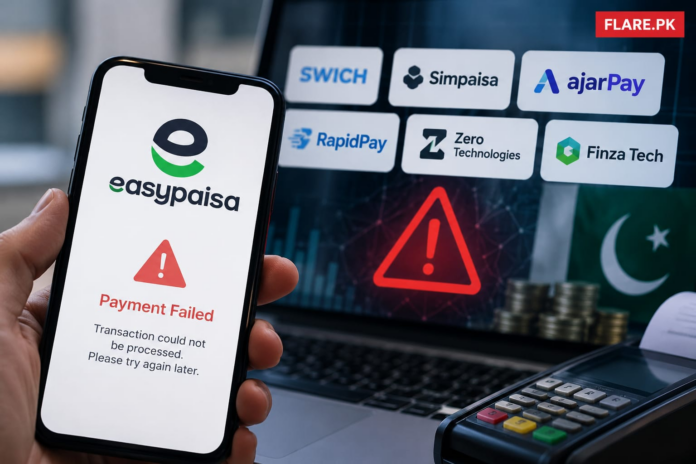

ISLAMABAD: Disruptions in certain merchant payments routed through Easypaisa have raised concerns across Pakistan’s digital payments ecosystem, with transactions linked to several payment facilitators and aggregators reportedly being affected.
According to information available with FLARE, payment channels associated with SWICH, Simpaisa, ajarPay, RapidPay, Zero Technologies and Finza Tech are among those affected by the disruption.
The issue has also received independent confirmation from international payment processor dLocal, which reported processing problems involving the Easypaisa payment method in Pakistan and said the matter was under investigation.
Industry sources said the development has emerged at a time when law-enforcement agencies are intensifying scrutiny of digital financial channels that may potentially be misused for online gaming, gambling, suspicious fund movements, unauthorised payment activity and other illicit financial transactions.
Recent investigations by the Federal Investigation Agency have also highlighted the growing use of bank accounts, mobile wallets and cryptocurrency-related channels in cases involving illegal online gaming and gambling networks.
Investigators in such cases have examined the movement of funds through multiple accounts, possible layering of transactions, digital hawala and hundi mechanisms and the use of USDT and other crypto assets for transferring or concealing the movement of money.
The latest disruption has therefore attracted wider attention within the payments industry, particularly over whether enhanced compliance checks or law-enforcement scrutiny may be affecting merchant transaction flows and settlement processes.
Separately, the State Bank of Pakistan introduced a regulatory framework in May 2026 covering payment intermediaries and aggregators involved in collecting rupee payments in Pakistan for onward remittance against foreign services.
The framework placed additional compliance obligations on banks and intermediaries, particularly in relation to documentation, foreign-exchange rules, settlement mechanisms and monitoring of payment flows.
For merchants, the immediate concern is the delay in settlement of legitimate transactions. Industry sources said a number of merchants and customers have experienced pending payments and settlement delays, creating uncertainty over when affected funds will be cleared.
The broader issue also underlines the challenge facing Pakistan’s rapidly expanding digital payments industry: ensuring that legitimate businesses and customers are not disrupted while financial institutions, payment facilitators and regulators strengthen controls against unlawful or suspicious transactions.
FLARE understands that Easypaisa-linked payment processing remains under close watch by affected merchants and industry participants.
Easypaisa’s position was sought repeatedly. A company representative said the company did not wish to comment on the matter at this stage.
The situation remains significant for Pakistan’s fintech and digital-commerce sectors as businesses increasingly depend on mobile wallets, payment gateways and digital settlement platforms for everyday transactions.