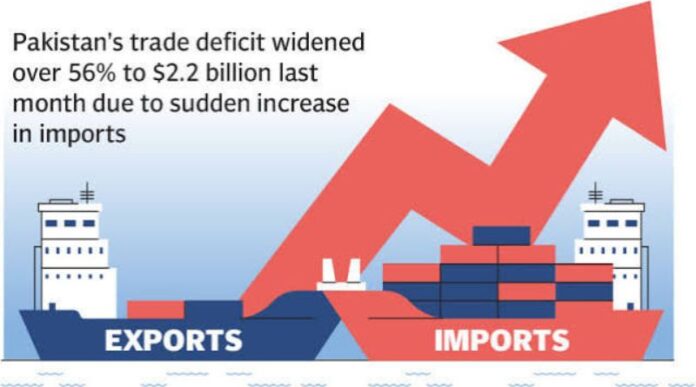

Pakistan’s trade deficit has increased again, raising fresh concerns about the country’s external trade position and the growing gap between imports and exports. The latest figures show that the country is spending more on imported goods than it is earning through exports, putting additional pressure on the balance of payments and foreign exchange resources.
The trade deficit is an important part of Pakistan’s economic picture because it shows the difference between the value of goods the country buys from other countries and the value of goods it sells abroad. When imports remain higher than exports for a long period, the country needs more foreign currency to meet its external payments.
The latest increase in the trade gap comes at a time when Pakistan is trying to improve exports, control unnecessary imports, increase foreign exchange earnings and maintain economic stability. While higher imports can also reflect stronger economic activity, a sharp rise in imports without a similar increase in exports can create pressure on the economy.
Trade Deficit Becomes a Growing Concern
Pakistan has faced a trade deficit for many years. The country imports a wide range of products, including petroleum, machinery, electrical equipment, chemicals, food items, medicines and other industrial goods. At the same time, its exports are mainly linked to sectors such as textiles, rice, leather, sports goods, surgical instruments and other products.
The basic problem is that the value of imports often remains much higher than the value of exports.
When the difference becomes wider, Pakistan needs more dollars and other foreign currencies to pay for imports. This can put pressure on foreign exchange reserves and may also affect the exchange rate if foreign currency demand becomes too high.
The latest worsening in the trade deficit has therefore attracted attention from businesses, economists and policymakers.
A wider deficit does not automatically mean that every part of the economy is performing poorly. Imports of machinery, technology and raw materials can help local industries expand production. However, the situation becomes more difficult when imports grow quickly while exports fail to increase at the same pace.
Imports Continue to Play a Major Role
One of the main reasons behind Pakistan’s trade deficit is the country’s dependence on imports.
Pakistan does not produce all the goods and raw materials it needs locally. Industries depend on imported machinery, fuel, chemicals, parts and other inputs. The transport sector also requires large quantities of petroleum products and other energy-related imports.
When global prices increase, the import bill can rise even if the quantity of goods being purchased does not increase significantly.
Energy imports are especially important in this regard. Pakistan spends a large amount of foreign currency on petroleum products, crude oil and other energy-related items. Changes in international oil prices can therefore have a direct impact on the country’s import bill.
If oil prices rise, Pakistan may have to spend more dollars to purchase the same amount of fuel. This can make the trade deficit larger.
Export Growth Remains Important
For Pakistan, increasing exports is one of the most important ways to reduce the trade gap.
A stronger export sector can bring more foreign currency into the country, support local businesses and create employment opportunities. It can also reduce pressure on foreign exchange reserves.
However, increasing exports is not always easy. Pakistani exporters face competition from other countries, while production costs, energy prices, taxes, transport expenses and other business costs can affect their ability to compete in international markets.
Textiles remain a major part of Pakistan’s export sector, but the country needs to expand its export base and move towards more products with higher value.
Technology and IT services are another important area. Pakistan has a growing digital workforce and a large number of software developers, freelancers and technology companies. Higher IT exports can provide an additional source of foreign exchange without requiring the same level of physical imports associated with traditional manufacturing.
Why the Trade Gap Matters
The trade deficit matters because it is closely linked to Pakistan’s wider external account.
When a country imports more goods than it exports, it needs other sources of foreign currency to cover the difference. These sources can include remittances from overseas Pakistanis, foreign investment, loans and other financial inflows.
Remittances are particularly important for Pakistan. Millions of Pakistanis working abroad send money back home every year. These funds provide valuable foreign exchange and help support the country’s external position.
However, relying too heavily on borrowing or other temporary sources of foreign currency is not a long-term solution.
A sustainable economy needs a stronger export base that can regularly generate foreign exchange.
Impact on the Pakistani Rupee
A rising trade deficit can also create pressure on the Pakistani rupee.
Importers need foreign currency to pay international suppliers. When import demand increases, demand for dollars can also rise. If dollar inflows do not increase at the same speed, pressure can build in the foreign exchange market.
A weaker rupee can make imported goods more expensive. This can affect fuel, machinery, electronics, medicines, industrial raw materials and other products.
Higher import costs can then affect businesses and consumers. Companies may increase prices because their production costs have gone up, while consumers may have to pay more for imported products or locally made goods that depend on imported materials.
This creates another challenge for policymakers because controlling the trade deficit is not only about reducing imports. It is also about increasing productive economic activity and improving exports.
Higher Imports Are Not Always Bad
It is important to understand that a rise in imports does not always represent a negative development.
For example, if businesses import machinery to establish new factories or expand existing production, those imports can support future economic growth. Similarly, imports of raw materials can help export-oriented industries increase their output.
The problem arises when imports mainly consist of products that do not contribute to future production or export growth, while essential foreign exchange earnings remain weak.
This is why policymakers usually look at the composition of imports instead of focusing only on the total number.
A rise in machinery and industrial equipment may have a different economic impact from a sharp increase in luxury or non-essential consumer goods.
Energy Imports Remain a Key Challenge
Pakistan’s energy needs remain one of the major factors affecting the import bill.
The country requires large amounts of fuel to run transport, industries, power plants and other parts of the economy. Local energy production has increased in some areas, but imported fuel continues to play an important role.
Global energy prices can therefore have a major impact on Pakistan’s external trade.
When international oil prices increase, the country’s import bill can rise quickly. When prices fall, the pressure may ease.
This makes the trade position partly dependent on international market conditions that Pakistan cannot control.
One way to reduce this vulnerability is to improve domestic energy production and increase the use of reliable local energy sources. Better energy efficiency can also help reduce the amount of fuel needed for economic activity.
Need to Improve Export Competitiveness
Pakistan needs to make its exporters more competitive if it wants to reduce the trade deficit in a sustainable way.
Businesses need reliable electricity, reasonable energy costs, better roads and transport systems, efficient ports and simpler government procedures.
Exporters also need easier access to finance and modern technology.
Another important issue is product quality. Pakistani companies need to meet international standards if they want to enter new markets and increase their share in existing markets.
Branding and marketing are also important. Pakistan produces many goods that have demand in international markets, but local businesses may not always have the resources or knowledge needed to build strong international brands.
Improving these areas can help Pakistani companies sell more products abroad.
Expanding Into New Markets
Pakistan also needs to reduce its dependence on a limited number of export markets.
Selling products to more countries can provide greater stability for exporters. If demand falls in one market, companies can continue selling in others.
Emerging markets in Asia, Africa, the Middle East and other regions may offer opportunities for Pakistani businesses.
However, entering new markets requires proper research. Exporters need to understand local consumer preferences, regulations, prices and competition.
Government trade missions and business groups can play a role in helping companies identify new opportunities.
The Role of Technology
Technology can help Pakistan improve both exports and productivity.
The IT sector has already become an important source of foreign exchange. Software development, freelancing, business process services, online platforms and other digital services can reach customers around the world.
Unlike many traditional industries, digital businesses can provide international services without shipping physical products.
Pakistan has a large young population, which gives the country an opportunity to expand its digital workforce. Better internet services, digital skills training and easier payment systems could help more people earn foreign currency from international clients.
Technology can also improve traditional industries. Modern machinery, better farming methods, digital supply chains and improved production systems can help businesses reduce costs and increase quality.
Trade Policies Need Long-Term Planning
The latest increase in the trade deficit highlights the need for consistent trade and economic policies.
Short-term restrictions on imports may help reduce pressure on foreign exchange reserves, but such measures cannot replace long-term reforms.
Pakistan needs to increase production, improve export quality, reduce business costs and attract investment in productive sectors.
Policies should also provide businesses with greater certainty. Frequent changes in taxes, regulations and import rules can make it difficult for companies to plan investments.
A stable business environment can encourage local and foreign investors to expand production.
What Can Help Reduce the Deficit?
Several steps can help Pakistan improve its trade balance over time.
First, the country needs to increase exports. This means supporting existing exporters while also helping new businesses enter international markets.
Second, Pakistan should encourage local production of goods that can be produced competitively at home. This can reduce dependence on imports.
Third, energy costs and supply problems need to be addressed. Industries cannot compete internationally if their production costs remain too high.
Fourth, the country should invest in technology and skills. A stronger IT sector can provide additional foreign exchange earnings.
Finally, Pakistan needs better trade infrastructure. Faster customs procedures, efficient ports and improved transport networks can reduce the cost and time involved in exporting goods.
A Wider Trade Deficit Needs Attention
The renewed increase in Pakistan’s trade deficit shows that the country still faces a major challenge in balancing imports and exports.
Imports are necessary for economic activity, and not all imports are harmful. Machinery, industrial inputs, technology and raw materials can support future growth. However, Pakistan also needs to make sure that the growth in imports is matched by stronger production and exports.
The country’s long-term economic stability depends on its ability to generate enough foreign exchange through exports, IT services, remittances and investment.
A wider trade deficit can put pressure on foreign exchange reserves, the rupee and the overall external position. At the same time, reducing the deficit only through import restrictions can limit economic activity if local industries depend on imported inputs.
The better long-term approach is to build a stronger and more competitive export economy.
Pakistan has opportunities in textiles, agriculture, food processing, technology, engineering, pharmaceuticals and other sectors. With better infrastructure, stable policies, improved skills and stronger access to international markets, businesses can potentially increase their presence abroad.
For now, the latest rise in the trade deficit is a reminder that Pakistan still needs to address the basic imbalance between what it buys from the world and what it sells to the world. Sustainable export growth will remain one of the key requirements for improving the country’s external position and supporting long-term economic stability.
Read Also: check