
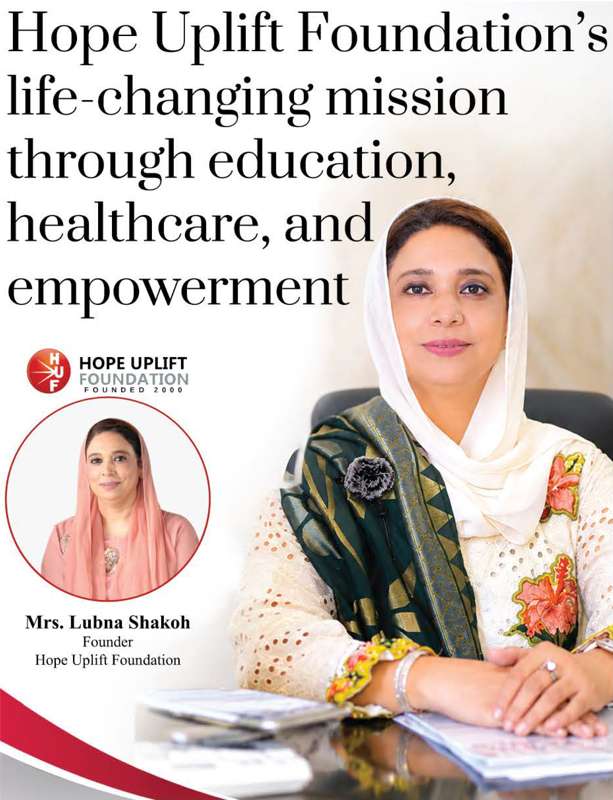

A candid conversation with Mrs. Lubna Shakoh, Founder of Hope Uplift Foundation (HUF), in which she highlighted her inspiring journey, the vision behind the organisation and its contributions to education, healthcare, women’s empowerment and community development. She shared with Flare the challenges and achievements shaping HUF’s mission to transform lives and create lasting social change.
Flare: What inspired you to start Hope Uplift Foundation in 2000 with just Rs. 300, and what were its key turning points?
Mrs. Lubna Shakoh: I never imagined that an initiative begun with Rs. 300 would grow into what Hope Uplift Foundation (HUF) is today. My father’s welfare work and the humanitarian efforts of Abdul Sattar Edhi inspired me, but a visit to our domestic worker’s home in Model Colony on my daughter’s birthday made the need personal. Seeing families living in difficult conditions convinced me that sympathy alone was not enough; practical action was needed.
On 4 July 2000, I began collecting donations with Rs. 300, involving family and friends. Within ten days, we had established our first dispensary. The support of others helped us take the next steps. What continues to motivate me is knowing that our work has made life easier for people. HUF has grown, but its purpose remains to help people live with dignity and opportunity.
Flare: What are HUF’s latest enrolment figures, educational achievements and expansion plans?
Mrs. Lubna Shakoh: Education is close to my heart. A child’s future should not be spoiled merely because of meagre resources of their parents. HUF supports approximately 2,000 children through affordable schooling, scholarships and educational assistance. Our work now extends to FSc education and university scholarship opportunities. We are also working to establish an IT campus to equip young people with skills relevant to today’s job market. We aim to improve educational quality, expand digital learning and help more students continue their studies. I hope our students will become professionals and community leaders, knowing that financial circumstances need not limit their ambitions.
Flare: How have HUF’s vocational training and Women’s Empowerment Hub strengthened women economically?
Mrs. Lubna Shakoh: Many women have valuable skills but lack the resources or opportunities to reach customers. Our vocational training initiatives help them develop practical skills, while the Women’s Empowerment Hub provides space to display and sell their products at nominal charges. This gives women opportunities to earn, contribute to household expenses and support their children’s education. Seeing them take pride in their work and become financially independent is especially rewarding. We hope to expand the Hub and encourage women to mentor and support others.
Flare: What are the key healthcare needs of communities around Lahore, and how does HUF ensure affordable access to medical services?
Mrs. Lubna Shakoh: Many people are unable to get medical support because of the treatment cost. Healthcare has been part of HUF’s work from the beginning; our first dispensary opened just ten days after we began collecting donations.
Today, our facilities in Al-Noor Town, Model Colony and Nishat Colony, along with mobile healthcare services, help communities access medical care. Key needs include affordable consultations, essential medicines, maternal and child healthcare, preventive services and health awareness. We subsidise services to make treatment more accessible. Our reported figures include approximately 20,000 patients served at the Nishat Colony Medical Centre over three months.
Behind every figure is a person or family seeking help. Although we cannot meet every need, we strive to make healthcare easier to access and afford.
Flare: Which HUF welfare programmes face the greatest demand, and how do you evaluate their impact?
Mrs. Lubna Shakoh: Families often face several challenges simultaneously, including food insecurity, unsafe drinking water, inadequate shelter and limited income. HUF provides daily meals through its food station and mobile distribution, as well as ration packages to the needy. Our water projects include wells, hand pumps and filtration facilities. Through HUF New Life Home, we provide shelter and care for vulnerable children, while interest-free financial assistance supports people facing difficult circumstances.
Demand varies, but food and ration support become particularly important when household budgets are strained. We track the people and communities reached, while also considering whether our support helps children remain in school, families access clean water, or individuals overcome difficult circumstances. We aim to provide practical, respectful and lasting assistance.
Flare: How does HUF ensure transparency, accountability and long-term financial sustainability?
Mrs. Lubna Shakoh: HUF was built on the trust of family, friends and donors, and we take that responsibility seriously. We maintain financial records and programme documentation and undergo an annual independent audit. Our company profile identifies Baker Tilly Mehmood Idrees Qamar as the external audit firm.
Donors and volunteers, particularly women who contribute their time and skills, remain central to our work. We are also seeking long-term partnerships and sustainable initiatives so that our programmes do not depend on donations alone. Accountability means respecting both those who support us and those who rely on our services.
Flare: What challenges have you faced leading HUF, and what advice would you offer women starting social initiatives?
Mrs. Lubna Shakoh: Limited resources have been our biggest challenge, teaching me the importance of careful planning, collaboration and persistence. My advice to women is to start with what they have, identify a need and take practical action. Trust, honesty and consistency matter more than a large budget. I started with Rs. 300; the key was taking the first step.
Flare: What are HUF’s five-year priorities, and what partnerships could support its growth?
Mrs. Lubna Shakoh: Our priorities include expanding scholarships, improving learning opportunities, establishing the planned IT campus, strengthening vocational training and empowering women through our Women’s Empowerment Hub. We also aim to expand healthcare, food assistance, clean water and shelter programmes. Partnerships with businesses, educational institutions, hospitals and donors can provide funding, expertise and resources. Our goal is to reach more people while preserving HUF’s founding commitment to serving communities.
Source: Flare Magazine, November 2026