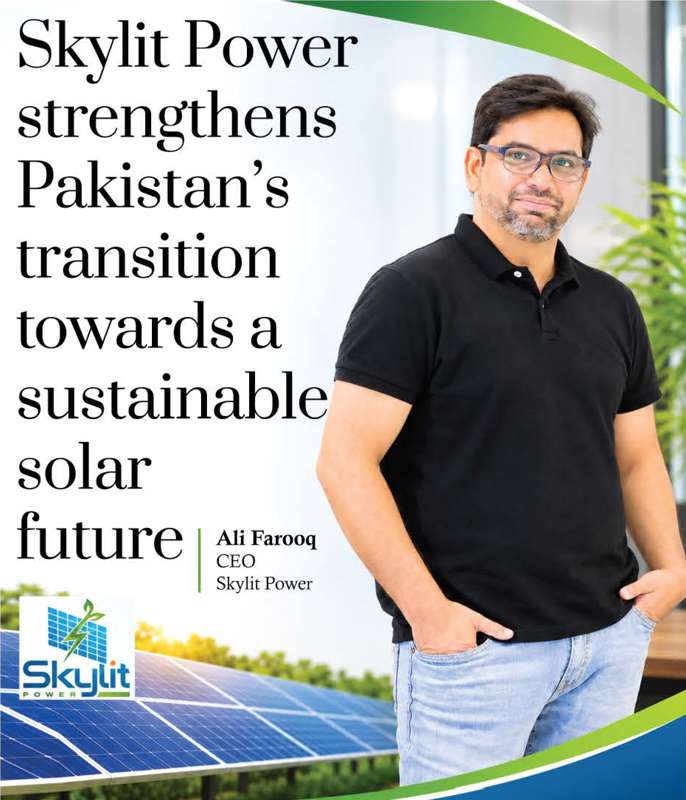

Flare speaks with Ali Farooq, CEO of Skylit Power, about his entrepreneurial journey and vision for Pakistan’s energy sector. Founded in 2023, Skylit Power aims to deliver reliable, efficient and sustainable energy solutions to residential, commercial and industrial customers.
Flare: What inspired you to lead Skylit Power, and what has shaped your leadership journey?
Ali Farooq: My professional journey has been driven by entrepreneurship, business development and a strong interest in Pakistan’s evolving energy sector. I established Skylit Power in 2023 with a vision to provide reliable, efficient and sustainable energy solutions to residential, commercial and industrial customers. Building the company has given me valuable experience in business management, project execution, customer relationships and strategic decision-making. We believe in maintaining high standards, building a capable team, understanding customer requirements and delivering on commitments. My vision is to develop Skylit Power into a trusted name in Pakistan’s renewable energy industry through quality, innovation and long-term customer relationships.
Flare: What are Skylit Power’s core services and market strengths?
Ali Farooq: Skylit Power is a solar engineering, procurement and construction (EPC) company serving residential, commercial and industrial customers. Our work includes system design, equipment supply, installation, commissioning and after-sales support. Skylit Power also specialises in delivering comprehensive solar energy solutions, hybrid inverters, lithium batteries, battery energy storage systems (BESS), UPS units and automatic servo voltage stabilisers. We select equipment from established manufacturers, including Longi, JA Solar, Jinko, Canadian Solar, Astronergy and Aiko for solar modules, and Solis, GoodWe, Delux, KStar and Chint Power for inverters, alongside other suitable options. Our competitive focus is practical system design, appropriate equipment selection, project execution and direct customer support.
Flare: What are the key challenges facing Pakistan’s solar industry, and how can stakeholders address them?
Ali Farooq: The industry faces several challenges, including changing policies and net-metering arrangements, uncertainty in electricity tariffs, currency fluctuations, import and financing costs, macroeconomic shifts and inconsistent installation practices. These factors can make customers hesitant and encourage decisions based solely on the lowest initial price. The government can help by providing clear, stable regulations and transparent approval processes. The private sector must improve engineering standards, safety, warranties and customer education. Industry associations can support common technical guidelines, training, responsible marketing and constructive dialogue with regulators. A predictable policy environment and a focus on quality will benefit consumers and businesses.
Flare: How is Skylit Power advancing reliable and affordable solar solutions?
Ali Farooq: We drive adoption by offering customised engineering, procurement and construction (EPC) solutions. We assess consumption, load profiles, available space, backup expectations and budgets before recommending a system. Our project experience includes residential, commercial and industrial installations, with our current business mix spanning these segments. We aim to combine suitable solar modules, reliable inverters and storage where required, supported by proper installation and commissioning. We also recognise that customer service continues after energisation; monitoring performance, responding to concerns and educating customers are important parts of delivering value.
Flare: Which emerging solar technologies will shape Pakistan’s energy future?
Ali Farooq: Over the next five years, I expect battery energy storage systems (BESS), high-capacity hybrid inverters, higher-efficiency solar modules and intelligent energy management systems to have the greatest impact. Solar panels will continue to improve in efficiency and power output, helping customers generate more energy from limited space. Batteries will make solar more useful beyond daylight hours and provide flexibility during outages and peak-tariff periods. Hybrid systems will increasingly coordinate solar, batteries, grid supply and generators. Smart monitoring and energy management will help users understand consumption, identify faults and optimise performance. The important point is to choose technologies that are proven, serviceable and appropriate for local conditions.
Flare: How does Skylit Power ensure the quality, safety and reliability of its solutions?
Ali Farooq: We ensure quality through strict sourcing protocols and partnerships with established manufacturers. Before finalising a solution, we assess site requirements, electrical configurations and customer needs. Our engineering teams enforce safety standards covering mounting, cabling, earthing, protection devices and commissioning. Proactive after-sales monitoring and support help maintain long-term performance. We believe safety and workmanship must never be compromised.
Flare: How do government policies, tariffs and financing affect renewable energy investments in Pakistan?
Ali Farooq: Government policy, net-metering rules, electricity tariffs and financing costs directly affect the financial returns on solar investments. When export compensation or approval requirements change, customers need clear information to evaluate viable payback periods. Higher grid tariffs can strengthen the case for self-consumption, while expensive financing and imported equipment can increase upfront investment costs. Customers should therefore assess their daytime usage, evening demand, backup requirements and applicable tariff rules before choosing between on-grid, hybrid or off-grid systems. Stable policies, accessible financing and transparent regulations would encourage responsible investment and support sustainable growth across the renewable energy sector.
Flare: What are Skylit Power’s expansion plans, strategic priorities and business goals for the next three to five years?
Ali Farooq: Our priority over the next three to five years is to strengthen Skylit Power’s position as a dependable EPC and energy-solutions provider. We intend to build on our experience by expanding our commercial and industrial (C&I) project portfolio, deepening our technical expertise in large-scale BESS applications, and refining our digital marketing and brand-positioning strategies to capture a larger share of the clean energy market. We will continue to evaluate new technologies and supplier relationships, focusing on product reliability, technical support and lifecycle value.
Flare: What is your message to entrepreneurs and investors considering renewable energy?
Ali Farooq: My message to Pakistani entrepreneurs, industrialists and investors is to view renewable energy as a strategic investment in competitiveness, resilience and the country’s future. Electricity is a major operating cost for many businesses, and a well-planned solar or storage system can help manage that cost while reducing exposure to supply uncertainty. However, decisions should be based on proper feasibility studies, realistic savings calculations, quality equipment, safe installation and credible after-sales support—not unrealistic promises or headline prices. The sector needs long-term thinking, consistent policies, skilled professionals and responsible companies. With these foundations, Pakistan can use its solar potential to support stronger businesses, resilient communities and cleaner energy.
Source: Flare Magazine, November 2026