
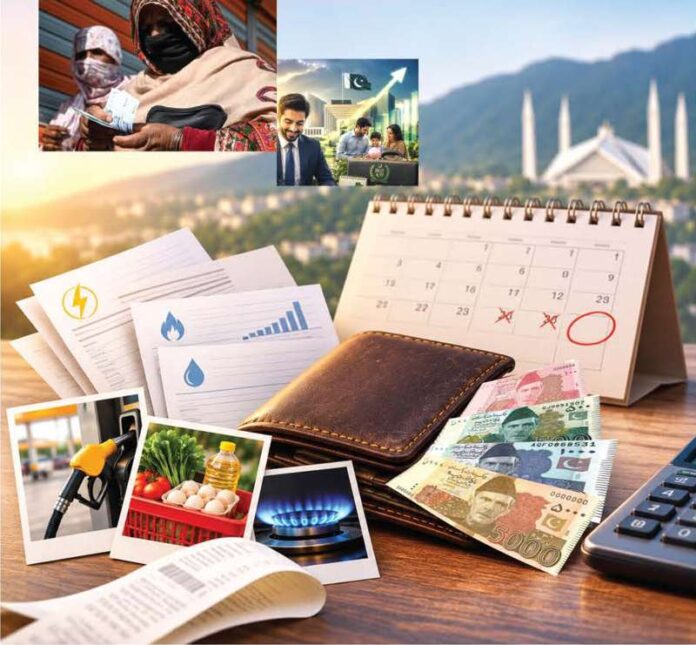

As Resident Editor Lahore of Flare Magazine, I begin this editorial with a simple conviction: a magazine earns its place only when it speaks to the lives of the people who read it. Journalism should not merely report events, figures and developments; it should also reflect the everyday concerns of ordinary people. I bring to this role many years of experience in classrooms, textbook writing and teacher training. Those years taught me that the most important questions are often the ones that begin at home, where families face daily challenges involving food, education, healthcare and household expenses.
In October, I wrote that the real contest in Pakistan is not the one in the headlines. It is the one fought in kitchens, at fuel pumps and in utility-bill queues. It is a struggle to make limited incomes cover increasing expenses while maintaining a reasonable standard of living. A month later, the official figures still support that view. Although inflation has eased somewhat, the financial pressure on ordinary households remains considerable.
What the numbers say
According to the Pakistan Bureau of Statistics, consumer inflation reached 11.1 percent year-on-year in August 2026, against 3.1 percent a year earlier. It has since eased to 10.3 percent in September and 9.6 percent in October, but that remains well above the 6.2 percent recorded in October 2025. In August, rural inflation, at 12.2 percent, ran ahead of the 10.4 percent recorded in the cities.
These figures indicate that the recent moderation in inflation has not translated into sufficient relief for consumers. Families continue to pay more for essential goods and services, while their incomes often remain unchanged. For salaried employees and daily wage earners, managing household expenses has therefore become increasingly difficult. Rural households face additional challenges as the cost of necessities contends with limited earnings and agricultural expenses.
The weekly picture is similar. The Sensitive Price Indicator (SPI), which tracks 51 essential items in 17 cities, stood 11.21 percent above its level a year earlier in the week ended 12 November, even though it slipped 0.46 percent from the previous week. In that same week, wheat flour was 36.14 percent dearer than a year before.
Wheat flour is a basic necessity for most Pakistani households, and such an increase directly affects their food budgets. Families cannot simply stop purchasing essential food items when prices rise. Instead, they reduce quantities, change their choices or cut spending on other necessities. A slight weekly decline may offer temporary comfort, but it does not reverse the burden created by earlier price increases.
Bills that cannot wait
Utility bills offer no relief. For November, the Oil and Gas Regulatory Authority (OGRA) notified a maximum LPG price of Rs294.08 per kilogram, and the Pakistan Bureau of Statistics puts LPG at 111.35 percent above last year’s level. This increase places additional pressure on households that depend on LPG for cooking and other domestic needs.
On electricity, the regulator approved a positive fuel charges adjustment of Rs2.3673 per unit for September consumption, to be added to the November bills of ex-WAPDA distribution companies and K-Electric consumers. For households already managing higher food and transportation expenses, additional electricity charges make monthly budgeting even more difficult.
One clarification matters here. A separate Rs2.32 per unit increase was approved for the discounted incremental-consumption rate. It applies only to additional electricity used by industrial and agricultural consumers, not to ordinary household bills. Consumers deserve clear information about such adjustments so that they can understand the charges reflected in their bills.
Electricity and cooking fuel are essential household requirements. Families cannot avoid these expenses, even when their incomes are insufficient to meet other basic needs. Consequently, higher utility costs leave less money available for food, education, healthcare and transportation.
The adjustments no table records
Numbers tell only part of the story. Behind every percentage point, families make difficult choices. Meat appears less often on the table, doctor’s visits are delayed, neighbours are asked for loans, and some children move from private to government schools or leave education altogether. As an educator, this last choice troubles me most, because financial hardship can quietly compromise a child’s future. Such sacrifices rarely appear in economic reports, but they reflect the real impact of rising living costs. Parents must prioritise expenses, sometimes sacrificing essential needs to manage until the next salary or wage payment.
Education is particularly vulnerable. School fees, books, uniforms and transportation add to household expenses. When families cannot afford these costs, children’s education suffers, affecting their future opportunities and development.
Small businesses, shopkeepers and farmers also face rising operational costs alongside household expenses. The pressure therefore extends across different communities and income groups.
What I ask of us all
A magazine cannot lower the price of flour or gas. But it can ask better questions and insist that progress be measured honestly. Whether Flare is reporting on telecom, business or technology, it wants us to ask one more thing each time: what does this mean for a family trying to get through the month?
Economic progress should ultimately improve people’s lives. Business expansion, investment and technological development are important, but their benefits should also be reflected in better opportunities and more manageable living conditions for ordinary citizens. Journalism must continue to connect these developments with the everyday experiences of readers.
To policymakers, my request is the same one I made in October. Judge success by the household budget, not only by the headline figure. Controlling inflation and achieving economic stability are important objectives, but their success must also be visible in the purchasing power of families. Stability is a worthy goal, but it is hollow if it never reaches the dastarkhwan.
To our readers, I extend a simple invitation. Write to us and tell us how rising prices are changing your home, your shop, your farm or your classroom. Those stories belong in our pages as much as any statistic, because they show what the statistics mean.
Dr. Noor-ul-Huda is Resident Editor Lahore, Flare Magazine; Correspondent, Awan-e-Aam; Chairperson, Mind Empowerment Council; Academic Author and Teacher Trainer.
Source: Flare Magazine, November 2026