
An Investigative Report Based on First-Hand Observation
In Pakistan, the process of applying for foreign visas has increasingly become a stressful, expensive, and uncertain experience for ordinary citizens. For many applicants, the fear is not only about whether the visa will be granted, but also about the financial loss they may suffer if their application is refused.
Against this backdrop, a recent visit to the Embassy of Morocco in Islamabad revealed a strikingly different and commendable approach—one that deserves public attention and appreciation.
An Eye-Witness Account
As a journalist, I accompanied a group of friends to the Diplomatic Enclave in Islamabad to apply for Moroccan visas. We arrived in the morning with complete documentation. After a brief wait, visa officials reviewed the applications in a calm and orderly environment.
What stood out was this:
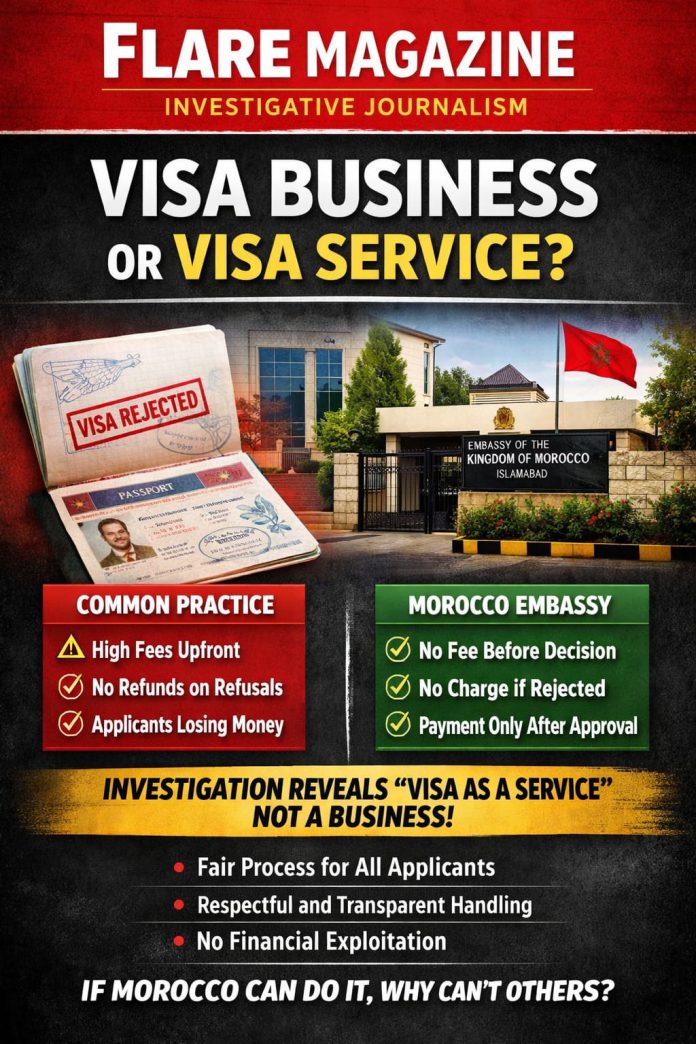
Applicants whose visa files were approved were asked to pay the visa fee. Applicants whose files were not approved were politely returned their documents without being charged a single rupee.
There was no unnecessary delay, no harassment, no confiscation of mobile phones, and no financial pressure. Most importantly, there was no concept of charging money simply for rejecting an application.
A Sharp Contrast With Other Visa Systems
This transparent and humane approach stands in clear contrast to the visa practices followed by many other foreign missions operating in Pakistan.
For example, the British High Commission charges visa fees in advance. According to official UK government policy, if a Standard Visitor Visa application is refused, the application fee is not refunded, regardless of the outcome. Applicants often pay significant amounts before even knowing whether their visa will be approved.
Similarly, the Embassy of Turkey requires applicants to pay embassy fees and service charges in advance. Official notices clearly state that several of these charges are non-refundable, even if the visa is refused.
In practical terms, this means that Pakistani applicants often lose large sums of money simply for applying—sometimes without any clear explanation beyond a refusal notice.
Visa Processing or Visa Business?
Over the years, visa applicants in Pakistan have repeatedly complained that visa systems have quietly turned into revenue-generating mechanisms. Whether the visa is granted or rejected, the money is collected first—and usually never returned.
In this environment, the Moroccan Embassy’s approach sends a powerful message:
Visa processing does not have to be a business. It can be a public service.
Commendation for the Moroccan Embassy
Based on direct observation and interaction with applicants, it is fair to say that the Moroccan Embassy in Islamabad is not exploiting Pakistani citizens financially. Instead, it has adopted a transparent, respectful, and ethical visa process.
This approach deserves open appreciation. The embassy staff demonstrated professionalism, clarity, and respect—qualities that are often missing from visa experiences elsewhere.
For many applicants present that day, the feeling was simple but important:
“Even if our visa is not approved, at least our money was not taken.”
A Question for Other Foreign Missions
This investigation raises an important question for policymakers and foreign missions operating in Pakistan:
If one embassy can manage visa processing without upfront fees, financial exploitation, or unnecessary pressure, why can’t others?
Conclusion
The Moroccan Embassy in Islamabad stands as a rare example of fairness and transparency in a system that many Pakistanis associate with financial loss and emotional stress. At a time when visa applicants feel increasingly vulnerable, this model offers dignity and trust.
This investigative observation is not an attack on any country’s immigration policy. Rather, it is a call for greater transparency, accountability, and respect for applicants—values that the Moroccan Embassy has demonstrated in practice.
For Pakistani citizens, this experience proves that ethical visa processing is possible—and that embassies do not need to profit from rejection.