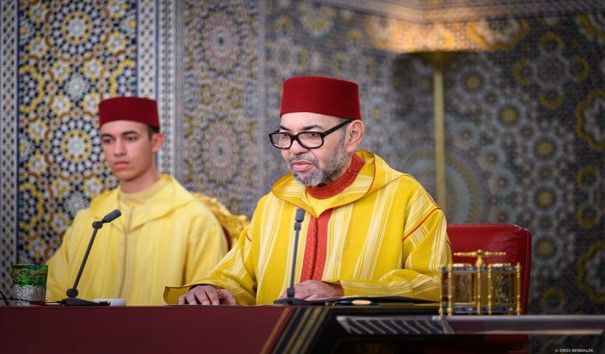

Rabat – His Majesty King Mohammed VI, accompanied by HRH Crown Prince Moulay El Hassan, HRH Prince Moulay Rachid and SA Prince Moulay Ahmed, addressed a speech to Parliament on Friday on the occasion of the opening of the first session of the first legislative year of the 12th Parliament.
At the opening of the first session of the first legislative year of the 12th Legislature, King Mohammed VI set the milestone for the new parliamentary and government mandate. The Sovereign calls for a “real turning point” to consolidate Morocco’s economic ambition, strengthen social and territorial justice, accelerate advanced regionalization and rethink the model of migration cooperation with the Kingdom’s partners.
In a world plagued by profound geoeconomic changes, Morocco is called to transform challenges into levers of development. This is the course set by King Mohammed VI in his speech to Parliament on Friday, October 9, at the opening of the first session of the first legislative year of the 12th Parliament. Strategic sovereignty, youth, reforms and the effectiveness of public action are among the priorities highlighted by the Sovereign.
The new legislative and government mandate must be a “real turning point” to enable the Kingdom to pursue its ambition as an emerging and reliable economic power, while seeking “a harmonious balance between the logics of economic growth and the imperatives of enhanced social and spatial justice.”. Beyond the economic and social orientations, the royal discourse recalled the responsibility of the representatives of the Nation. “The parliamentary mandate is a commitment Politics and a moral contract that binds you to the citizens “ The Sovereign stressed, calling on parliamentarians to live up to this responsibility before God, citizens and history.
Returning to a topic already addressed before parliamentarians in 2014, King Mohammed VI reaffirmed his commitment to Moroccanity. “The feeling that is dearest to me in life is to be proud of My moroccanity,” he said twelve years ago. “Even today, the same feeling remains intact, and in the years to the past, it is only growing and taking more root,” he said. The Sovereign highlighted the historical depth of Morocco, the anteriority of its monarchy, the richness of its religious identity and the diversity of its civilizational tributaries. Political and diplomatic achievements, economic and social progress and the country’s transformations are also grounds for national pride. This pride cannot, however, be reduced to a sense of self-satisfaction. “National pride here is not a form of vanity, nor is the expression of self-satisfaction. Rather, it is the catalyst that transforms membership in liability, insurance into a national duty,” said King Mohammed VI, placing the sense of belonging in the service of commitment and action.
On the economic front, the royal discourse announces a new generation of major strategies, which will have to accompany infrastructure projects already committed. These will include water, energy and food security, industrial emergence, the digital economy and artificial intelligence. The Sovereign also stressed the urgency of strengthening the Kingdom’s capacity for strategic reserves and securing supplies of basic necessities. In this sense, he called for greater speed in the constitution of these reserves, in order to better prepare the country for the risks of supply disruptions and changes in the international environment. The private sector is called upon to take its full place in this dynamic. King Mohammed VI urges him to strengthen his role as a “strategic actor in the transformation” of the country and to be “more enterprising, more creative and more able to create job opportunities and develop its investment and export capabilities.”. This orientation reflects the desire to make private investment contribute more to economic transformation, job creation and the strengthening of Morocco’s competitiveness.
Youth at the forefront of public policies.
Economic development cannot, in the vision presented by the Sovereign, be separated from social justice and the inclusion of young people. The speech calls for placing youth-related issues “at the forefront of public policies and the concerns of governance bodies.”. This priority must be realized through an integrated vision guaranteeing equal opportunities and covering education, qualification and economic integration. The objective is to enable young people to move up the social ladder, to believe more in their future prospects and to strengthen their confidence in national institutions. The Sovereign hopes that they will be able to build their future in a framework that guarantees “ freedom, dignity and stability “.
Advanced regionalization and deconcentration :
According to King Mohammed VI, territorial action is “the real challenge of the next stage.” Integrated development, improving the quality of public services and encouraging productive investment remain closely linked to the operationalization of advanced regionalization and the effective implementation of administrative deconcentration. The Sovereign has again denounced the delays and malfunctions that hinder these projects and prevent the public authorities from responding to the concrete concerns of the citizens. He called for identifying the problems specific to each region and providing them with realistic solutions, adapted to the needs of the field. The message is particularly strong about administrative deconcentration. “No delay or delay is more tolerable in the full implementation of the Charter of Deconcentration,” said King Mohammed VI. This requirement involves the actual transfer of skills and the reallocation of the necessary human and financial resources from the centre to the provinces and regions. It also presupposes removing obstacles to the functioning of regional institutions, clarifying their skills and strengthening their human and material resources.
Finally, the Sovereign insisted on the need to better organize relations between the State and the regions, by putting in place the coordination and contractualization mechanisms essential to enable them to fully exercise their decision-making and project execution powers. The challenge is to bring public decision-making closer to the territories and to make decentralization an effective lever for development.
A Call for Fairer and More Effective International Cooperation
Addressing the challenges surrounding migration, the King acknowledged that Morocco’s balanced approach had delivered tangible results through cooperation with its international partners. However, he cautioned that recurring crises had exposed the limitations of the existing cooperation framework, which he described as outdated.
The monarch highlighted progress in cooperation with neighbouring Spain, particularly in combating irregular migration. At the same time, he pointed to legal and judicial obstacles affecting the repatriation of minors and individuals whose asylum claims are considered unfounded, arguing that such gaps can create opportunities for criminal networks to exploit vulnerable people and weaknesses in migration management.
His message called for a more practical, balanced and sustainable approach—one that addresses shared challenges while respecting the responsibilities and interests of all parties.