

PROFILE
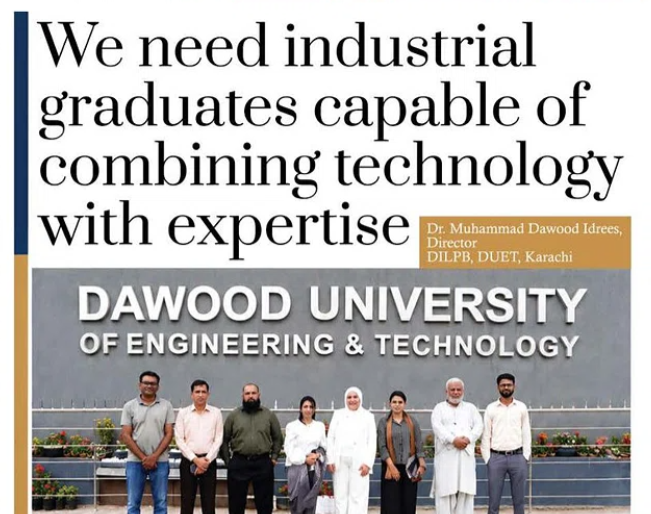
Dr. Muhammad Dawood Idrees is an academic, researcher and higher-education professional with 14 years of experience. He currently serves as Director, Industrial Liaison & Placement Bureau (DILPB), Dawood University of Engineering and Technology (DUET), Karachi. Since 2022, he has focused on strengthening industry-academia liaison, graduate employability, internships, recruitment, career development and skills enhancement. He holds a PhD in Industrial Management Engineering from Hanyang University, South Korea, and a BE in Industrial Engineering and Management from DUET. His research interests include Human Factors Engineering, Ergonomics, Industry 4.0, AI, occupational safety and Engineering Management.
Q&A Section (Question & Answer)
Here is the question & answer session with Dr. Muhammad Dawood Idrees.
Flare: How do you assess the current relationship between Pakistan’s universities and industry?
Dr. Muhammad Dawood Idrees: The relationship has strengthened, but there is considerable scope to make it more formal, sustained and meaningful. Universities provide technical graduates, while industry offers practical knowledge and insight into changing market needs. The challenge is bringing these strengths together systematically.
Beyond seminars, MoUs and recruitment visits, collaboration should include employer input, curriculum development, internships, applied research, coordinated projects and faculty-industry interaction. Universities must understand not only current hiring needs but also the skills industry will need over the next two to five years.
Flare: What are the principal skills gaps employers see in engineering and technology graduates?
Dr. Muhammad Dawood Idrees: The major gap is often not theoretical knowledge but the ability to apply it in the workplace. Employers seek graduates who can solve unfamiliar problems, analyse data, communicate effectively, collaborate and take responsibility.
Key technology gaps include AI, data analytics, automation, digital manufacturing, cybersecurity, modern engineering software and industry-specific technologies. Graduates also need knowledge of productivity, quality, sustainability and business realities.
Flare: What initiatives is DUET undertaking to strengthen industry-academia linkages?
Dr. Muhammad Dawood Idrees: DUET is focusing on meaningful industry interaction and graduate outcomes. Through the Industry Liaison & Placement Bureau (DILPB), we are moving beyond conventional job fairs towards targeted recruitment based on employers’ actual requirements.
We are strengthening internships, industrial visits, employer interaction and graduate tracking. Employer and alumni feedback is also being collected to better align academic programmes with industry expectations.
DUET is also promoting three graduate pathways: employment, lifelong learning and entrepreneurship, giving students broader options for career development.
Flare: How can internships, placements and applied research be made more meaningful?
Dr. Muhammad Dawood Idrees: The focus should be on outcomes rather than hours completed. Internships should have clear learning goals, purposeful assignments, workplace supervision and feedback – not simply result in a certificate.
Employers should identify genuine operational and technical challenges, while universities can nominate students based on their skills and preparation. Students should then be assessed on what they learned and contributed.
Applied research should similarly address problems faced by local industry, government and society rather than being selected only for academic suitability. This creates a three-way benefit: students gain experience, industry gains new ideas, and universities increase the impact of their research.
Flare: What role should universities play in Pakistan’s digital transformation and emerging technology sectors?
Dr. Muhammad Dawood Idrees: Universities have a crucial role in Pakistan’s digital transformation. Teachers must prepare students not only to use new technologies but to understand, implement, evaluate and responsibly govern them.
AI, automation, data analytics and IoT are transforming manufacturing, healthcare, finance, logistics and the public sector. Pakistan therefore needs graduates who combine technological competence with domain expertise. For example, industrial engineers should understand production systems as well as how AI and analytics can improve productivity and decision-making.
Universities must also address ergonomics, human factors, ethics, safety, privacy and the impact of automation on workers, ensuring technology improves human and organisational performance.
Flare: What reforms are needed to improve graduate employability in Pakistan?
Dr. Muhammad Dawood Idrees: Employability should be an institutional priority throughout the degree, not something addressed only in the final year. Curricula should better integrate practical projects, industrial exposure, communication, digital competence and problem-solving.
Employer and alumni feedback should systematically inform programme improvement, while graduate tracking should measure employment, further education and entrepreneurship outcomes.
Flare: How can academia better support entrepreneurship, startups and commercialisation of research?
Dr. Muhammad Dawood Idrees: Pakistan has significant potential to bridge the gap between research and market application. Universities need to help researchers and students move from ideas and publications to prototypes, intellectual property, validation, investment and market adoption.
This requires stronger cooperation among faculty, students, ORICs, business incubation centres, investors, industry and government. Entrepreneurship should also be introduced to students across disciplines, including engineering.
Flare: How important are international partnerships and industry-sponsored research for public-sector universities?
Dr. Muhammad Dawood Idrees: They are highly significant. International partnerships expose faculty and students to global research practices, technologies and methods while creating opportunities for collaborative research, mobility and knowledge exchange. Industry-sponsored research can connect academic expertise with real economic and technological challenges and give students valuable research experience. Successful partnerships should produce tangible outcomes such as research, training, innovation, mobility, publications, prototypes or employment, rather than simply agreements.
Flare: What are your priorities for DUET’s Industry Liaison & Placement Bureau?
Dr. Muhammad Dawood Idrees: Our priority is to make the bridge between DUET graduates and industry employment needs stronger and more sustainable. We are also strengthening alumni and industry engagement to better prepare students for the workplace. DILPB is therefore more than a placement office; it is a strategic bridge between education, students and industry, bringing industry expectations back into the university.
Flare: What advice would you give engineering and technology students preparing for the changing job market?
Dr. Muhammad Dawood Idrees: Don’t prepare yourself only for today’s job; prepare for tomorrow’s job. Build a strong foundation while continuously developing your skills. Learn to use digital and AI tools, strengthen analytical and communication abilities, and gain hands-on experience through projects, internships, research and industry engagement.
Your degree opens the door, but your attitude towards continuous learning and professional growth determines how far you go.


